

What is property division in a divorce?
Property division in a divorce is the legal procedure by which former spouses determine who will own the jointly acquired property after the marriage ends. Everything the law treats as joint marital property is, as a general rule, subject to equal distribution unless the parties agree otherwise. When a family has children, the process becomes more complex: their interests, housing conditions, and stable income must be taken into account so that the court or notary does not violate the rights of minors.
Compared to a simple dissolution of marriage, the financial aspect often becomes the most painful: it is necessary to clarify sources of funds, analyze loans, and even cryptocurrencies acquired during the marriage. The court evaluates not only tangible assets but also intangible ones—copyrights, corporate shares, insurance payouts, pension savings. Proper preparation determines whether these assets are recognized as joint or excluded from the pool subject to distribution.

Key terms (joint marital property, exclusions)
Joint marital property is assets and rights acquired by both spouses during the marriage, regardless of whose name they are registered in. Exclusions include gifts, inheritances, personal items, and amounts of compensation for moral or physical harm received by one spouse. These “exclusions” often become grounds to demand compensation during property division when one spouse proves that certain assets were acquired exclusively with their personal funds.
Joint property also includes claims—deposits, unpaid wages, bonus programs, crypto wallets, and shares in startups registered to only one spouse. Determining their real value requires additional property valuation by a professional financial analyst.
Specifics when there are children
If the spouses have minors, the court primarily safeguards the children’s well-being. Therefore, the distribution of property in a divorce may deviate from strict equality: the home is left with the parent with whom the children live, and the other party is awarded monetary compensation. At the same time, the court considers child support, expenses for education, healthcare, and leisure. The right strategy by an attorney helps substantiate why certain assets should remain with the parent who provides better conditions for the child.
The court also anticipates the child’s future needs: possible treatment, specialized education, or sports activities. If one parent guarantees housing, the other may receive a smaller portion of other property but be partially relieved from child support—such a flexible approach ensures long-term stability for minors.
Legal framework
The procedure for property division in a divorce is governed by the Family Code of Ukraine, in particular Article 69 of the FCU. The Civil Procedure Code, laws on notaries and taxes also apply, and for business assets—corporate legislation. A family lawyer relies on these norms when preparing a claim for property division or a notarial agreement.
Supreme Court practice in 2023–2025 shows that the 50/50 formula is not a dogma: panels of judges departed even to a 70/30 ratio if one party proved substantial expenses for raising and supporting the children. Therefore, a qualified lawyer always cites current cassation practice to justify a departure from equality.
Art. 69 FCU — the 50/50 principle
The basic rule: all joint property is divided equally. However, Article 69 of the FCU allows a departure from equality if one of the spouses did not care for the family, concealed income, or spent funds on personal needs causing harm to the other party or the children. The court assesses each spouse’s contribution to acquiring assets, the duration of the marriage, the presence of minors, and health status.
Exceptions and compensation
When property cannot be physically divided (an apartment, car, business share), the court determines compensation upon property division. The amount is based on an independent property valuation report: the expert analyzes technical condition, market value, and investments. Compensation may be paid in a lump sum or in installments for up to three years. If an asset is encumbered by a mortgage, the court also allocates the debt to avoid imbalance. For corporate shares, a priority buyout mechanism is used—a practical tool for amicable settlement that preserves the company’s operations.
Statute of limitations (3 years)
You may seek division within 3 years from the date of divorce or from the date you learned of the rights violation. If the defendant claims the limitation period has been missed, the court may leave the claim without consideration, so it is important to contact a lawyer in time.

How we work — our approach
The “Pravovyi Lider” team specializes in family disputes: we handle property division in divorce with children comprehensively, reducing risks and timelines. We combine legal expertise, financial audit, and negotiation mediation so the client gets a predictable result.
Free consultation
During the initial conversation, we analyze documents and explain how the court fee for property division is calculated, whether it’s worth trying an amicable division through a notary, and what the prospects of litigation are.
Document preparation (claim, valuation)
We commission an independent property valuation, gather evidence, and prepare a claim or draft agreement. In cases involving children, we add certificates about place of residence and maintenance expenses to protect minors’ interests.
Filing with the court
We file the claim at the location of the property or the defendant, monitor payment of the court fee for property division, and petition to freeze assets so they are not disposed of before judgment.
Representation at hearings and enforcement
Our family lawyer represents the client in hearings, negotiates a settlement, and after the decision enters into force, supports title registration, compensation recovery, and enforcement proceedings.
Required documents
To move the case without delays, the lawyer immediately forms a complete package confirming identity, marriage, and rights to assets. An advance property valuation confirms market value, and properly executed title documents minimize the risk of repeated court requests. Submitting a clear evidentiary base increases the chances of an amicable division of property or swift satisfaction of the claim, so we recommend preparing the following documents:
- Passport
- Tax ID
- Marriage certificate / divorce decree
- Title documents for property
- Valuer’s report
- Bank certificates and loan statements
- Draft claim for property division / notarial agreement
Special situations
Business division and compensation
Corporate rights (LLC, sole proprietorship) are also joint assets. They are divided by determining the value of the share and paying compensation to the other party. The court reviews accounting records, contracts, and hidden revenue so as not to paralyze the company’s operations.
Real estate / apartment / car
Real estate is rarely divided physically: more often, one party remains in the apartment and the other is awarded compensation based on an expert report. A mortgage loan is allocated proportionally to the share or transferred to the person who receives the housing.
Children’s share
A child does not acquire ownership of the parents’ property, but the court may leave the home with the parent who provides better conditions and order child support or obligations to cover educational and medical expenses.
Why “Pravovyi Lider”
Our cases
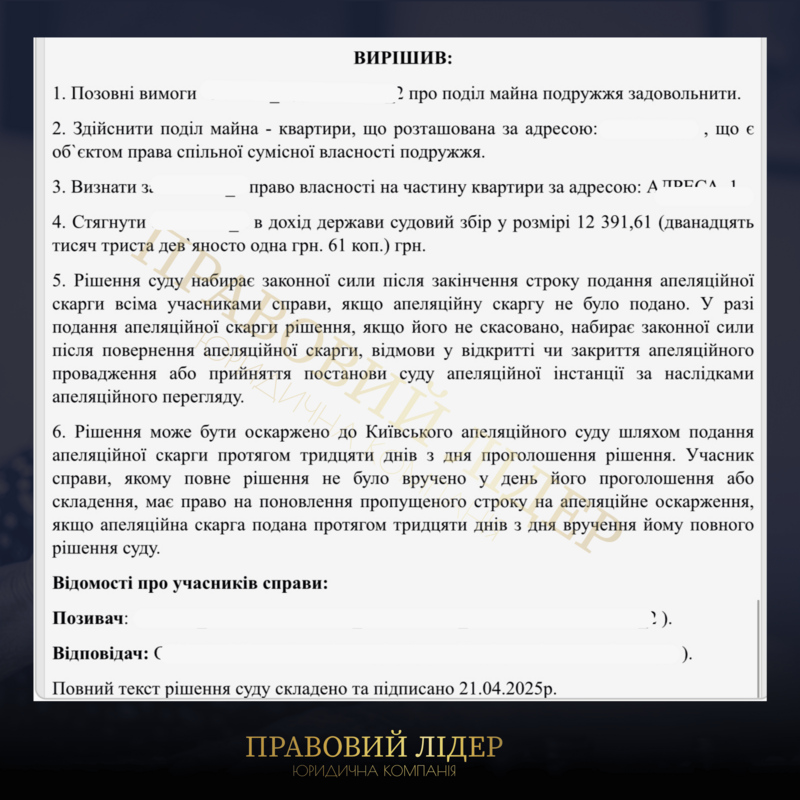
Positive court practice in a spousal property division case (case No. 752/17406/24)
On June 30, 2024, a client—PERSON_1—applied to the “Pravovyi Lider” law firm due to the impossibility of amicably settling the division of an apartment acquired by the spouses during the marriage.
According to the decision of the Holosiivskyi District Court of Kyiv in case No. 752/17623/23, the marriage between PERSON_1 and PERSON_2 was dissolved on 08.01.2024. At the same time, the disputed issue of distributing ownership of the apartment acquired during the marriage remained unresolved.
The apartment had been provided for use back in 1981 on the basis of a warrant, and in 2003 a certificate of title was issued.
🔹 The firm’s lawyers prepared a civil claim for division of the spouses’ joint property, substantiating the existence of joint marital ownership of the apartment and the lack of an agreement between the parties regarding its division.
📌 Court proceedings:
Proceedings were opened by order dated 21.08.2024.
Subsequently, the case was considered under general claim proceedings, by court order of 03.10.2024. Then, by order of 24.03.2025, the preparatory proceedings were closed and the case was scheduled for trial on the merits.
The plaintiff maintained the claims and requested consideration of the case in her absence.
The defendant, PERSON_2, did not file a response and did not appear at the court hearings.
⚖️ Court decision:
On April 09, 2025, the Holosiivskyi District Court of Kyiv (Judge Olshevska I.O.) fully upheld the claim:
Recognize PERSON_1’s ownership of a share of the apartment at: ADDRESS_1.
Carry out the division of the apartment as an object of the spouses’ joint marital property.
Recover from PERSON_2 a court fee to the state budget in the amount of UAH 12,391.61.
📑 In analyzing the circumstances, the court relied on the provisions of the Family Code of Ukraine (Arts. 60, 61, 70, 71), which establish the presumption of equal shares in property acquired during the marriage, and on the provisions of the Civil Code of Ukraine.
Experience of family lawyers
Lawyers with 10+ years of practice know Article 69 of the FCU and case law inside out and avoid common mistakes (incorrect property valuation, missing the 3-year limitation period).
Guarantees, support, individual approach
The contract specifies stages, budget, and timelines. The client has a 24/7 online account with documents, and if we miss deadlines, we refund part of the fee. This transparent mechanism minimizes risks and makes property division in divorce predictable.
FAQ
How do children affect property division?
The court may deviate from the 50/50 principle, leaving the home with the parent with whom the child lives and awarding compensation to the other party.
Is it possible to settle without going to court?
Yes, an amicable division through a notarial agreement is cheaper and faster, but it must be fair.
What is better—an agreement or court?
An agreement saves time and money if the parties are open and honest. When assets are concealed or the conflict is deep, only court will help.
Who pays for the property valuation?
Usually the claimant bears the cost, but the court may apportion it in proportion to the determined shares.
Can I file a claim online without appearing in person?
Yes, through the “eCourt” system you can file an application and track the case from your phone, and a lawyer can represent you remotely if the court allows it.





What they say about us
Leave a request for consultation and our specialist will contact you soon!

Хочу подякувати старшому юристу Валентині Миколаївні за допомогу у сімейній справі. Вона супроводжувала мене під час розлучення та поділу майна — все пройшло спокійно й без зайвих нервів. Завдяки її порадам я змогла захистити свої права та уникнути конфліктів. Дуже вдячна за чуйність і професіоналізм!
Щиро дякую старшому юристу Валентині Миколаївні за допомогу у військовій справі. Завдяки її професіоналізму та уважності питання було вирішено швидко й позитивно. Рекомендую як компетентного фахівця!
Бажаю . Задоволен надонною !нформац!ею. Допомогли з визначенням в моему питанн!. Дуже допомогли з правово!! Сторони. Бажаю добра та мирного неба.
Дякую вам за відмінну вашу працю . Рекомендації: все активно, старанно, швидко!
Дуже вдячна Катерині Колотуха за співпрацю і вирішення мого питання у суді!!!У свідоцтві про народження була допущена помилка,яку треба було виправити.Катерина дуже кваліфіковано віднеслась до роботи,я ні за що не хвилювалась,вся робота була зроблена з її сторони на найвищому рівні і за найкоротший час.Рекомендую Катерину як дуже відповідального і практичного спеціаліста своєї справи!
Дякую за надану інформацію,гарне відношення ,чітке пояснення та розуміння мого питання. Зокрема, Алініі Віталіївні,до якої потрапила на безкоштовну консультацію.
Fill out the form or contact us in any way convenient for you
Choose the nearest office to you and receive consultations in a convenient format for you