

Discharge from military service during wartime: legal grounds
War does not mean a “total ban” on discharge from military service. There are lawful grounds — but they are narrow, tied to specific circumstances, and almost always depend on procedure and evidence. The biggest trap is that people think: “if the reason is fair, they will definitely discharge me.”
In practice, refusals happen not because “it’s impossible,” but because the grounds were not proven or were formatted incorrectly. In this article — which grounds are actually recognized and where even strong cases most often “break.”
What “discharge” means during martial law
During martial law, discharge does not work the way it does in peacetime: it is not a “free exit” at will and not a matter of a commander’s mood. Most cases are clearly defined legal exceptions where three things must align: a legal ground + proof + the correct sequence of actions. It is important to understand: what matters here is not the “logic of the situation,” but the availability of documents and how they moved through the procedure.
Lawful grounds that actually work
Health condition
What counts as a ground. The key element is the Military Medical Commission (MMC/VLK) conclusion. It is this conclusion that records whether there are grounds for discharge on health grounds.
What most often “breaks” the case. There is no MMC/VLK conclusion, or there are “everyday” medical notes that do not replace it. Another frequent failure is when a person expects that “limited fitness” automatically means discharge.
Practical cautions.
- The distinction matters: “unfit” and “limited fitness” are different legal consequences, and the decision may be unfavorable for discharge.
- Until there is a clear MMC/VLK conclusion, talk of “they will/won’t discharge me” is only an assumption.
Family circumstances
What counts as a ground. Most often — documented caregiving, maintenance/dependence, or the status of close relatives (when the law explicitly recognizes such circumstances as a ground).
What most often “breaks” the case. Phrases like “a difficult situation at home” without evidence. Or documents exist, but they do not confirm exactly what is required (for example, there is no proof of actual caregiving or of the relevant status).
Practical cautions.
- Emotions do not decide anything here — the package of proof does: certificates, decisions, documents confirming status and the need for care.
- If the ground depends on a specific person/status, any “gap” in the documents gives a basis for refusal.
Service-related circumstances
What counts as a ground. These are cases where the grounds follow from the conditions of service (contract, terms, special conditions), but they work only within what is explicitly allowed by law.
What most often “breaks” the case. Myths like “I transferred — so I got discharged,” or “the contract ended — they automatically let you go.” During wartime, it does not work like that without a specific lawful ground.
Practical cautions.
- A transfer by itself is not a “springboard” to discharge.
- Even when everything seems “obvious,” the procedure may require additional steps and confirmations.
Other cases provided by law
There are other lawful grounds as well, but they are usually tied to narrow situations and also require documentary proof. The important point is not to “guess,” but to precisely match your situation to what is recognized as a ground.

Why refusals happen even when grounds exist
- An incomplete set of documents or documents “about something else”
- Incorrect wording of the report (raport) (grounds mixed, no clear request)
- Procedural violations or steps completed incorrectly
- Haste and “verbal agreements” instead of written confirmations
How to prepare properly for discharge
- Verify that you have a legal ground, not just a “logical reason.”
- Collect proof: everything that confirms the ground and the actual circumstances.
- Draft the report (raport) clearly: one ground — one request, no “water.”
- Control deadlines and the movement of documents; don’t leave the case “hanging.”
- Record everything in writing: copies, stamps, registration, replies.
Mini case
During the period of martial law, a client approached LLC “Pravovyi Lider” — a serviceman of the Armed Forces of Ukraine serving under mobilization.
Case circumstances
The client reported that he had grounds for discharge from service during martial law due to family circumstances: he is the sole guardian of a minor child whose mother has died. Despite having supporting documents, the military unit’s command verbally refused discharge, citing a difficult operational situation.
Legal analysis
The firm’s specialists conducted a legal analysis in accordance with the Law of Ukraine “On Military Duty and Military Service”, which provides for the possibility of discharge during martial law if certain family circumstances exist.
It was established that the client had lawful grounds for discharge, and that a refusal by the command without a written decision was unlawful.
Measures taken
The lawyers:
- prepared and submitted a discharge report (raport) with references to the relevant legal provisions;
- collected and properly certified a package of supporting documents;
- sent an attorney’s request to the military unit;
- in case of inaction — prepared a draft administrative claim to the court.
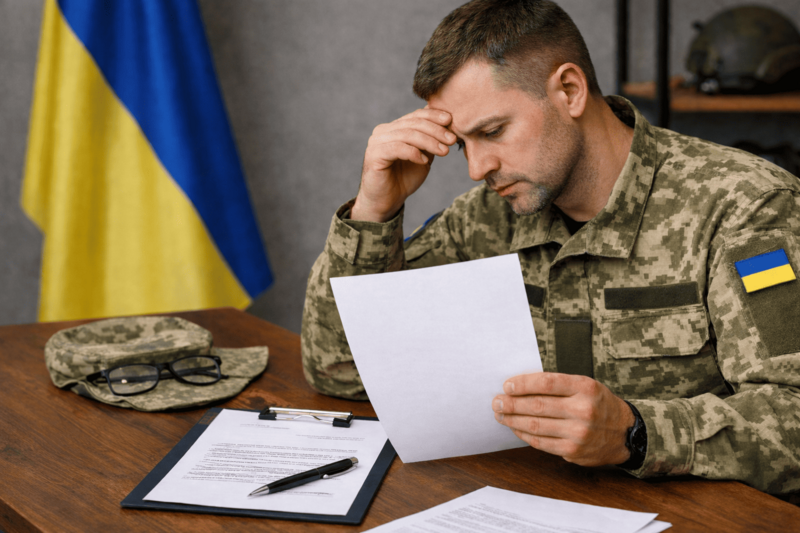
Result
After the official review of the report and the legal position presented by the lawyers, the military unit’s command made a decision to discharge the client on lawful grounds.
The client received a discharge order and was removed from the unit’s personnel lists.
This case confirms that even during martial law, servicemen have rights guaranteed by law to be discharged if the prescribed circumstances exist. Competent legal support and proper paperwork are key to resolving the issue successfully.
Conclusion
Discharge during war is possible, but only “by the rules”: the ground must be lawful, proven, and carried through the procedure correctly. The best thing you can do is verify the grounds and documents before submitting the report, so you don’t waste time and don’t receive a formal refusal where a real chance existed — in such situations, a short consultation with a military lawyer is often enough.

Leave a request for consultation and our specialist will contact you soon!
Leave a request and our specialist will contact you soon!
More useful information




Fill out the form or contact us in any way convenient for you
Choose the nearest office to you and receive consultations in a convenient format for you