

Curfew in Ukraine: Rules, Restrictions, and Penalties
Curfew is a ban on being on the streets and in public places during a specified time without a pass or service documents. The specific schedule and exceptions are established separately in each region. A patrol may check documents, belongings, and vehicles, and, if there are grounds, take a person to the police. Liability depends not only on the very fact of being outside, but also on accompanying actions: disobeying a lawful order, violating traffic rules, hooliganism, resistance, or other offenses.
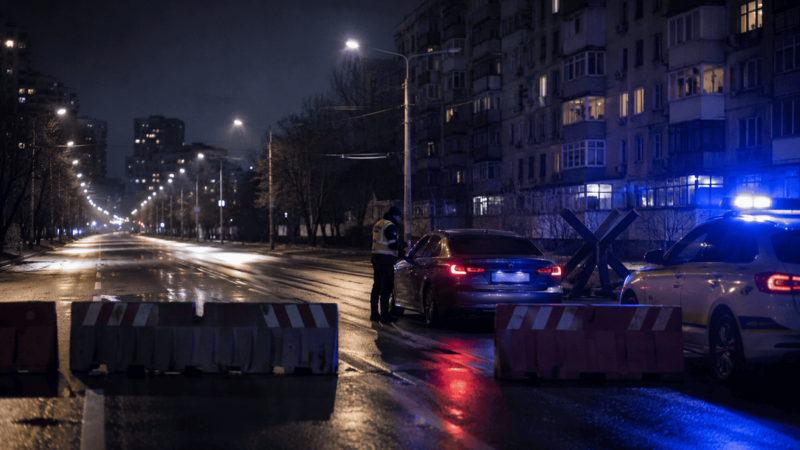
What curfew is
Legal definition
Curfew is one of the measures of the legal regime of martial law. The law defines it as a ban on being on the streets and in other public places during a certain period of the day without specially issued passes and certificates.
The restriction applies not only to walks. It concerns being in yards, parks, squares, railway stations, stops, establishments, and other places accessible to people. The exact start and end time is determined for a specific region or community and may change depending on the security situation.
Why it is introduced
Curfew is needed to protect the population, maintain public order, guard important facilities, and carry out counter-sabotage measures. During this period, it is easier for patrols to detect suspicious persons, illegal transportation of weapons, attempts to enter restricted facilities, or filming of military infrastructure.
It also simplifies the work of the police, military, rescuers, and utility services during shelling, accidents, and other dangerous events.
Which laws regulate curfew
Law on martial law
The main act is the Law of Ukraine “On the Legal Regime of Martial Law”. Article 8 allows military command together with military administrations to introduce curfew, a special entry and exit regime, restrict movement, check documents, and conduct inspections provided for by law.
Cabinet of Ministers resolution
Cabinet of Ministers Resolution No. 573 defines the procedure for introducing curfew, appointing a commandant, organizing patrols, and issuing passes. Resolution No. 1456 regulates checking documents, inspecting belongings, vehicles, luggage, and cargo during martial law.
These rules must be applied together with the laws on the National Police, administrative liability, and criminal proceedings.
Powers of military administrations
The military administration together with the military command determines the territory and duration of restrictions, patrol composition, pass issuance procedure, vehicle movement rules, and exceptions for certain services.
Therefore, the curfew schedule and conditions are not the same throughout Ukraine. Before traveling, you should check the official announcements of the military administration of your specific region.
What restrictions apply during curfew
Being outside
The general rule is that during this time a person must be at home, at their place of residence, at work if they have the right to work at night, or in a shelter. Without a lawful basis, it is not allowed to walk, sit in a yard, stay in a park, near a shop, or at a stop.
Going out “for a few minutes” is also considered being in a public place. There is no separate grace period after the curfew starts.
Moving by transport
Driving a private car without proper grounds is also prohibited. A patrol may stop the car, check the driver and passengers, the route, documents, and inspect the vehicle in accordance with the established procedure.
Ordering a taxi does not create the right to move. Both the driver and the passenger must have lawful grounds and the necessary documents.
Public places
During curfew, catering establishments, shops, entertainment venues, and other facilities that receive visitors usually do not operate. Their work schedule must allow employees and clients to leave the establishment before restrictions begin.
If a facility operates around the clock due to critical necessity, this does not mean that any person may freely go there at night.
Exceptions
Exceptions may apply to military personnel, police officers, medical workers, rescuers, emergency services, critical infrastructure workers, and persons with special passes.
During an air raid alert, it is allowed to go to the nearest shelter. In an urgent medical situation, you should call 103. When an independent trip to the hospital is the only way to save a life, you should be ready to explain the circumstances and confirm them.
Table “What is allowed / what is prohibited during curfew”
|
Situation |
Allowed or prohibited |
Condition |
|
Staying at home |
Allowed |
Follow air raid alerts |
|
Going to a shelter |
Allowed |
Go to the nearest shelter |
|
Walking or sitting in a yard |
Prohibited |
There is no separate exception |
|
Walking a dog |
As a rule, prohibited |
This must be done in advance |
|
Going to friends |
Prohibited |
Personal plans are not an exception |
|
Moving by car |
Only with a lawful basis |
Documents are required |
|
Going to the hospital |
Possible in an urgent case |
It is advisable to call 103 |
|
Going to a pharmacy |
Usually prohibited |
A pharmacy being open does not give the right to move |
|
Working at a critical facility |
Allowed |
A pass or certificate is required |
|
Using a taxi |
Only with a lawful basis |
An order does not replace a pass |
Who has the right to be outside
Critical infrastructure workers
Employees of energy, water supply, communications, transport, utility, and other critically important enterprises may move to perform official duties. An oral explanation is not enough: documents determined by the local military administration are required.
Medical workers
Doctors, hospital staff, and emergency medical teams may move during a shift or call. It is advisable to have a passport, service ID, pass, and, if necessary, confirmation of the shift.
Rescuers
Employees of the State Emergency Service, gas, energy, and emergency services may go out to eliminate fires, accidents, and the consequences of shelling. Their movement must be related to an official task.
Persons with special passes
A pass is issued for a specific service purpose, not for personal trips. It may be valid only in a certain territory, on a route, or during an established period. It cannot be transferred to another person or used after cancellation.
What documents you need to have with you
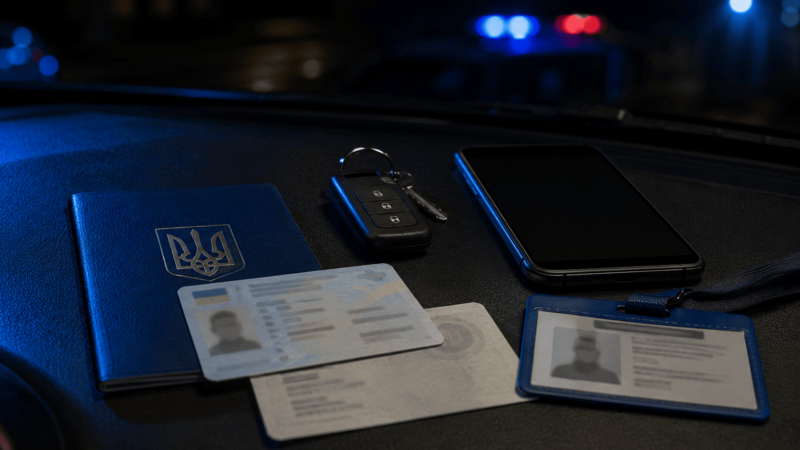
First of all, you need a passport or another identity document. An electronic document in Diia may be used in cases provided for by law, but you should take into account a discharged phone or lack of connection.
Persons liable for military service must have a military registration document in accordance with current rules. A driver needs a driver’s license, vehicle registration document, and insurance policy.
To move during curfew, a special pass, service ID, employer’s certificate, or another document determined by local authorities is additionally required.
Who checks documents
Police
Police officers may check documents on the grounds defined by the Law “On the National Police” and martial law rules. Such grounds may include being in a special regime zone, signs of an offense, resemblance to a wanted person, or the need to identify a person.
Military personnel
Checks may be carried out by servicemembers involved in martial law measures and authorized by the relevant order. A military uniform itself does not mean unlimited powers: actions must take place within the law.
Curfew patrols
Patrols may include police officers, servicemembers of the Armed Forces of Ukraine, the National Guard, the State Border Guard Service, and other designated formations. They monitor compliance with restrictions, check people and vehicles, and stop offenses.
What rights curfew patrols have
Document check
A patrol may require an identity document, and, if necessary, a military registration document, driver’s license, vehicle documents, a pass, or service ID.
If a person cannot be identified on the spot, they may be taken to a police unit if there are grounds provided by law.
Inspection of belongings
An authorized person may conduct a superficial check of a person, belongings, luggage, or vehicle. They may visually inspect belongings, use a special device, or ask the person to independently show the contents of a bag or open the trunk.
A full search, entry into a home, or seizure of property requires a separate legal basis and proper documentation.
Detention
Detention is possible if it is impossible to identify a person, there are signs of an administrative or criminal offense, the person is wanted, including wanted by the TCC, disobeys, has a weapon, or creates a threat.
The detainee must be told the reason, have their rights explained, and the procedure must be documented in accordance with the law.
Other powers
A patrol may stop transport, restrict movement, check luggage and cargo, demand that a dangerous place be left, take persons to the police, and apply coercive measures in cases directly provided for by law.
Curfew does not automatically give the right to read all correspondence on a phone. Detailed access to the contents requires the owner’s consent or a proper procedural basis. However, filming checkpoints, military facilities, or equipment may become a reason for an additional check.
What liability applies for violating curfew
Is there a separate article?
It cannot be automatically assumed that every person on the street will receive the same fine only for the fact of violation. The issue of separate liability has been discussed repeatedly, so before indicating a specific sanction, the current version of the Code of Ukraine on Administrative Offenses must be checked, rather than referring to draft laws or old news.
At the same time, the absence of a separate fine does not make movement allowed. A person may be stopped, checked, taken to the police, and brought to liability for another offense.
Administrative liability
Administrative liability is possible for malicious disobedience to a lawful order of a police officer or servicemember, petty hooliganism, drinking alcohol, violating traffic rules, driving under the influence, violating weapons handling rules, and other actions.
Article 185 of the Code of Ukraine on Administrative Offenses applies specifically to malicious disobedience to a lawful order, not to an ordinary clarifying question or a calm request to explain the grounds for the check.
Criminal liability
Criminal liability may arise for resisting a law enforcement officer or servicemember, threat or violence, illegal handling of weapons, use of forged documents, sabotage activity, AWOL, unauthorized dissemination of information about troop movements, or another crime.
Failure to comply with lawful requirements
If a requirement seems unlawful, you should not run away, insult the patrol, or physically resist. You should calmly clarify the grounds for the check, the data of the authorized person, and the procedure for further actions. Possible violations are better recorded and appealed later with the help of an attorney.
What to do if a patrol stops you
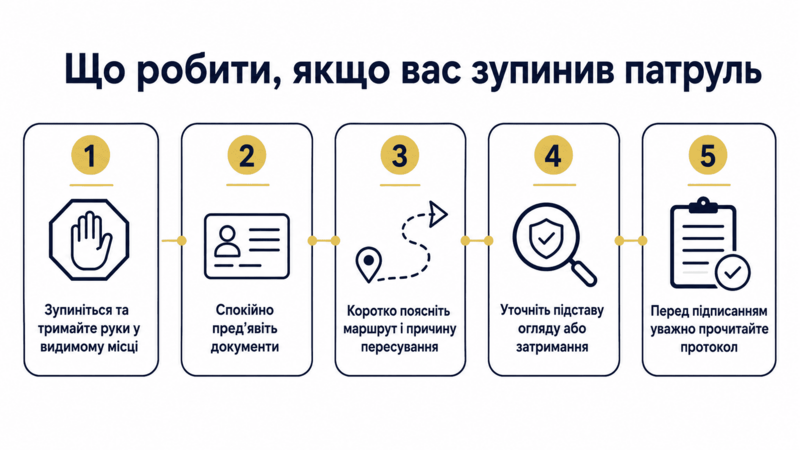
Stop and keep your hands visible. If you are driving, follow the patrol’s signal, do not leave the car without instruction, and warn where the documents are located.
Calmly present your passport, military registration document, vehicle documents, pass, or service ID. Briefly explain where you are coming from and where you are going, and why you are outside.
Do not invent stories about a hospital or an accident — such circumstances are easy to verify. If an inspection is being carried out, clarify its type and grounds. If items are seized, demand a protocol.
If you are detained, ask the reason, the place where you are being taken, and demand that your relatives and attorney be notified. Read the protocol before signing it. State your disagreement with the content in writing in the explanations.
Typical mistakes citizens make during curfew
The most common mistakes are not checking the current schedule, hoping for “five allowed minutes,” going out without documents, ordering a taxi without a lawful basis, and using someone else’s or an expired pass.
You should not argue in a raised voice, make sudden movements, run away, or film checkpoints and military equipment close up. Because of such behavior, an ordinary check may turn into detention and recording of an offense.
A separate mistake is driving after drinking alcohol because the roads are empty. Curfew does not cancel traffic rules and liability for drunk driving.
Myths about curfew
Myth: you can walk a dog. There is no general exception for walking animals, so this must be done before restrictions begin.
Myth: you can go to friends if you do not leave the car. Moving by car is also restricted, and a personal trip is not a lawful basis.
Myth: the police can always check a phone. A patrol does not receive unlimited access to correspondence only because of a stop on the street. Consent or a basis provided by law is required.
Myth: you can go out for five minutes. There is no minimum permitted time.
Myth: if there is no separate fine, the ban can be ignored. A person may still be checked, taken to the police, and brought to liability for accompanying actions.
Conclusions
Curfew is a mandatory measure of martial law. Its schedule and exceptions are determined separately in the regions, so up-to-date information should be checked on the official resources of the military administration.
Without a lawful basis, it is not allowed to walk, drive a car, or be in public places. Persons who work at night need to prepare documents in advance. During a check, one should behave calmly, comply with lawful requirements, and record possible violations without conflict.
Frequently asked questions
What is curfew?
It is a ban on being on the streets and in public places during specified hours without a pass or relevant certificate.
Who sets curfew?
It is introduced by the military command together with the military administration, which determine the territory, time, and exceptions.
Can you move by car?
Only with a lawful basis and documents established for the specific region.
Who has the right to check documents?
Police officers, authorized servicemembers, and members of curfew patrols.
What documents should you have with you?
A passport, and depending on the situation, a military registration document, driver’s license, vehicle documents, pass, or service ID.
Can you be detained for violating curfew?
Yes, if it is necessary to identify the person or if there are other grounds provided by law.
What liability is provided by law?
It depends on the specific actions and may be administrative or criminal.
Can you go to a pharmacy or hospital?
A planned visit to a pharmacy is not a general exception. In an urgent situation, you should call 103 or confirm the need for an urgent trip.
Is a pass required for movement?
For planned movement at night, a pass or relevant service ID is usually required.
Are curfew rules the same throughout Ukraine?
No. The schedule, pass procedure, and exceptions may differ depending on the region.
Leave a request for consultation and our specialist will contact you soon!
Leave a request and our specialist will contact you soon!
More useful information


Fill out the form or contact us in any way convenient for you
Choose the nearest office to you and receive consultations in a convenient format for you