
Transfer to Another Military Unit: How to Apply and Transfer to Another Brigade
Transfer to another military unit or brigade is a procedure where it is important to correctly determine the grounds, prepare a report, attach supporting documents, and, if necessary, obtain a letter of acceptance from the receiving unit. The submission procedure, list of attachments, review timeframes, and risk of refusal depend on the specific situation.
It is also necessary to take into account where exactly the servicemember wants to transfer: within their own unit, to another unit of the Armed Forces of Ukraine, to another brigade, from a combat unit to a rear unit, due to health condition, because of family circumstances, or between the Armed Forces of Ukraine and the National Guard of Ukraine. Each transfer option has its own package of documents and registration procedure.
How to transfer to another brigade
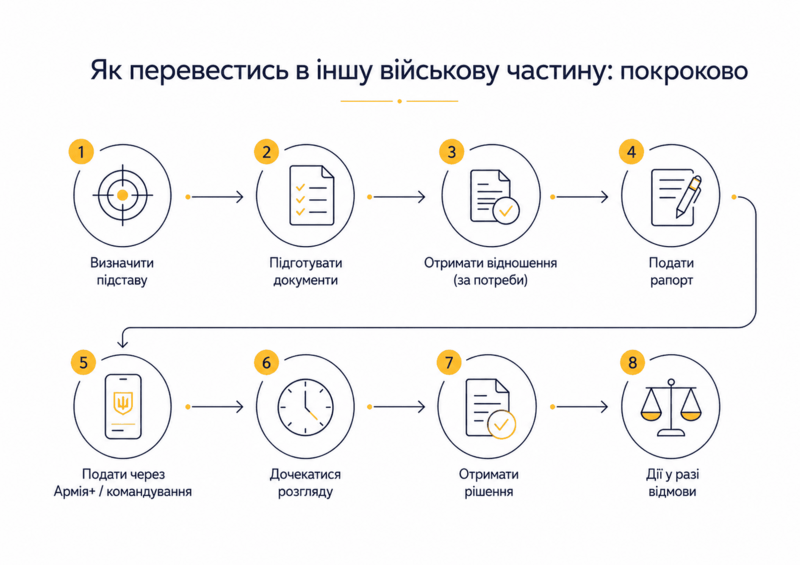
To transfer to another brigade, a servicemember needs to justify the grounds for transfer, prepare a report, attach documents, and, if possible, obtain a letter of acceptance from the unit that is ready to accept them for service. The report can be submitted through Army+ or in paper form, depending on the submission procedure applied in the specific case.
In most situations, it is important not just to write a general request, but to show the connection between the grounds and the desired place of service. For example, if the servicemember has a specialty needed by the receiving unit, this should be directly stated in the report and confirmed with documents or a letter of acceptance.
The main steps are as follows:
- Determine the grounds for transfer: personal initiative, health condition, family circumstances, service necessity, or another confirmed argument.
- Find out whether a letter of acceptance from the receiving unit is required.
- Prepare a report with a specific request for transfer.
- Attach documents confirming the grounds.
- Submit the report through Army+ or through the command.
- Monitor registration, review, and implementation of the decision.
What transfer to another military unit means
Transfer of a servicemember means a change of place of service, position, or subordination. In practice, it is important to understand whether this means reassignment within the same unit, transfer to another unit, or transfer between different military formations, for example between the Armed Forces of Ukraine and the NGU.
The difference matters for the procedure. Internal reassignment is usually resolved more simply, while transfer to another brigade requires interaction between the current unit, the receiving unit, and personnel bodies.
That is why the report should not be made universal for all cases. The document must correspond to the specific route: internal reassignment, transfer to another unit, transfer based on the MMC conclusion, family circumstances, or transfer between different military formations.
Transfer within one military unit
This is a change of subunit, position, or functional duties without leaving for another military unit. This option is relevant when the problem is not related to the unit as a whole, but to the position, service conditions, MMC conclusion, or the need to select another function.
For example, after a MMC conclusion, a servicemember may remain fit for service, but not in the previous position. In that case, it is first assessed whether another position can be selected within the same unit, and only then may the issue move to transfer to another unit.
Transfer to another military unit or brigade
In this case, the servicemember actually changes the place of service. Therefore, it is important to show not only the desire to transfer, but also the existence of a receiving unit that needs such a specialist. For this purpose, a letter of acceptance or recommendation letter is often prepared.
A letter of acceptance does not replace the decision of the personnel body and does not remove the need to submit a report. But it helps prove that the transfer is not an abstract request to go “somewhere,” but is connected with a specific position or need of the receiving unit.
Transfer between the AFU and the NGU
Transfer between the Armed Forces of Ukraine and the National Guard of Ukraine is a separate scenario, because it involves transfer between different military formations. Such documents may take longer to process, and the procedure depends on coordination between the relevant personnel departments.
For such a transfer, it is especially important not to confuse the timeframes and procedure with transfer within the AFU or within the NGU. It is worth clarifying in advance which attachments are needed, whether the commander’s approval is required, and whether there are any formal restrictions on the transfer.
Who can submit a transfer report
A transfer report may be submitted by a servicemember who is serving in the military and has grounds to change their place of service. Most often, this is done by servicemembers who have a letter of acceptance from another unit, a MMC conclusion, family circumstances, or an objective inability to perform duties in their current position.
Different categories of servicemembers may have different rules for approval, issuing an order, or directive. Therefore, before submitting, it is worth checking which procedure applies to the specific grounds and direction of transfer.
The mere desire to transfer does not guarantee a positive decision. The report must explain where exactly the servicemember asks to be transferred, on what grounds, which documents confirm this, and why the receiving unit may be interested in such a transfer.
Main grounds for transfer to another unit
The grounds for transfer are the central element of the procedure. If they are formulated unclearly or not confirmed by documents, the report may be left without a positive result. The main grounds are: personal initiative, health condition, family circumstances, service necessity, a letter of acceptance, or a recommendation letter from another unit.
You should not write only “I request transfer due to family circumstances” or “I request transfer due to health condition” if no evidence is attached to the report. The personnel body evaluates not the emotional persuasiveness of the request, but documents, facts, and compliance with the procedure.
Transfer on personal initiative
Transfer on personal initiative means that the servicemember personally asks to change their place of service. In the report, it is advisable to indicate a specific unit or brigade, the reason for transfer, useful skills or military occupational specialty, and also attach a letter of acceptance if available.
The reasons may vary: a desire to serve in one’s specialty, experience needed by another brigade, readiness to transfer to a combat unit, or a prior agreement with the receiving subunit. It is better to describe all these circumstances specifically, without general phrases.
The command is not obliged to approve every such request, but a properly prepared report and the presence of a receiving unit reduce the risk of a formal refusal.
Transfer due to health condition and MMC conclusion
Health condition may be grounds for transfer if a servicemember, after injury, illness, or deterioration of health, cannot perform duties in the current position. The MMC conclusion, which specifies restrictions or the need for other service conditions, is of key importance.
The MMC may determine that the servicemember is fit for service but has certain restrictions. In such a case, it is important not simply to refer to the diagnosis, but to show which specific duties or service conditions do not correspond to the medical conclusion.
If the current position does not correspond to medical restrictions, this may be an argument for reassignment or transfer. Poor well-being alone is not enough: medical documents, a MMC conclusion, and an explanation of why the current service does not correspond to the established restrictions are required.
Special attention should be paid to the wording in the MMC conclusion. If it is too general and does not explain which specific restrictions are established, additional analysis of medical documents or clarification of the grounds for the report may be needed.
Transfer due to family circumstances
Family circumstances may be an argument for transfer if they are confirmed by documents. This may include having young children, the need to care for a relative, disability of a family member, serious health condition of a loved one, or other circumstances that affect the ability to serve in the current location.
For example, a marriage certificate alone does not always prove the need for transfer. If the argument is related to caring for a relative, documents on health condition, disability, the need for permanent care, or other confirmations will be important.
Certificates, medical records, disability documents, documents confirming the need for care, or other confirmations are attached to the report. It is important to connect these documents with the request: why exactly the transfer will help resolve the family situation.
Transfer due to service necessity
Transfer may be initiated by the command if there is a staffing need, a need for a specific specialist, or service interests. The servicemember should check whether such a decision contradicts the MMC conclusion, confirmed family circumstances, or other documents.
If a service transfer contradicts medical restrictions or does not take into account documented circumstances, the servicemember has the right to record the violations and seek legal assistance.
Transfer based on a recommendation letter
A recommendation letter or letter of acceptance confirms the interest of the receiving unit. It is not an order and does not guarantee transfer, but it strengthens the servicemember’s position if it indicates a specific unit, position, specialty, or need for a specialist.
The more specific the document, the better. If it lacks details, position, servicemember’s data, or the signature of an authorized person, it may be perceived as a weak argument.
What a letter of acceptance from a military unit is
A letter of acceptance from a military unit is a document from a unit or subunit that is ready to accept the servicemember. In everyday language, it is also called a consent letter, recommendation letter, or letter from the receiving unit.
The letter of acceptance should preferably indicate the servicemember’s data, rank, position, military occupational specialty, information about the receiving unit, the desired position, and the signature of an authorized person. At the same time, a letter of acceptance is only an attachment to the report, not an automatic ground for transfer.
The most common mistake is to believe that after receiving a letter of acceptance, the servicemember must be transferred automatically. In fact, the final decision is made after checking the grounds, documents, needs of the current and receiving units, and compliance with the procedure.
How to prepare a transfer report
A transfer report must be clear and supported by documents. It should indicate the addressee, the servicemember’s data, current place of service, request for transfer, desired unit or brigade, grounds, and list of attached documents.
In the wording of the request, it is advisable to directly state: “I request transfer to...” or “I request reassignment to the position of...,” and then explain the grounds. If there is a letter of acceptance, MMC conclusion, or family documents, they should be named in the text of the report and attached as separate files or copies.
It is better to avoid emotional assessments, conflictual wording, and unverified statements in the report. The problem should be described through facts: grounds, circumstances, documents, and a specific request. If the report is submitted through Army+, attachments must be uploaded in readable quality.
How to submit a report through Army+
Through Army+, the servicemember selects the appropriate type of report, fills in the information, attaches documents, and sends the request for review. After that, the documents are checked by the authorized personnel body.
Before sending, it is worth checking whether all files are readable, whether pages are not cut off, and whether signatures, stamps, dates, and details are visible. Technical errors do not always mean absence of grounds, but they may delay the review.
Before submission, all attachments should be prepared: letter of acceptance, MMC conclusion, medical or family documents depending on the grounds. Poor-quality photos, missing pages, or data mismatches may delay the review or become a reason for refusal.
After sending, you need to save the report number, submission date, status in the application, and all messages. If the decision is positive but the unit does not carry out the transfer, this data will help when contacting the authorized bodies.
What documents are needed for transfer
The list of documents depends on the grounds for transfer. There is no universal set, but usually a report, military document, letter of acceptance from the receiving unit, and documents confirming the specific grounds are required: MMC conclusion, medical certificates, family documents, documents on disability or care.
In many cases, the problem is not that the servicemember has no grounds, but that the documents are submitted chaotically or do not prove the exact circumstance they refer to. Therefore, it is better to structure attachments according to the logic: grounds — document — what exactly it confirms.
Before submission, you need to check whether all copies are readable, whether names and dates match, whether the unit number is indicated correctly, and whether the documents prove the exact circumstance the servicemember refers to.
Table: which documents to attach depending on the grounds
| Grounds for transfer | What to attach to the report | What is checked |
| On personal initiative | Military document, letter of acceptance, explanation of the reason for transfer | Whether there are grounds, a receiving unit, and compliance with the procedure |
| Based on the MMC conclusion | MMC conclusion, medical documents, extracts, certificates | Whether the current position corresponds to the health condition |
| Due to family circumstances | Certificates, medical records, documents on disability or care | Whether the circumstances are confirmed and whether they are connected with the transfer |
| To a combat unit | Letter of acceptance, military document, data on specialty or experience | Whether there is a need in the receiving unit |
| From a combat unit to a rear unit | MMC conclusion, medical documents, confirmation of restrictions | Whether there are grounds to change service conditions |
| Due to service necessity | Decision or initiative of the command, personnel documents | Whether the transfer corresponds to the interests of service and the servicemember’s rights |
| Between the AFU and the NGU | Military document, recommendation letter, letter of acceptance, other attachments | Whether the interdepartmental procedure and approvals have been followed |
Timeframes for reviewing a transfer report
The timeframes depend on the direction of transfer. Within one military formation, the procedure is usually shorter, while between the AFU and the NGU it may take longer due to interdepartmental coordination.
The timeframes may also depend on the completeness of the document package, the need for additional approval, and whether the correct submission mechanism was chosen. If the report is returned due to mistakes, the actual procedure time increases.
It is also necessary to distinguish between the timeframe for reviewing the report and the actual departure from the unit. Even after a positive decision, the current unit must execute the order or directive, and this stage sometimes gets delayed. Therefore, it is worth monitoring the report registration, the decision, and the implementation of the document.
Why transfer may be refused
Transfer may be refused due to an incomplete document package, unclear grounds, poor-quality copies, lack of confirmation, incorrect transfer algorithm, or absence of approval where it is required.
Sometimes the refusal is related not to the absence of a problem, but to the fact that it is not proven with documents. For example, family circumstances must be confirmed not by general explanations, but by specific certificates, records, or medical documents.
For example, a servicemember asks to be transferred due to health condition but does not attach a valid MMC conclusion, or requests transfer to a specific brigade without a letter of acceptance. If the refusal is general and does not explain the specific reason, clarification should be requested.
What to do if transfer was refused
If transfer was refused, first it is necessary to find out the reason. If documents are missing — complete the package; if copies are poor-quality — submit readable ones; if the wrong grounds were chosen — reformulate the report and attach proper confirmations.
You should not immediately submit the same report again. If the reason for refusal is not eliminated, a repeated request may again produce no result and only delay the procedure.
If the refusal seems unfounded, it is worth recording its text, date, report number, list of submitted documents, and messages in Army+. After that, an updated report, complaint, or application to the authorized bodies may be submitted. In complex situations, it is better to consult a military lawyer.
Typical mistakes when preparing a transfer
- Submitting a report without clear grounds and documents confirming them.
- Considering a letter of acceptance a guarantee of transfer, although it is only an attachment to the report.
- Attaching documents that do not prove the stated grounds.
- Not monitoring the report status after submission through Army+ or the command.
- Using emotional accusations instead of facts, documents, and a specific request.
When to contact a military lawyer
You should contact a military lawyer if you need to correctly choose the grounds, assess the MMC conclusion, prepare a report, appeal a refusal, achieve execution of an order, or arrange a transfer between the AFU and the NGU.
This is especially important when the servicemember has already received a refusal, has a complex MMC conclusion, cannot achieve execution of an order, or does not understand which document exactly confirms their grounds. In such situations, a mistake in the report may cost time.
A lawyer can check documents, identify weak points, prepare attachments, and explain the procedure after submission. If you want to transfer to another military unit or brigade, a consultation will help avoid formal mistakes and delays in the procedure.

Frequently asked questions
How to transfer to another brigade?
You need to determine the grounds, prepare a report, attach documents, and, if possible, obtain a letter of acceptance from the brigade that is ready to accept the servicemember. Then the report is submitted through Army+ or another prescribed method.
Can you transfer to another military unit without the commander’s consent?
It depends on the direction of transfer, the servicemember’s status, the grounds, and the procedure. In some cases, approval is required; in others, the procedure may be different.
What is a letter of acceptance from a military unit?
A letter of acceptance is a document from the receiving unit that confirms its interest in transferring a specific servicemember. It may indicate the position, specialty, and need for a specialist.
Does a letter of acceptance guarantee transfer?
No, a letter of acceptance does not guarantee transfer automatically. It only strengthens the report, while the final decision is made after checking the documents and procedure.
What documents are needed for transfer?
Usually, a report, military document, letter of acceptance, and documents confirming the grounds are needed. For MMC, medical documents are attached; for family circumstances, certificates, records, or documents on care are attached.
How long is a transfer report reviewed?
The timeframe depends on the type of transfer. Within one formation, the procedure is usually shorter, while between the AFU and the NGU it is longer due to interdepartmental coordination.
Why can transfer be refused?
Most often, transfer is refused due to an incomplete document package, unclear grounds, poor-quality copies, lack of a letter of acceptance, or incorrect submission procedure.
What should I do if transfer was refused?
You need to find out the reason for refusal, correct the deficiencies, and, if necessary, submit an updated report or complaint. If the reason is unclear or disputed, it is worth contacting a military lawyer.
Can you transfer due to health condition?
Yes, if the health condition is confirmed by a MMC conclusion and the current position or service conditions do not correspond to the established restrictions.
Can a transfer report be submitted through Army+?
Yes, if this option is available for the specific situation. Before submission, you need to prepare the documents, check file quality, and save the report number.

Leave a request for consultation and our specialist will contact you soon!
Leave a request and our specialist will contact you soon!




Fill out the form or contact us in any way convenient for you
Choose the nearest office to you and receive consultations in a convenient format for you