

Appealing a Medical Examination Commission Decision: Procedure, Deadlines, and Required Documents
A decision of the military medical commission affects the determination of fitness for military service, the possibility of further service, the need for treatment or leave for health reasons, as well as the establishment of a causal link between an illness, wound, or injury. If the conclusion does not correspond to the actual state of health or the commission violated the examination procedure, the MMC resolution can be appealed.
The review procedure depends on the level of the commission and the nature of the violations. Disagreement must be substantiated by medical or procedural violations and documents.
Can a MMC decision be appealed?
The right to appeal is provided by the Regulation on Military Medical Commission in the Armed Forces of Ukraine, approved by Order of the Ministry of Defense of Ukraine No. 402. A resolution of a non-staff MMC can be reviewed by a staff MMC within the relevant area of responsibility. Decisions of MMCs of district or city TCC and SP are appealed by subordination to the regional-level MMC, a resolution of a regional MMC — to the Central Military Medical Commission or to court, and decisions of the MMC — in court.
The court does not determine the diagnosis or fitness instead of the MMC. It checks the legality of the decision, compliance with the procedure, and completeness of consideration of documents.
Grounds for appealing a MMC decision
Disagreement with the conclusion alone is not enough. The complaint or claim must state what the violation consists of and how it affected the result of the examination.
A diagnosis or medical documents were not taken into account
A ground for review may be a situation where the MMC did not take into account hospital discharge summaries, conclusions of specialized doctors, MRI, CT, laboratory, or other test results. What matters is not only the name of the diagnosis, but also the degree of impairment of body functions, the course of the disease, the consequences of treatment, and the limitations it causes.
If an important examination was conducted later, it is necessary to explain that it confirms the state of health that existed on the date of the resolution.
The Schedule of Diseases was applied incorrectly
An appeal may be justified if the diagnosis was correlated with the wrong article of the Schedule of Diseases, functional impairments were not taken into account, or the conclusion on fitness is inconsistent with the medical part of the resolution.
The complaint should indicate the confirmed diagnosis, functional impairments, and the provision that, in the applicant’s opinion, was applied incorrectly.
The medical examination procedure was violated
Procedural violations may include an incomplete examination by doctors, absence of mandatory tests, failure to refer to a specialized specialist when indicated, failure to consider submitted documents, improper preparation of the resolution, or discrepancies between its medical and operative parts.
It is necessary to explain why the violation was significant and could have affected the result of the examination.
The causal link between an illness or injury was established incorrectly
To review the causal link, documents on the circumstances of the event are required: a certificate on the circumstances of the injury, materials of the official investigation, primary medical records, extracts from orders, and confirmation of participation in the relevant activities.
The required documents must be obtained and submitted together with the complaint: a general statement that the illness occurred during service is not enough.
What to do before appealing a MMC decision
First, it is necessary to obtain a copy of the resolution: a MMC certificate, a certificate of illness, or an extract from the protocol of the staff MMC. Without the text of the decision, it is difficult to correctly determine the subject of appeal, the start date of the deadline, and the proper addressee.
Next, it is necessary to compare the diagnoses with the medical documents, check the article and column of the Schedule of Diseases, the wording of fitness, and the causal link. It is also worth creating a chronology of treatment and examination.
Before preparing the complaint, it is worth:
- obtaining the MMC resolution and recording the date of receipt;
- collecting medical documents in chronological order;
- identifying specific medical and procedural violations;
- preparing evidence that documents were submitted during the examination;
- establishing the level of the MMC that adopted the resolution and the proper commission for review;
- formulating the demand: to review or cancel the resolution, conduct a control examination, or refer for a repeated examination.
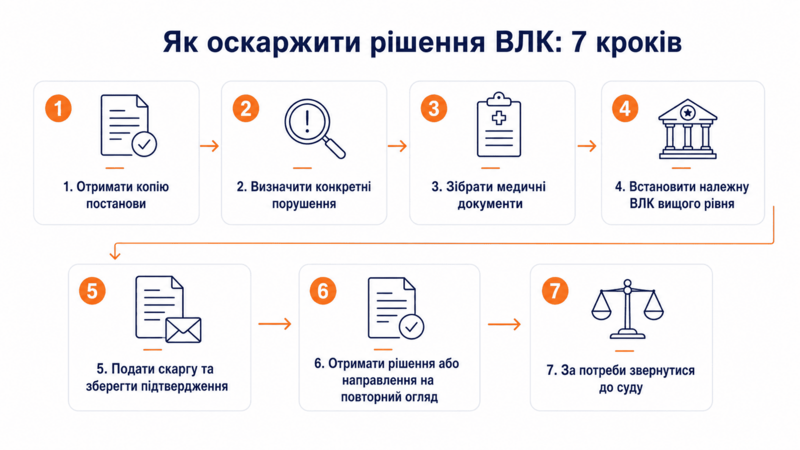
How to appeal a MMC decision: step-by-step algorithm
- Obtain a copy of the resolution. You need a document with the date, number, diagnosis, article of the Schedule of Diseases, and MMC conclusion.
- Determine the grounds for appeal. It is necessary to separate medical disagreement from procedural violations and indicate specific errors.
- Collect evidence. The package includes medical, military registration, and other documents confirming the arguments.
- Determine the proper addressee. The complaint is submitted to a higher-level MMC by subordination or administrative-territorial area of responsibility.
- Prepare and submit the complaint. It should state the circumstances of the examination, violations, demands, and list of attachments.
- Receive the review result. The higher MMC may leave the resolution unchanged, review or cancel it, or refer the person for a control examination and medical examination.
- Continue the appeal if necessary. If the violations have not been remedied, the decision is appealed to the next MMC or to an administrative court, taking into account the commission level and deadlines.
A new examination is not appointed automatically. The higher-level MMC first assesses the complaint and determines whether a control examination or repeated examination is needed.
Where to submit a complaint against a MMC decision
The general appeal route looks as follows: non-staff or local MMC → higher-level MMC or staff MMC by area of responsibility → regional MMC → MMC → administrative court. However, the specific addressee depends on the type of commission, not only on the place where the examination was conducted.
Complaints against actions, inaction, and resolutions of non-staff MMCs are submitted to staff MMCs according to administrative-territorial areas of responsibility. If the decision was made by a MMC at a district or city TCC and SP, the complaint is submitted by subordination to the MMC of the regional, Kyiv city TCC and SP, or the TCC and SP of the Autonomous Republic of Crimea.
Actions, inaction, and resolutions of regional-level MMCs may be appealed to a staff MMC or to court. A resolution of a regional MMC may be appealed to the MMC or directly in court. Decisions, resolutions, actions, or inaction of the MMC are appealed to the district administrative court.
Before filing, it is necessary to establish the status of the MMC that issued the document, rather than relying only on the name of the medical institution.
How to prepare and submit a complaint against a MMC decision
What to state in the complaint
The complaint is prepared in writing. It states the name of the MMC to which the application is submitted, the applicant’s full name, address and contacts, their status, and the date and number of the challenged resolution. Then it consistently describes the examination, established diagnoses, submitted medical documents, and specific violations.
The demands must correspond to the powers of the addressee. You may ask to review or cancel the resolution, assess the documents, check the correctness of applying Regulation No. 402, refer for a control examination, or conduct a repeated medical examination. At the end, list the attachments, date, and signature.
Which documents to attach to the complaint
Depending on the circumstances, the following are attached to the complaint:
- a copy of the MMC certificate, certificate of illness, or extract from the protocol;
- a copy of the military registration document;
- extracts from the outpatient card and medical history;
- discharge summaries, MRI, CT, ultrasound, X-ray, ECG, and test results;
- conclusions of specialized doctors and documents on treatment, surgeries, and rehabilitation;
- previous MMC resolutions;
- evidence that the documents were submitted during the examination;
- a certificate on the circumstances of the injury, materials of the official investigation, and primary medical records;
- copies of previous complaints, replies, and evidence of their submission.
It is advisable to submit certified copies, keep the originals, and prepare a list of attachments with the number of pages.
How to submit the complaint
The complaint may be submitted personally through the office. The applicant’s copy must receive an incoming number, date, and acceptance mark. Another option is to send the documents by valuable or registered letter with a list of enclosures and delivery notice. The receipt, list, and delivery confirmation must be kept.
The higher-level MMC may leave the resolution unchanged, review it, or refer the applicant for a control examination. The result must be formalized by a proper decision, not by an informational letter without resolving the complaint.
Deadlines for appealing a MMC decision
Deadline for submitting a complaint to a higher-level MMC
The general deadline for administrative appeal of an administrative act is 30 calendar days from the day the decision is brought to the person’s attention. This is provided by Article 80 of the Law of Ukraine “On Administrative Procedure”. For certain categories of cases, the law may establish another deadline, so filing a complaint against a MMC resolution should not be delayed.
If the resolution does not specify the deadline and appeal procedure, as a general rule under the Law “On Administrative Procedure,” the deadline is not considered missed. At the same time, in practice it is safer to submit the complaint no later than 30 calendar days from receiving the decision and to keep confirmation of this date.
Deadline for applying to an administrative court
Under Article 122 of the Code of Administrative Procedure of Ukraine, the general deadline for applying to an administrative court is six months from the day when the person learned or should have learned about the violation of their rights.
If the applicant used the pre-trial procedure and the law provides such a possibility, a three-month deadline from the day of service of the decision on the complaint may apply for applying to court. If the decision was not made or served within the established period, a six-month deadline applies, calculated from the day the complaint was submitted.
For a servicemember, the court may qualify the dispute as concerning public service. In this category, part five of Article 122 of the Code of Administrative Procedure of Ukraine establishes a one-month deadline. Therefore, the deadline must be determined individually, taking into account the applicant’s status, the subject of the claim, the MMC level, and the pre-trial review procedure.
What to do if the deadline is missed
Together with the complaint or claim, a motion or application for renewal of the deadline is submitted. It must state the specific circumstances that prevented timely filing and attach evidence: medical documents, confirmation of treatment, performance of combat missions, being on a business trip, lack of access to documents, or late receipt of the resolution.
A mere reference to martial law or military service does not guarantee renewal of the deadline. It is necessary to show a causal link between the circumstances and the inability to file the complaint or claim on time.

How to appeal a MMC decision in court
Disputes regarding decisions, actions, or inaction of the MMC are considered under administrative proceedings. The claim is filed with the district administrative court. The defendant is the commission or body that adopted the challenged resolution, improperly considered the complaint, or allowed inaction.
For resolutions of local and non-staff MMCs, it is advisable to first undergo review by a higher-level MMC. Court practice shows that applying without using the review mechanism provided by Regulation No. 402 may be grounds for refusal, especially when the arguments concern medical assessment, correctness of diagnosis, or application of the Schedule of Diseases.
In court, one may challenge violations of the examination procedure, failure to consider mandatory documents, absence of necessary tests, decision-making by an improper composition, lack of substantiation of the resolution, inaction during complaint consideration, or provision of an ordinary letter instead of a properly formalized decision.
The claim must include the challenged resolution, decision on the complaint, medical documents, evidence of procedural violations and compliance with deadlines, as well as a document confirming payment of the court fee or grounds for exemption from it. Claims may include recognizing the resolution as unlawful and canceling it, recognizing inaction as unlawful, obliging a repeated consideration of the complaint, or conducting a new review in compliance with the procedure.
The court does not conduct a medical examination instead of the MMC, does not establish a diagnosis, and does not determine the degree of fitness for military service. Therefore, a demand to directly “recognize as unfit” usually does not correspond to the court’s powers. The proper method of protection depends on the violation: cancellation of an unlawful resolution, repeated consideration of documents, or obliging the commission to make a decision provided by law.
Does an appeal suspend the effect of a MMC decision?
The very fact of submitting a complaint to a higher-level MMC should not be considered an automatic suspension of the resolution. Under Article 83 of the Law of Ukraine “On Administrative Procedure,” the complainant may file a separate motion to suspend the effect of the administrative act, unless otherwise provided by law. However, until a decision on suspension or a new resolution is received, the previous conclusion remains valid.
Filing a claim and opening proceedings in an administrative case also do not automatically suspend the effect of the resolution. The claimant may submit an application for securing the claim, but the court applies such measures only if there are grounds provided by the Code of Administrative Procedure of Ukraine. The mere desire to suspend the decision is not enough.
Appealing a MMC decision by itself does not grant a deferment from mobilization and does not release a servicemember from service obligations. If, as a result of the review, a repeated or control examination is appointed, after it is passed a new resolution is adopted, which is then used by the TCC and SP, military unit, and other bodies.
Typical mistakes when appealing a MMC decision
Most often, applicants:
- refer only to disagreement with the conclusion without specific violations;
- add the name of the diagnosis but do not confirm the degree of functional impairment;
- submit an incomplete or disorganized package of documents;
- do not prove that medical materials were provided during the examination;
- send the complaint to the wrong MMC;
- miss deadlines and do not submit an application for their renewal;
- do not keep the incoming number, list of enclosures, or delivery confirmation;
- demand that the court independently establish the diagnosis or fitness category;
- go to court without going through the prescribed procedure for reviewing the medical decision;
- mix appealing the MMC resolution with appealing mobilization, an order of assignment to a unit, or other decisions.
If several decisions are being appealed, for each one it is necessary to separately determine the addressee, grounds, deadlines, and method of protection.
Court practice regarding appeals against MMC decisions
In the Supreme Court ruling of February 26, 2025 in case No. 600/3273/22-а, the claimant challenged the wording of the causal link of the disease but did not go through the review by the regional MMC or MMC provided by Regulation No. 402. The Supreme Court agreed that verification of medical criteria first falls within the competence of a higher-level MMC and dismissed the claim.
In case No. 320/15737/25, the Kyiv District Administrative Court recognized the inaction of the MMC as unlawful because it did not consider the complaint in the proper manner. The court obliged the commission to reconsider the application by adopting a resolution in accordance with Regulation No. 402, but did not substitute the MMC in resolving the medical issue.
In case No. 160/36792/25, the Dnipropetrovsk District Administrative Court refused to satisfy the claims regarding the certificate of the local MMC. The court pointed to the prescribed review procedure through the regional-level MMC, regional MMC, and MMC and took into account that the claimant had not used this mechanism before applying to court.
The practical conclusion from these cases is that the court controls the legality of the procedure and the proper consideration of the complaint, but does not determine the diagnosis or fitness instead of doctors. If the dispute concerns medical assessment, it is especially important to first apply to the competent higher-level MMC.
Frequently asked questions
Can a MMC decision be appealed?
Yes. The resolution can be appealed to a higher-level MMC, and decisions of the regional MMC or MMC can also be appealed to an administrative court.
How much time is there to appeal a MMC decision?
It is safer to submit a pre-trial complaint within 30 calendar days from the day of receiving the resolution. The deadline for applying to court depends on the person’s status, the subject of the dispute, and whether pre-trial review was carried out.
Where to submit a complaint against a MMC decision?
The complaint is submitted to a higher-level MMC by subordination or area of responsibility. A decision of a district or city MMC is appealed to the regional-level MMC, and a resolution of a regional MMC — to the MMC or court.
What documents are needed to appeal a MMC decision?
A copy of the resolution, medical discharge summaries, test results, doctors’ conclusions, and evidence of procedural violations are needed. To review the causal link, documents on the circumstances of the injury or illness are also attached.
Can a MMC decision be appealed directly in court?
It depends on the level of the commission and the subject of the dispute. For resolutions of local and non-staff MMCs, it is advisable to first undergo review by a higher-level MMC, especially if the dispute concerns medical conclusions.
Is it necessary to undergo a repeated MMC after an appeal?
Not always. A repeated or control examination is conducted if it was appointed by a staff MMC or if the need for a new review follows from a court decision.
Does filing a complaint suspend the effect of a MMC decision?
Not automatically. A separate motion to suspend the effect of the act may be filed, but until the relevant decision is made, the resolution remains valid.
Does applying to court suspend mobilization?
No. Filing a claim by itself does not suspend the MMC resolution and does not grant a deferment from mobilization.
What to do if the MMC did not take medical documents into account?
It is necessary to obtain a copy of the resolution and submit a reasoned complaint to a higher-level MMC. The complaint should list the ignored documents and attach evidence that they were submitted.
Can a MMC decision be appealed?
Yes. Resolutions, decisions, actions, and inaction of the MMC can be appealed to the district administrative court.
What to do if the deadline for appealing a MMC decision has been missed?
Together with the complaint or claim, it is necessary to submit an application for renewal of the deadline and evidence of valid reasons. Without proper substantiation, the application may be left without consideration.
Can a court recognize a person as unfit for military service?
No. The court may cancel an unlawful resolution or oblige a proper repeated review, but determining the degree of fitness falls within the competence of the MMC.

Leave a request for consultation and our specialist will contact you soon!
Leave a request and our specialist will contact you soon!




Fill out the form or contact us in any way convenient for you
Choose the nearest office to you and receive consultations in a convenient format for you