

Consultations conducted
Cases won
Satisfied clients
Professionals in the team
Criminal proceedings under Article 336 of the Criminal Code of Ukraine may be initiated following a report of possible evasion of conscription for military service during mobilization. After being summoned for questioning or served with a notice of suspicion, it is important to verify the legality of conscription and the evidence of intent.
An attorney specializing in Article 336 of the Criminal Code of Ukraine helps clarify a person's procedural status, examine TCC and SP documents, MMB conclusions, deferment records, and criminal case materials. We provide legal assistance during the investigation and in court.
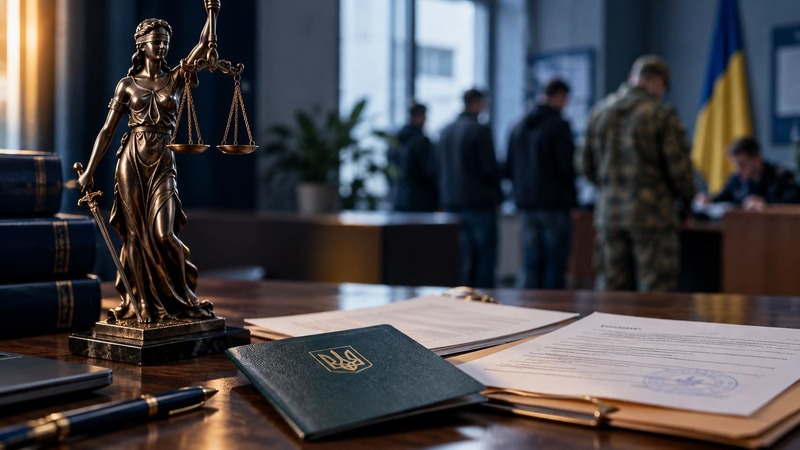
When Criminal Liability Arises Under Article 336 of the Criminal Code of Ukraine
Not every failure to appear at the TCC automatically constitutes a crime under Article 336 of the Criminal Code of Ukraine. Criminal liability requires establishing all legally defined elements of evasion of conscription. Relevant factors include the person's military registration status, fitness for service, grounds for deferment, stage of the mobilization procedure, method of notification, and circumstances of non-appearance.
Article 336 of the Criminal Code of Ukraine covers evasion of conscription for military service during mobilization, for a special period, as well as evasion of conscription of reservists during a special period. A summons alone does not prove that a crime has been committed.
Who Can Be Subject to Criminal Liability?
For Article 336 of the Criminal Code of Ukraine to apply, it is important to determine whether, at the time of the relevant events, the person belonged to a category of citizens who could lawfully be conscripted under the applicable procedure. This primarily concerns persons liable for military service and reservists who are subject to the relevant obligation.
Age or the mere fact of military registration does not prove the legality of conscription. The attorney checks the person's status, deferment, reservation, and the rules in force on the date of the event.
What Must the Prosecution Prove?
The prosecution must prove:
- that the person belonged to a category subject to the relevant conscription;
- that the necessary stages of the mobilization procedure were completed, including a medical examination when required;
- that there was a lawful obligation to appear for conscription or deployment to the place of service;
- proper notification in accordance with the rules in force on the date of the event;
- that there were no grounds preventing lawful conscription in the specific circumstances;
- intentional evasion, rather than merely the fact of non-appearance.
Evidence may include summonses, MMB documents, TCC materials, and witness testimony. Procedural violations are assessed according to their significance for the prosecution's case.
Why Direct Intent Is Crucial
Evasion involves knowingly failing to fulfill an obligation. Non-appearance due to lack of awareness, documented obstacles, or a dispute concerning deferment requires a separate assessment.
The attorney establishes whether the person knew about the summons, how they acted, whether they reported the reasons for non-appearance, and whether direct intent has been proven.
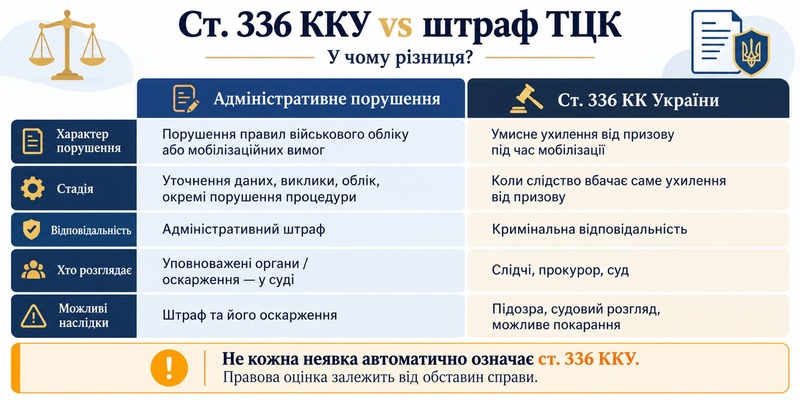
Article 336 of the Criminal Code of Ukraine vs. a TCC Fine: What Is the Difference?
A TCC fine and criminal liability under Article 336 of the Criminal Code of Ukraine have different legal consequences. Articles 210 and 210-1 of the Code of Ukraine on Administrative Offenses concern administrative violations, while Article 336 of the Criminal Code concerns proven evasion of conscription.
| Criterion | Administrative Violation | Article 336 of the Criminal Code of Ukraine |
|---|---|---|
| Nature of the violation | Violation of military registration rules or mobilization legislation requirements | Intentional evasion of conscription provided for by law |
| Stage of the procedure | May arise during registration, data updates, notification, and other procedures | Assessed in the context of a specific obligation concerning conscription for service |
| Type of liability | Administrative fine | Criminal liability, with a penalty of 3–5 years of imprisonment |
| Who considers the case | Authorized officials, with the possibility of appealing the resolution in court | Pre-trial investigation is conducted by authorized bodies; guilt is determined by the court |
| Possible consequences | A fine resolution and its enforcement or appeal | Notice of suspicion, court proceedings, conviction, or another decision provided for by law |
An imposed fine does not in itself confirm or exclude the elements of a crime under different circumstances.
Is Failure to Appear for a Military Registration Data Update a Criminal Offense?
Failure to appear when summoned to update military registration data does not in itself constitute a crime under Article 336. Administrative consequences may apply. What matters is the purpose of the summons, notification, and the actual actions of the TCC, not merely the name of the summons.
Does Failure to Appear for the MMB Automatically Constitute an Offense Under Article 336?
No. The mere failure to appear before the military medical commission does not automatically establish evasion of conscription. The obligation to undergo the examination, notification, and determination of fitness for service must be verified.
When Do You Need an Attorney for a Case Under Article 336 of the Criminal Code of Ukraine?
It is advisable to seek legal assistance before the first procedural action, rather than only after receiving a notice of suspicion. This helps ensure that important circumstances are documented in time.
Legal defense is needed during witness questioning, service of a notice of suspicion, searches, selection of a preventive measure, or transfer of the case to court, as well as when TCC or MMB documents or deferment issues are disputed.
An attorney will explain procedural rights, prepare the client for lawful participation in questioning, help develop a consistent legal position, and determine which documents need to be collected.
What Does an Attorney Check in a Case Under Article 336 of the Criminal Code of Ukraine?
The first stage is reconstructing an accurate timeline: when the person was summoned, which documents they received, what happened at the TCC, whether they underwent the MMB, and what the results were.
- Review of the mobilization procedure. We establish the person's status as a person liable for military service or a reservist, the notification procedure, the legality of actions by authorized bodies, and the existence of a MMB decision, deferment, or reservation on the relevant date.
- Review of criminal evidence. We analyze what confirms receipt of the summons and whether witness statements, reports, records, and official documents are consistent. We assess the admissibility of evidence, contradictions, and proof of intent.
- Review of procedural decisions. We examine the notice of suspicion, records of investigative actions, motions, and court rulings. Where legal grounds exist, the attorney prepares applications, motions, objections, and complaints, initiates examination of the necessary documents, and defends the client's position in court.
What Documents Should You Provide to an Attorney?
Provide the documents you have available. You do not need to obtain confidential investigation materials independently.
Practical checklist:
- summonses, notifications, and other documents received from the TCC and SP;
- military registration documents, including available electronic records;
- MMB conclusions, certificates, examination results, and medical documents;
- documents confirming deferment, reservation, or applications for obtaining them;
- confirmation of valid reasons for non-appearance, if any;
- investigator's summonses or other notices to appear before the investigating authority;
- notice of suspicion, if served;
- available copies of records of questioning, searches, and other investigative actions;
- other case materials lawfully obtained by you or your defense attorney.
If some documents are missing, inform your attorney. They will determine what can be obtained through procedural means. You should also prepare a timeline of events.
Can Criminal Proceedings Under Article 336 of the Criminal Code of Ukraine Be Closed?
Proceedings may be closed if grounds provided for by the Criminal Procedure Code of Ukraine exist. It is necessary to examine whether the criminal event and elements of the offense are present and whether the evidence is sufficient. An attorney cannot guarantee that the proceedings will be closed.
Possible grounds for the defense's position include the absence of a lawful obligation concerning conscription, failure to prove intent, or evidence that refutes the investigation's claims.
At the pre-trial stage, the matter is decided by an authorized investigator or prosecutor within their powers. After the indictment is submitted, the court may also close the proceedings, but only on the grounds and according to the procedure expressly provided for by the Criminal Procedure Code.
Punishment for Evasion of Mobilization Under Article 336 of the Criminal Code of Ukraine
Article 336 of the Criminal Code of Ukraine provides for imprisonment for a term of three to five years. It is not possible to pay a fine instead of this punishment.
However, actually serving a prison sentence is not inevitable in every case: where the legal conditions are met, the court may grant a suspended sentence with probation. The decision depends on the circumstances and the verdict.
The court considers the circumstances of the case and information about the defendant. An attorney cannot guarantee acquittal, closure of the case, or a particular verdict, but can ensure the proper use of lawful defense mechanisms.
Article 336 of the Criminal Code of Ukraine and Religious Beliefs
Religious or other beliefs do not in themselves exempt a person from the obligation to perform military service during mobilization and do not exclude liability under Article 336 of the Criminal Code of Ukraine if all elements of the offense are proven.
This position was set out by the Joint Chamber of the Criminal Cassation Court of the Supreme Court in its ruling of October 27, 2025, in case No. 573/838/24. At the same time, such beliefs must be taken into account during service, particularly regarding the use of weapons.
This position does not provide for the automatic replacement of military service during mobilization with alternative service.
What to Do After Being Summoned for Questioning in a Case Under Article 336
A summons to appear before an investigator does not necessarily mean that a person is suspected of a crime, but their statements may become evidence.
- Clarify your procedural status. Find out whether you are being summoned as a witness or a suspect, and check the details of the summons.
- Contact an attorney. Provide available summonses, TCC and MMB documents, and other materials related to the events.
- Agree on a legal position. Reconstruct the timeline together, identify documents confirming relevant circumstances, and discuss procedural rights.
- Use legal assistance during questioning. A suspect has the right to a defense attorney; a witness has the right to legal assistance from an attorney when giving testimony.
- Read official records carefully. If the document is unclear or does not accurately reflect your statements, consult your attorney before signing and request that the necessary comments be included.
Article 63 of the Constitution of Ukraine allows a person to refuse to testify against themselves and close relatives.
How We Handle Cases Under Article 336 of the Criminal Code of Ukraine
We begin with a consultation: we determine what prompted the summons or suspicion, clarify the stage of the case, and analyze the available documents.
The attorney then reviews the mobilization procedure, the circumstances of non-appearance, and the prosecution's position. We agree on a plan covering participation in questioning, motions, evidence, and appeals against decisions where grounds exist.
If the case proceeds to court, the attorney examines the indictment, prepares objections, participates in court hearings, questions witnesses, and works with evidence. If necessary, we prepare an appeal and explain the possible outcomes.
Why Choose «Pravovyi Lider»?
At the law firm «Pravovyi Lider», you can obtain legal assistance in criminal proceedings under Article 336 of the Criminal Code of Ukraine during the pre-trial investigation and court proceedings.
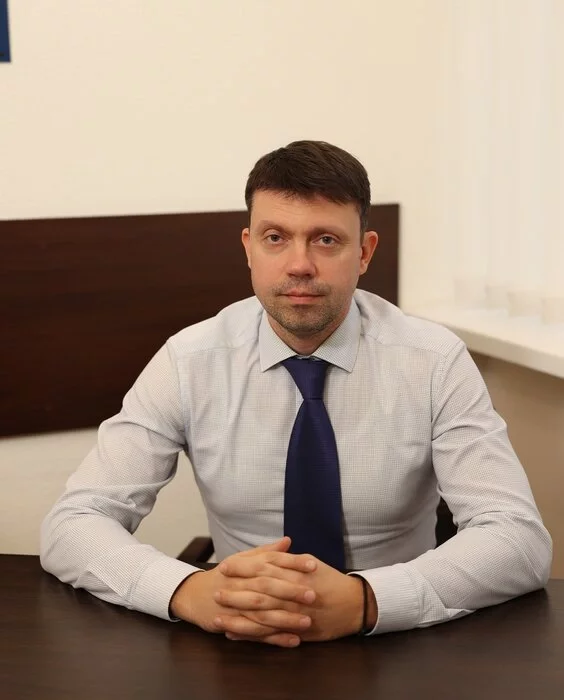
Attorney Oleksii Vitaliiovych Oropai specializes in criminal and military law. His practice includes defending suspects and defendants, participating in investigative actions, representing clients in court, resolving mobilization disputes, and appealing MMB decisions.
When handling a case, we verify the legality of the mobilization procedure, analyze the prosecution's evidence, prepare the necessary procedural documents, and defend the client's rights at every stage of the proceedings.
«Pravovyi Lider» has offices in Kyiv, Vinnytsia, Lviv, and Odesa. An initial consultation is available remotely. All information provided to an attorney as part of legal assistance is protected by attorney-client confidentiality.
Get a Consultation with an Attorney for Article 336 of the Criminal Code of Ukraine
After being summoned for questioning or receiving a notice of suspicion, contact «Pravovyi Lider». An attorney will clarify your status, review the documents, and identify possible defense steps.
To get started, submit a request on the website or call us. After the initial contact, the attorney will explain how to securely provide the available documents: summons, MMB decision, confirmation of deferment, investigator's summons, notice of suspicion, or other procedural materials.
Frequently Asked Questions (FAQ)
Can a Relative Contact an Attorney If the Person Liable for Military Service Is Abroad?
Yes. A relative may arrange an initial consultation, explain the situation, and provide available documents. However, full legal defense and access to confidential information require properly formalizing the relationship with the client and respecting their wishes. Being abroad does not eliminate procedural obligations.
Can an Attorney Determine Whether Information Has Been Entered into the Unified Register of Pre-Trial Investigations If No Notice of Suspicion Has Been Served?
An attorney may submit requests and motions provided for by law, review documents received by the client, and clarify available information about possible proceedings. However, the Unified Register of Pre-Trial Investigations (URPTI) is not a public register: without the appropriate procedural status and legal grounds, confirmation or complete information may not always be obtainable.
Can a Witness in a Case Under Article 336 of the Criminal Code of Ukraine Later Become a Suspect?
Yes. A person's status may change if grounds provided for by law for serving a notice of suspicion arise during the investigation. Therefore, even when being questioned as a witness, it is important to understand your rights, use legal assistance from an attorney, and carefully review the contents of the official record.
What If Statements Were Already Given During Questioning Without an Attorney?
Inform your attorney of the date of questioning, your procedural status, and the content of your statements. If you have a copy of the questioning record, provide it for analysis. The defense attorney will check whether your rights were explained, whether your statements were recorded accurately, and whether there are grounds to challenge the admissibility of the evidence or provide additional explanations. The absence of an attorney does not automatically make testimony inadmissible.
Can You Change Your Attorney If Criminal Proceedings Are Already Before the Court?
Yes. A defendant may engage another defense attorney during the trial. The new attorney's authority must be properly documented, and their involvement in the case must comply with procedural requirements, including cases where defense counsel's participation is mandatory.
Can Proceedings Under Article 336 of the Criminal Code of Ukraine Be Closed After the Indictment Has Been Submitted to Court?
Yes, but only on the grounds and according to the procedure provided for by the Criminal Procedure Code of Ukraine. Depending on the established circumstances, the proceedings may be closed, an acquittal may be issued, or another lawful decision may be made. The attorney assesses the available grounds based on the specific stage and case materials.
Can You Travel Abroad If Criminal Proceedings Under Article 336 of the Criminal Code of Ukraine Have Been Opened Against You?
The mere fact that proceedings have been initiated does not automatically create a universal ban on crossing the border. Procedural restrictions, preventive measures, and rules for leaving Ukraine during martial law must be considered. Before traveling, an attorney should review the procedural decisions concerning the person and determine whether there is a lawful basis for crossing the border.
Can Criminal Proceedings Under Article 336 Affect Employment, Reservation from Mobilization, or Obtaining a Criminal Record Certificate?
Possible consequences depend on the stage of the case, the requirements of the particular position, reservation conditions, and the content of the required extract from the Ministry of Internal Affairs information system. Initiation of criminal proceedings is not the same as having a criminal record: a criminal record arises under the rules of the Criminal Code of Ukraine after a conviction becomes final. At the same time, certain checks may take into account information about a person being subject to criminal prosecution.


Leave a request for consultation and our specialist will contact you soon!


файни сервіс
Работаю оперативно. Профессионалы своего дела. С такими специалистами приятно работать. Я очень довольно. Большое спасибо!!!
Умение общаться с клиентами. Быстрая оперативность. Умение выслушать клиента. Работают профессионально. Я очень осталась довольна. Спасибо большое.
Хорошее отношение. Быстрая оперативность. Профессиональное общение с клиентами. Я осталась довольна. Если будет потребность буду с удовольствием обращаться к вам. Спасибо большое!!!
Дякую вам велике Ангеліна Водимівна за вашу щиру допомогу і консультацію
Вчора в Центрі отримала дуже розлогу і корисну для мене в рішенні моїх проблем юридичну консультацію від юриста консультанта Ксенії Василівни. Я отримала відповіді на мої питання і поради з приводу подальших моїх дій. Дуже вдячна за дуже уважне і детальне ставлення до кожної моєї проблеми і запропоновані дії і допомогу стосовно їх вирішення.
Fill out the form or contact us in any way convenient for you








Choose the nearest office to you and receive consultations in a convenient format for you