

Subpoena: Types, Rules for Service, and What to Do After Receiving One
A summons is an official call for a conscript, person liable for military service, or reservist to appear at a specific place, day, and time. Receiving it by itself does not mean automatic mobilization: the purpose of the call matters — registration for military registration, clarification of data, medical examination, or conscription and dispatch to the place of service. A summons may be served in person or sent by post; refusal of a postal item or absence at the proper address may, under certain conditions, also confirm notification. A summons with a QR code generated through the register is not an «electronic summons» in Reserve+. If there is a documented valid reason for non-appearance, the TCC must be notified in a timely manner.
What is a summons and what receiving it means
A summons is an official document by which a person is called to perform a specific military registration or mobilization duty. The mere fact of receiving it does not mean that the person has already been mobilized.
First of all, the purpose of the call should be checked. It determines whether it is necessary to register, clarify information, undergo a medical examination, or appear in connection with conscription during mobilization. Procedure No. 560 directly distinguishes these purposes of the call.

What types of summonses exist in Ukraine
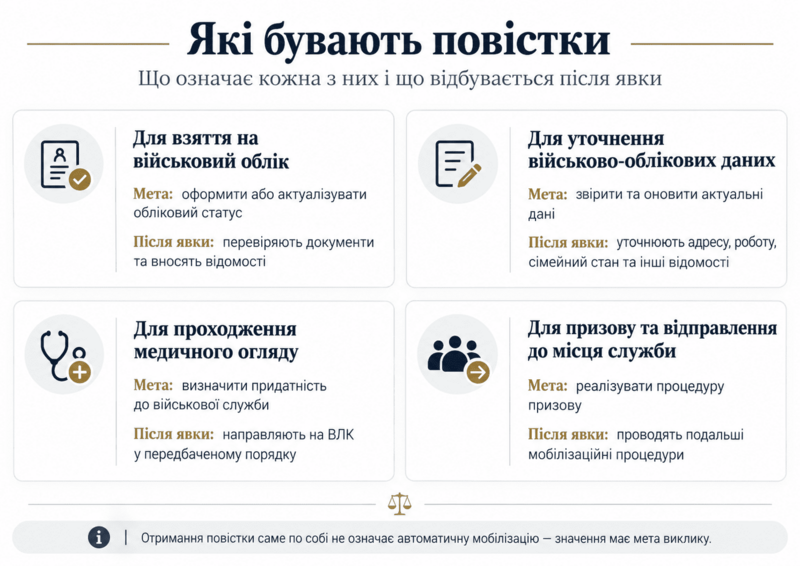
It is more correct to distinguish summonses by the purpose of the call, not by a conditional number of «types».
| Purpose of the call | What it means | What happens after appearance |
| Registration for military registration | The registration status must be formalized | Documents are checked and information is entered |
| Clarification of data | Military registration information must be verified | Data are checked and, if necessary, updated |
| Medical examination | Fitness must be determined | The person undergoes the MMC under a proper referral |
| Conscription and dispatch | The call is related to conscription during mobilization | Procedures are carried out for dispatch to the place of service |
Summons for registration for military registration
Its purpose is to place the person on the relevant military register or properly formalize their registration status. After appearance, documents and register information are checked. Registration itself is not conscription for service.
Summons for clarification of military registration data
Under such a summons, the TCC checks the relevance of personal and military registration information. This is a separate procedure that is not equal to mobilization.
What data may be clarified
The address of residence or stay, contact details, documents, education, place of work, family and military registration information, MMC results, information about deferment, and other data provided by law for the register may be checked. Part of the information enters it through electronic interaction with other state systems.
Does such a summons mean automatic mobilization?
No. A summons for clarification of data is not a summons for conscription and dispatch. At the same time, after the check, grounds may arise for other lawful procedures, for example, referral to the MMC or formalization of a deferment from mobilization.
Summons for undergoing a medical examination
Its purpose is to determine fitness for military service. A summons should not be confused with a referral to the MMC: a referral is a separate document on the basis of which a medical examination is undergone, and it may be electronic.
An electronic referral to the MMC is available in Reserve+, but it is not a summons. If there are doubts about the health condition or a previous conclusion, it is worth separately checking the rules for undergoing the MMC. If a decision has already been made with violations, a separate procedure for appealing a MMC decision applies.
Summons for conscription and dispatch to the place of service
This call is directly related to conscription during mobilization and subsequent dispatch to the place of military service. Its consequences differ from a call only for clarification of data.
What is called a «combat summons»?
«Combat summons» is an everyday term, not a separate legal name. This is usually how people refer to a summons regarding conscription for military service during mobilization and dispatch to the place of service. The document should be assessed by the officially stated purpose of the call.
It should also not be automatically equated with a mobilization order — these are documents used at different stages of the mobilization procedure.
How a combat summons differs from a summons for clarification of data
| Criterion | Clarification of data | Conscription and dispatch |
| Purpose | Verify registration information | Implement the conscription procedure |
| Does it mean conscription? | No | Directly related to conscription |
| After appearance | Checking data and documents | Actions for further dispatch |
What details a summons must contain
The summons indicates the full name and date of birth of the addressee, the body that issued it, the purpose of the call, place, date and time of appearance, registration number, as well as an explanation of the consequences of non-appearance and the obligation to report its reasons.
For a paper summons, the details and signature of the authorized official and proper formatting of the form are required. For a document generated through the register, the rules of electronic generation and signing apply.
Is a QR code mandatory?
A summons generated through the Unified State Register of Conscripts, Persons Liable for Military Service and Reservists has a unique electronic identifier in the form of a QR code. If such a document is printed, the code must be readable.
But a summons may also be issued on a paper form. Therefore, the absence of a QR code does not make any summons automatically invalid — first, it is necessary to determine how it was issued.
Who has the right to serve summonses
Under Procedure No. 560, summonses may be served by authorized representatives of the TCC and SP, district and city state or military administrations, executive bodies of local councils, as well as enterprises, institutions, and organizations in cases provided for. Separate rules are established for the SBU and intelligence agencies regarding persons on their military register.
The police may participate in notification measures within their powers, but the statement that «any police officer can independently issue a summons» is an incorrect simplification.
What documents must the person serving the summons present?
The person carrying out notification must introduce themselves and state the purpose of the approach. At the citizen’s request, the authorized representative must show documents by which their identity and authority to serve the summons can be verified.
Where a summons may be served
A summons may be served not only at the TCC or at the place of registration. Procedure No. 560 allows notification around the clock at the place of residence or stay, work, study, in public places and buildings, places of mass gatherings, at checkpoints, in the TCC, and at border crossing points.
That is, the place of service itself does not make the summons illegal. Legislation does not establish a universal list of places where serving summonses is «prohibited»; what matters are the powers of the persons and compliance with the procedure.
Summons by post: how it is sent and when it is considered served
To what address a summons may be sent
If a person has reported their current residential address, the summons may be sent there. If the necessary information has not been clarified, Procedure No. 560 provides for sending it to the address of the declared or registered place of residence.
Therefore, actual residence elsewhere does not always refute proper notification: it is necessary to check what address the person officially reported.
How the postal item must be formalized
The summons is sent by registered postal item with an inventory of enclosure and delivery notification. Special marks are used for it, including «TCC summons» and «Deliver personally».
The envelope, inventory, tracking, and notification may confirm the date of sending, delivery attempts, and delivery result.
What happens if the addressee is not at the address?
If the addressee is absent, the postal operator notifies them of the arrival of the letter under the established rules. For items marked «TCC summons», a special procedure applies: if the addressee does not appear to receive it within three working days after being informed, the item is returned with a mark indicating the addressee’s absence.
Under Procedure No. 560, the date of the mark on the person’s absence at the proper address in certain cases may be the date confirming notification. Therefore, the absence of one’s own signature does not always mean non-service.
What happens in case of refusal to receive the letter?
Refusal is also recorded by the operator. The date of the postal mark on refusal to receive in cases provided for by the Procedure may confirm notification, so intentional refusal of the letter does not guarantee the absence of legal consequences.
What appearance date may be indicated in a summons sent by post?
For an addressee from a settlement that is an administrative center of a region, the day of appearance is determined within seven days from the day of sending. For other settlements — within ten days from the day of sending.
These time limits should be checked according to the version of Procedure No. 560 in force on the date of the specific postal item, not according to old publications with other rules.
Can a summons come in Reserve+?
No, summonses are not served through Reserve+. In the application, you can see a military registration document, current data from the register, or receive an electronic referral to the MMC, but all this is not a summons.
At the same time, the summons itself may be generated through the register. After generation, it is used in the ordinary notification procedure — served in person or sent by post.
How a summons with a QR code differs from an «electronic summons»
The QR code is needed to verify a summons generated through the register and contains its electronic identifier. Its presence does not mean that the document was sent to the person through Reserve+ or another electronic service.
Therefore, a summons with a QR code is not an «electronic summons», but a document generated in the electronic system and then served in the prescribed manner.
What to do after receiving a summons
Step 1. Check the purpose for which you are being called
Find the purpose of the call in the document: military registration, clarification of data, medical examination, or conscription and dispatch.
Step 2. Check the document details
Check the full name, date of birth, body, place, date and time of appearance, registration number, and formatting. For a document from the register, check the QR code.
Step 3. Record the date and method of receipt
Keep the summons or its photo. If it came by post, also keep the envelope, inventory of enclosure, notification, and tracking. This may be evidence in a dispute regarding the timing or method of notification.
Step 4. Prepare the necessary documents
Prepare documents related to the purpose of the call, military registration, deferment, or health condition, if these circumstances matter.
Step 5. Appear or report a valid reason
If it is impossible to appear for a valid reason, notify the TCC within the established period and keep documentary confirmation of the reason and the notification itself.
What to bring after receiving a summons
The practical set depends on the purpose of the call:
- identity document;
- military registration document;
- documents needed to clarify specific registration information;
- confirmation of the right to deferment, if it matters;
- medical documents, if they relate to the MMC or health condition.
There is no need to bring «all documents you have» — it is important to take what confirms legally significant circumstances for the specific procedure.
Valid reasons for non-appearance under a summons
Valid reasons may include a natural obstacle, illness, hostilities in the relevant territory and their consequences, or other circumstances that actually deprived the person of the opportunity to appear. A separate ground is the death of a close relative: parents, husband or wife, child, sibling, grandfather or grandmother, as well as a close relative of the husband or wife. The reason must be documented.
The TCC should be notified of non-appearance as soon as possible, but no later than three days from the date and time specified in the summons. After that, the law requires further appearance within a period not exceeding seven calendar days. If the obstacle continues, it is important to document it and communication with the TCC.
Non-appearance under a summons: what liability applies
When administrative liability is possible
Violation of military registration rules or legislation on defense and mobilization may entail liability under Articles 210 or 210-1 of the Code of Ukraine on Administrative Offenses. During a special period, citizens face a fine of 1,000–1,500 tax-free minimum incomes for the relevant violations, i.e. UAH 17,000–25,500.
But a fine is not automatic for any non-appearance: a specific offense must be established and the procedure for bringing a person to liability must be followed. If a resolution has already been issued, the issue of appealing the fine or other actions of the TCC must be assessed based on the materials of the specific case.
When criminal liability may arise
Article 336 of the Criminal Code of Ukraine provides for liability for evasion of conscription for military service during mobilization. This is not a formula of «second non-appearance = criminal liability».
For assessment, the stage of the mobilization procedure, properness of the call, fitness, presence or absence of legal grounds not to be conscripted, the content of the document, and the person’s behavior matter. The sanction of Article 336 is imprisonment for a term of three to five years.
If the person is already a servicemember, unauthorized abandonment of the unit is regulated by other rules and should not be mixed with non-appearance under a summons. For such situations, the separate area of an AWOL attorney applies.
Does payment of a fine release from the obligation to appear?
No. Payment of a fine concerns an already established violation, but does not cancel the military registration or mobilization duty and does not prohibit a lawful repeated call.
What to do if a summons was issued or served with violations
What violations should be checked
First of all, check whether the full name and other personal data are stated correctly, whether the document contains the purpose of the call, place, date and time of appearance, registration number, and other mandatory details. If the summons was served in person, it is worth paying attention to who exactly did it and whether that person had the appropriate authority.
For a postal summons, the address of dispatch, type of postal item, date of sending, delivery result, and postal operator marks are checked separately. It is also important to compare the date of actual receipt with the date on which the person was called.
Not every typo or technical inaccuracy automatically makes a summons invalid. What matters is whether the specific violation affects the ability to identify the addressee, understand the purpose of the call, or confirm proper notification.
How to record the circumstances of service
Keep the summons, its photo or copy, the envelope, inventory of enclosure, notification, and tracking. In case of personal service, the details of authorized persons, video recording, witnesses, and other lawfully obtained evidence may matter.
The summons itself must be kept, and a photo or copy should also be made where all details are clearly visible. If the document arrived by post, it is worth keeping the envelope, delivery notification, item number, and tracking data — they may confirm the sending date and actual receipt.
In case of personal service, it is advisable to record the date, time, and place, as well as the details of the person who served the document. If a dispute arises regarding the procedure, witnesses or a lawfully made video recording may additionally matter.
When it is worth contacting an attorney
Legal assistance is appropriate if the issue concerns conscription and dispatch, disputed deferment, MMC, a fine resolution, questionable service, or the risk of criminal proceedings. A military attorney can assess not only the form itself, but the entire procedure of the TCC’s actions and the available evidence.
If the issue concerns specifically an unlawful resolution, refusal, search, or another decision, it is also worth separately assessing the possibility of appealing TCC actions.
What happens after appearing at the TCC
It all depends on the purpose of the call. At the TCC, data may be clarified, military registration documents checked, necessary documents prepared, the issue of deferment considered, or, if there are legal grounds, a referral for medical examination may be issued.
If the person is subject to conscription and the necessary conditions are met, further mobilization procedures are possible. But every appearance does not mean automatic MMC or immediate dispatch to a military unit.
Typical mistakes after receiving a summons
- ignoring the document without checking the purpose;
- believing that the absence of one’s own signature always means non-service;
- confusing Reserve+, an electronic military registration document, or referral to the MMC with a summons;
- using old rules of postal service;
- not reporting a documented valid reason;
- not bringing documents confirming deferment, health condition, or other important circumstances.

FAQ
Can a husband, wife, or another relative receive a summons instead of me?
A postal item marked «TCC summons» is delivered personally to the addressee. The rule under which an ordinary registered letter may in certain cases be received by an adult family member does not apply to such a special item.
What should be done if the full name or other personal data are written incorrectly in the summons?
Record the error and notify the body that issued the document. Do not automatically ignore the summons: the nature of the error and the possibility of clearly identifying the addressee matter.
Can another summons be served after I have already clarified my data?
Yes. Clarification of data serves one purpose of the call and does not exclude a subsequent summons with another lawful purpose.
Is it necessary to appear under a summons if a valid deferment is already displayed in Reserve+?
A valid deferment prevents conscription for the period of its validity, but it does not mean that any call can be ignored. It is necessary to check the purpose of the summons and have confirmation of the valid deferment.
What should be done if a postal summons was actually received after the date specified for appearance?
Keep the envelope and tracking, record the actual date of receipt, and notify the TCC as soon as possible. This circumstance may matter for assessing proper notification and guilt.
Can I appear at another TCC with the received summons?
The general rule is to appear at the body and address specified in the summons. A visit to another TCC without coordination does not guarantee fulfillment of the obligation under the specific call.
Can a person receive several summonses with different purposes of call?
Yes. Different documents may relate to different stages of military registration and the mobilization procedure.
Is it necessary to keep the envelope if the summons came by post?
Yes. The envelope, inventory, notification, and tracking help confirm the sending date, receipt, and compliance with the procedure.

Leave a request for consultation and our specialist will contact you soon!
Leave a request and our specialist will contact you soon!
More useful information




Fill out the form or contact us in any way convenient for you
Choose the nearest office to you and receive consultations in a convenient format for you