

How to Obtain Information About Crossing the State Border
The SBGS records and stores information about crossings of the state border. You can obtain your own data, as well as information about a child or another person if there are legal grounds, by submitting an application to the Administration of the SBGS. Identification documents are attached to it, and the current application template is published on the service’s website. In response, the applicant receives official information for the specified period.

What is information about crossing the state border?
Crossing the state border is recorded by the State Border Guard Service of Ukraine when a person passes border control. Information about entry and exit is processed in the SBGS information systems and stored in the relevant database of persons who have crossed the state border of Ukraine.
What is usually called a «border crossing certificate» is actually an official response from the SBGS to an application for information for a certain period. Depending on the content of the request and the data available in the system, the response may indicate the crossing date, direction of movement — entry or exit, checkpoint, and other information.
The SBGS response should not be confused with a stamp in a foreign passport. A stamp confirms a separate crossing if it was placed during border control, while the SBGS response is generated based on information system data and may cover several crossings within a defined period.
The information is provided in the form of an official response from the State Border Guard Service of Ukraine to the applicant’s request. Its content depends on what specific information was requested and what data are available in the SBGS database.
What a border crossing certificate is needed for
The need to obtain official SBGS information arises when a passport, tickets, bookings, or other indirect evidence alone is insufficient. The document may be needed to confirm a person’s actual stay in Ukraine or abroad during a specific period of time.
Most often, information is requested:
- during the consideration of civil, administrative, family, and other court cases;
- to confirm a person’s stay in Ukraine or abroad during a certain period;
- within migration procedures;
- to resolve issues related to determining tax residency;
- when confirming circumstances for granting, terminating, or renewing certain social payments;
- in matters related to military registration and confirmation of actual stay outside Ukraine;
- for notarial procedures, inheritance cases, representation of interests, and other legally significant situations.
For example, in a dispute, it may be important to establish whether a person was in Ukraine on the day a document was signed, correspondence was received, or during another significant period. In another case, it may be necessary to confirm the duration of stay abroad or the date of return to Ukraine.
An official SBGS response may be submitted as evidence, but by itself it does not always resolve the dispute. The court evaluates it together with other evidence and the circumstances of the specific case.
Who can obtain information about border crossings
Obtaining your own data or information about a child
A person may independently apply to the SBGS and obtain information about their own border crossings. To do this, the application must indicate personal data, details of the document used for the crossings, and the period for which the information is needed.
Regarding a child, one of the parents or another legal representative may apply. The application should indicate the child’s full name, date of birth, details of their document, and the required period. Documents confirming the applicant’s authority are attached to the request, for example, a birth certificate, guardianship document, or another appropriate document.
Obtaining information about another person
Data about another person’s crossings can be obtained only if there is a legal ground. This may be the person’s consent, properly executed representation, or another ground provided by law.
A representative acts within the powers granted to them and attaches a document confirming those powers. An attorney may also apply to the SBGS, but an attorney’s request does not provide automatic access to personal data without a proper legal basis.
If the information is needed for a court case, the court may request it from the SBGS in the established procedural manner. Ordinary interest in another person’s movements is not enough, since such information belongs to personal data.
Where and how to submit a request to the SBGS
A special application regarding crossing the state border should be addressed to the Administration of the State Border Guard Service of Ukraine. As of August 2026, it is located at: 26 Volodymyrska St., Kyiv, 01601, Ukraine.
| Method | How to submit | What to check |
| In person | Submit a written request through the relevant unit or public reception office of the SBGS | The current place for receiving documents and working hours before the visit |
| By post | Send the application and copies of the necessary documents to the SBGS Administration | The current postal address and completeness of the document package |
| Electronically | The SBGS has an official electronic form for citizens’ appeals | Whether the selected electronic method is permitted specifically for the requested personal data and what requirements are set for identification and attachments |
The SBGS has an electronic appeal form, but for obtaining border crossing data it publishes a separate application template. Therefore, before submission, it is worth checking the requirements specifically for this type of request.
The sequence of actions is as follows:
- Determine the required period. Do not request the entire history of crossings unnecessarily if a specific procedure requires information only for certain dates.
- Prepare the application. Use the current SBGS template and clearly formulate what information must be provided.
- Collect documents. First of all, it is necessary to confirm the applicant’s identity, and when applying in the interests of another person, also the relevant authority.
- Choose the submission method. For postal or in-person submission, check the current SBGS details, and for electronic submission, check the requirements for this submission method.
- Send the request. If possible, keep confirmation of submission or dispatch.
- Receive the SBGS response. Check whether it covers the entire period specified in the application and whether it contains the information necessary for your procedure.
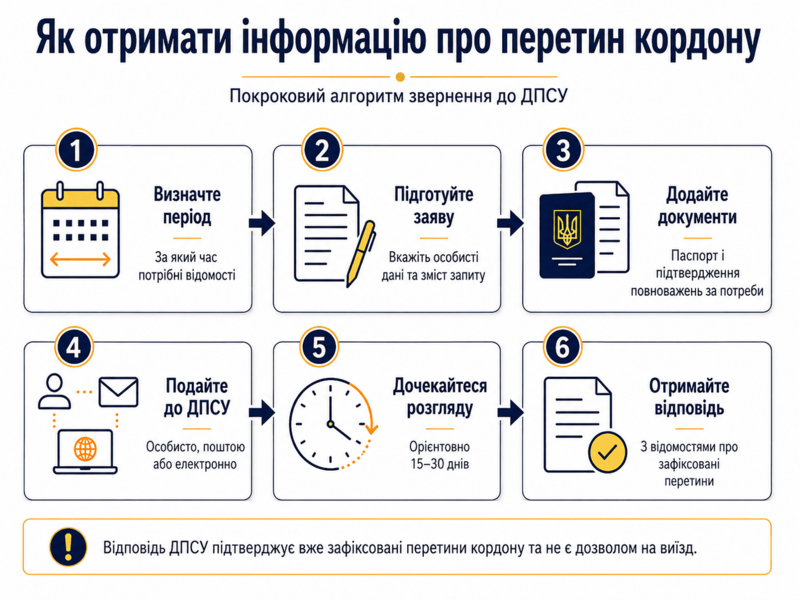
How to prepare an application for information
What data to indicate in the application
The application must indicate data that will allow the SBGS to identify the applicant and find the necessary information. In particular:
- full name;
- citizenship;
- date of birth;
- address of residence or stay;
- details of the passport or other document;
- the period for which the information is needed;
- clear content of the request;
- method of receiving the response;
- date and signature.
It is better to specify the period clearly, for example: «for the period from ..____ to ..____». This simplifies the search and reduces the risk of receiving incomplete or irrelevant information.
Where to get an application template
The SBGS publishes its own application template, so it is not worth creating an arbitrary document unless necessary.
Current official page:
Application regarding a person’s crossing of the state border of Ukraine — SBGS
https://dpsu.gov.ua/uk/zayava-stosovno-peretinannya-osoboyu-derzhavnogo-kordonu
The template is also available in the SBGS section «Citizens’ Appeals» → «Requirements for appeals and application templates». The official page separately states that a copy of the passport document for travelling abroad is attached to the application and, if necessary, other documents.
Before sending the document, it is advisable to open this page again: addresses, technical requirements, and submission methods of state authorities may change.
What documents must be attached to the application
There is no universal package for all cases. The list of documents depends on who applies, whether one’s own data or information about another person is requested, and the submission method.
| Who applies | What documents may be needed |
| A person regarding their own crossings | Application; copy of a passport document for travelling abroad; if necessary, copies of other documents needed for identification |
| Representative | Application; documents of the applicant and the person whose information is requested; document confirming the representative’s authority |
| Attorney | Documents confirming the attorney’s authority, and documents/information confirming legal grounds for obtaining the specific information |
| One of the parents or legal representative of a child | Documents allowing the child to be identified; copy of their passport document, if available; birth certificate or another document confirming the applicant’s status and authority |
The special SBGS page directly indicates a photocopy of the passport document for travelling abroad and provides for the possibility of attaching other necessary documents.
If during the required period the person had several foreign passports, it is advisable to indicate the details of all documents that could have been used to cross the border.
Review period, response format, and online receipt
How long the request is reviewed
Applications regarding information about crossing the state border are usually considered within one month from the date they are received by the SBGS. If the request does not require additional study, the response may be provided sooner — no later than 15 days.
If it is impossible to resolve the issue within a month due to the need for additional verification or processing of information, the review period may be extended. In this case, the applicant must be informed of the extension, and the total period must not exceed 45 days.
Separate deadlines are established for access to personal data: the possibility of satisfying such a request is examined within 10 working days, and the request itself, as a general rule, is satisfied within 30 calendar days from the date of receipt.
In practice, the SBGS itself has also indicated an approximate processing period for border crossing applications of 15–30 days.
Can information be obtained online or through Diia?
A request to the SBGS can be submitted electronically through the service’s official channels if the requirements for such a request are met and the necessary documents are attached.
At the same time, there is no open register where a person could independently view the full history of their border crossings. A separate personal account with such data is also not provided.
A separate service for obtaining a border crossing certificate or viewing the full history of entries and exits is not provided through the Diia application or portal. The applicant receives the finished response in the manner provided for the relevant request and specified in the application.
Why the SBGS may not provide information
Common reasons for refusal or return of a request
The SBGS may refuse to provide information or return the request if it concerns another person, but the applicant has not confirmed consent, representative authority, or another legal ground for obtaining personal data. Problems also arise if the submitted information does not make it possible to clearly identify the applicant or the person whose data are requested.
The absence of mandatory details, signature, copies of necessary documents, or an incomplete package of confirmations may be grounds for returning the request or delaying its review. In addition, before submission, it is worth checking the current SBGS channels and requirements, since using an outdated submission method may also complicate receiving a response.
What to do after a refusal
If the SBGS has not provided the necessary information, first it is necessary to determine whether this is a final refusal of access or deficiencies in the specific request.
The optimal sequence of actions:
- Obtain and check the reason for refusal. It is important to understand what exactly became an obstacle: documents, authority, person identification, or restrictions on access to information.
- Correct mistakes. If the problem is in the details or documents, prepare the correct package.
- Submit a repeated request. It is advisable to take into account all remarks stated in the previous response.
- Appeal the refusal if there are grounds. A decision regarding access to personal data may be appealed in the manner established by law.
- Apply to court or request the taking of evidence. If the information is needed for an already opened case and it is impossible to obtain it independently, the issue can be resolved through procedural means.
Typical mistakes when obtaining information
Even when the applicant has the right to the necessary information, incorrect preparation of the request may delay its receipt. The most common mistakes are:
- no specific period is indicated for which the information is needed;
- mistakes are made in the surname, date of birth, or passport details;
- the document is not signed where a signature is required;
- a copy of the passport document or other required documents is not attached;
- data of another person are requested without a legal basis;
- the representative’s authority is not confirmed;
- an outdated address or outdated submission method is used;
- the border crossing certificate is confused with permission to leave Ukraine.
Information about border crossing confirms only those entries and exits that have already taken place and were recorded by the SBGS. It is not a permit for future departure from Ukraine and does not replace the documents that must be presented during border control.
If the SBGS response is needed for a court, tax, social, or other procedure, it is worth determining in advance which specific fact must be confirmed and for what period. This will help formulate the request correctly and obtain the necessary amount of information.
Frequently Asked Questions
Can information about another person’s border crossings be obtained?
Yes, but only if there is consent, proper authority, or another legal ground. Border crossing data are personal data.
Can an attorney obtain border crossing data?
Yes, if they have proper authority and legal grounds. An attorney’s request itself does not provide automatic access to personal data.
Is the checkpoint always indicated in the SBGS response?
Not always. The content of the response depends on the request and the information available in the SBGS database.
Can information be obtained through Diia?
No. As of August 2026, there is no separate service in Diia for viewing border crossing history or obtaining such a certificate.
Can the SBGS response be used as evidence in court?
Yes. The court may take it into account as evidence together with other case materials.

Leave a request for consultation and our specialist will contact you soon!
Leave a request and our specialist will contact you soon!
More useful information




Fill out the form or contact us in any way convenient for you
Choose the nearest office to you and receive consultations in a convenient format for you