

TCC Wanted List: How to Remove the “Wanted” Status and Appeal a Fine
«TCC search» is not a criminal search. The TCC may transfer information about a person liable for military service to the National Police in connection with a possible violation of military registration rules, while Reserve+ only displays this data from «Oberih». A fine is imposed for a specific offense, not for the «wanted» status itself. If the record is erroneous or the violation is not proven, it can be appealed without automatically admitting guilt and paying the fine.

What the «wanted» TCC status means
«TCC search» is an everyday term. The TCC does not carry out a criminal search: it records a possible violation of military registration rules and, in cases provided for by law, applies to the National Police regarding administrative detention and delivery. Reserve+ only displays information from the «Oberih» register.
What the red banner in Reserve+ means
The red banner «Information is available about the TCC’s request to the National Police» means that a violation and a TCC request have been recorded in «Oberih». The reason can be viewed in the expanded eMRD data. The banner itself is not a fine resolution and does not automatically prove the fact of an offense.
How TCC search differs from criminal search
| Type of status | Reason | Who initiates it | Where it may be displayed | Consequences |
|---|---|---|---|---|
| So-called TCC search | Possible violation of military registration or mobilization duties | The TCC applies to the National Police | «Oberih», Reserve+, police information systems | Administrative detention and delivery, consideration of an administrative case |
| Criminal search | Criminal proceedings and procedural grounds | Investigator, prosecutor, or other authorized entities | Materials and systems of criminal proceedings | Criminal procedural consequences |
Why the TCC may put a person liable for military service on the wanted list
Non-appearance under a summons
The reason may be failure to appear under a properly served or sent summons without a valid reason. It is necessary to check the date, address, purpose of the call, and evidence of service. The absence of a personal signature by itself does not prove an improper call, since a summons may be sent by post.
Violation of military registration rules
The grounds may include failure to register for military service and other unfulfilled obligations. At the same time, a record in «Oberih» does not replace establishing the elements of an offense; the note to Articles 210 and 210-1 of the Code of Ukraine on Administrative Offenses regarding data that the state can obtain from other registers should also be taken into account.
Failure to undergo or refusal to undergo the MMB
The grounds may be failure to appear for the MMB after a proper referral or call. But the absence of an up-to-date MMB record by itself does not confirm the legality of the search: it is necessary to check the obligation to undergo the examination, the referral, notification, and possible valid reasons.
Outdated or erroneous data in the register
The status may appear due to erroneous or unsynchronized data: for example, absence of information about a fulfilled obligation, reservation, or MMB. In that case, it is necessary to confirm the correct information and demand that the register be updated.
Can a person with deferment or reservation be put on the wanted list?
Yes. Deferment or reservation resolves the issue of conscription for military service during mobilization, but does not cancel military registration duties. Therefore, a valid deferment may be displayed at the same time as information about a separate violation. The Ministry of Defense directly states that the existence of a deferment does not cancel liability for violation of military registration rules.
How to check whether you are wanted by the TCC
Checking through Reserve+
- Open the electronic military registration document in Reserve+.
- Go to the expanded information.
- Check whether there is a message about the TCC’s request to the National Police.
- View the reason for the violation, if it is displayed.
The reason for submitting information to the police is displayed in the expanded Reserve+ data.
How to find out the exact reason for the search
If the Reserve+ data is insufficient, it is worth contacting the TCC that created the record. In a disputed situation, it is better to do this in writing; a military attorney can request the grounds for entering the data, administrative case materials, and documents regarding the call.
It is not possible to check another person only by surname in an open state database. Unofficial Telegram bots and «draft dodger databases» are not a reliable source.
How to remove yourself from the TCC wanted list
There is no universal button for removing the status. The algorithm depends on the reason it appeared.
- Establish the reason. Check Reserve+, the date and grounds of the TCC’s request to the police. If the information is incomplete, obtain it directly from the TCC.
- Check whether there was a violation. Find out whether there was a proper call, an obligation to undergo the MMB or fulfill another requirement, and whether it had not been fulfilled earlier.
- Collect evidence. This may include documents on deferment or reservation, MMB results, postal documents, confirmation of a valid reason for non-appearance, and copies of previous applications.
- Eliminate the violation or appeal the record. If the violation is confirmed, fulfill the relevant obligation and resolve the issue of administrative liability. If the record is erroneous, demand its correction and, if necessary, appeal the decision or inaction.
- Check data updates. After resolving the situation, update the eMRD in Reserve+ and make sure the information in «Oberih» has been changed.
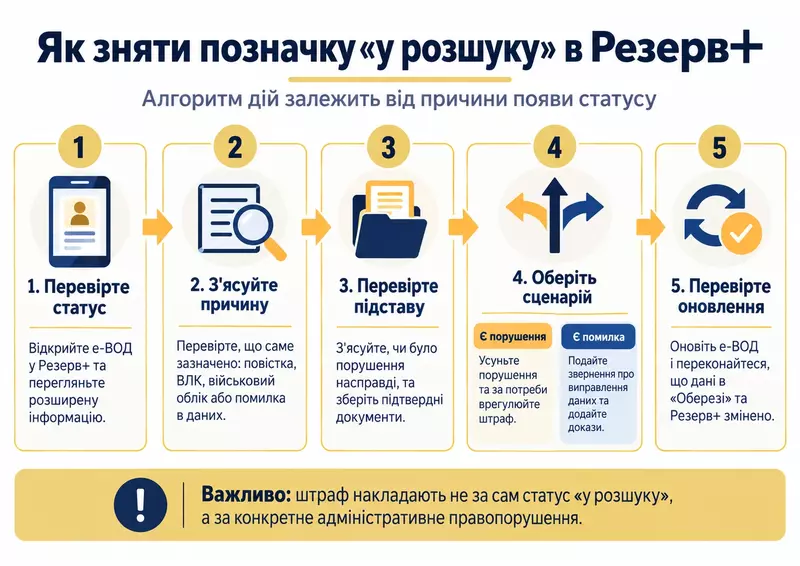
How to remove TCC search through Reserve+
When online data correction can be used
Reserve+ has services for correcting certain types of data, but there is no universal request to «remove search». If the reason lies in incorrect information, first it is necessary to check whether a corresponding online request is provided for such a case.
Depending on the situation, confirmation may include documents on deferment or reservation, undergoing the MMB, fulfillment of military registration requirements, or a valid reason for non-appearance. However, Reserve+ does not allow a random document to be simply attached for every scenario: some evidence will have to be submitted in another prescribed way.
Does submitting a request mean automatic removal from the wanted list?
No. Reserve+ is an interface to «Oberih» data, not a body that independently recognizes the TCC’s request as unlawful. The request starts verification or the relevant procedure, and the status will change after the data in the register are updated.
Can you remove yourself from the wanted list without a personal visit to the TCC?
When the issue can be resolved remotely
The issue can be resolved remotely if it is enough to correct data, use an available Reserve+ service, submit a written application, or settle a supported violation through «Fines Online». An attorney may request part of the information.
When personal appearance at the TCC is required
Personal appearance is required if, to eliminate the grounds, it is necessary to fulfill an obligation that cannot be fulfilled remotely or undergo a procedure requiring personal participation.
Fine for being wanted by the TCC: does it exist?
There is no fine specifically «for being wanted». Liability arises for a specific violation of military registration rules or legislation on defense, mobilization preparation, and mobilization.
For what violations can a fine be imposed?
Among the grounds are non-appearance under a summons without a valid reason, violation of military registration rules, failure to undergo the MMB when there is a relevant obligation, and other violations under Articles 210 and 210-1 of the Code of Ukraine on Administrative Offenses.
What is the amount of the fine?
For violations provided for by Articles 210 and 210-1 of the Code of Ukraine on Administrative Offenses committed by a citizen during a special period, the fine ranges from UAH 17,000 to UAH 25,500.
For violations that can be settled through Reserve+, after submitting an application recognizing the violation, payment of UAH 8,500 may be available — 50% of the minimum fine within the prescribed period.
How to pay a fine through Reserve+
In «Fines Online», it is necessary to select the violation and submit an application recognizing it. After review by the TCC, the resolution and the option to pay appear in the application. If the person disputes the violation, it is first worth assessing the grounds for appeal.
What happens to the status after paying the fine?
After the violation is closed, the data should be updated, and the red banner should disappear after synchronization. If this has not happened, the payment entry and the presence of other grounds should be checked. Payment of the fine does not cancel further military registration duties.
When can TCC search be removed without paying a fine?
If the violation was entered by mistake or is not confirmed by evidence
If the person fulfilled the obligation and the record appeared due to incorrect data, it is necessary to seek correction of that data. Likewise, a violation should not be automatically admitted if the TCC cannot confirm the circumstances on which it is based.
For example, in a dispute about non-appearance, evidence of a proper call matters. At the same time, the formula «I did not sign the summons — there is no violation» is incorrect, since the law provides for other methods of serving or sending it.
If there was a documented valid reason
A valid reason for non-appearance may exclude liability if it complies with legislation and is properly confirmed. It is important to keep documents on the relevant circumstances and evidence of notifying the TCC if such an obligation was provided for.
If the resolution was canceled or the limitation period for bringing to liability expired
After cancellation of the resolution, it is necessary to separately check whether the related record has been removed from «Oberih» and whether the grounds for police delivery have been terminated.
For violations under Articles 210 and 210-1 of the Code of Ukraine on Administrative Offenses during a special period, a penalty may be imposed within three months from the date of detection, but no later than one year from the date of commission. Therefore, there is no rule that «three months have passed — there will be no fine»: the date of commission, date of detection, and nature of the specific offense must be established.
How to appeal a TCC fine
When there are grounds for appeal
The grounds may include absence of the event or elements of an offense, failure to prove a proper call, erroneous data, failure to take into account a valid reason, procedural violations, or expiry of the limitation periods for bringing to liability.
What documents and evidence are needed
Depending on the case, these may include the TCC resolution, administrative case materials, eMRD and Reserve+ screenshots, summons and postal documents, medical documents, confirmation of deferment or reservation, MMB results, and correspondence with the TCC.
What is the deadline for appealing the resolution?
Under Article 289 of the Code of Ukraine on Administrative Offenses, a complaint against a resolution in an administrative offense case may generally be filed within 10 days from the date it was issued. Therefore, after receiving the resolution, it is advisable to immediately determine the method of defense and prepare evidence.
What to do if the appeal deadline has been missed
A missed deadline may be renewed if there are valid reasons. Along with the appeal, it is necessary to request renewal of the deadline and explain and confirm why timely filing was impossible.
What to do if TCC search was entered by mistake
- Take a screenshot of the electronic MRD and expanded data.
- Check the stated reason and date of the request to the police.
- Prepare documents that refute the violation.
- Submit a request for data correction through an available method.
- Keep the number, date, and confirmation of submission of the request.
- If there is no result, send a written request or attorney’s request.
- If the incorrect record is not removed and it violates rights, assess the possibility of going to court.
How to appeal unlawful TCC search in court
In what cases it is worth going to court
Judicial protection may be needed if the TCC does not correct inaccurate information, continues to store the record after cancellation of the administrative resolution, does not confirm the grounds for the request to the police, or effectively ignores a proper application.
What exactly can be demanded in the claim
Depending on the situation, the claim may raise the issue of declaring actions or inaction unlawful, obliging the authority to update or exclude certain information from the register, as well as taking related actions regarding information transferred to the police.
Specific claims must be formed according to the circumstances of the case: an incorrectly chosen method of protection may become a separate problem even when the register record is questionable.
What evidence to attach to the claim
It is worth attaching the eMRD and screenshots, TCC responses, copies of applications and attorney’s requests, documents on deferment, reservation or MMB, administrative case materials, postal evidence, and the decision canceling the fine, if it already exists.
Court practice regarding unlawful TCC search
Case No. 420/7396/26, decision dated 12.08.2026. The plaintiff had reservation, but saw a violation in Reserve+ due to alleged failure to undergo the MMB. After paying UAH 8,500, the record appeared again. The court established that the TCC had not sent a summons for the MMB, recognized the entry of the status as unlawful, and obliged the information to be excluded.
Case No. 420/17852/26, decision dated 12.08.2026. A record of non-appearance under a summons remained in «Oberih», although there was no evidence that it had been sent and that the person had been properly brought to liability. The court recognized the entry and storage of the information as unlawful and obliged the TCC to exclude it.
Court practice depends on specific evidence, so these decisions are not a universal algorithm.
Can a person wanted by the TCC be detained?
At the request of the TCC, the National Police may, in cases provided by law, carry out administrative detention and delivery of a person liable for military service to the nearest TCC. This is related to an administrative offense and is not a criminal arrest: administrative and criminal procedural detention have different grounds.
TCC search with deferment or reservation
Does deferment cancel a military registration violation?
No. A valid deferment does not annul a violation of military registration rules if it was actually committed. Therefore, deferment and a red banner in Reserve+ may exist at the same time.
What to do if there is valid reservation, but Reserve+ shows search
It is necessary to separately check two records: whether the reservation is displayed correctly and what exactly is the reason for the TCC’s request to the police. If the problem arose due to incorrect information about employment or reservation, confirm the current data. If the reason is different, resolve that specific violation.
Can deferment be issued or extended with the «wanted» status?
The right to deferment and violation of military registration rules are different issues. In 2026, depending on the grounds, deferments are issued through Reserve+ or ASC, and some are extended automatically. The violation status itself does not mean loss of the legal ground for deferment.
TCC search and AWOL: what is the difference
| TCC search | Search in criminal proceedings for AWOL |
|---|---|
| Related to a possible administrative violation | Related to criminal proceedings |
| The TCC applies to the National Police | Procedural decisions are made within criminal proceedings |
| Information may be displayed in «Oberih» and Reserve+ | Status is determined by the materials of criminal proceedings |
| Fine, administrative detention, and delivery are possible | Criminal procedural consequences are possible |
| The ground is eliminated or appealed administratively/in court | Search is terminated according to criminal procedure rules |
Is AWOL visible in Reserve+?
Reserve+ does not make it possible to reliably establish the existence or absence of criminal proceedings for AWOL. Separate information in other military systems also does not replace checking procedural status.
How to check whether a servicemember is wanted because of AWOL
The check depends on the stage of the proceedings and may be carried out through procedural documents, the pre-trial investigation body, or an attorney. The absence of information in an open search does not guarantee the absence of proceedings. Payment of a TCC fine does not close criminal proceedings for AWOL.
What to do if a person is abroad and sees the «wanted» status
While abroad, first check the reason in Reserve+, save the eMRD, and identify the TCC that created the request. Then you can use an available online service, written application, or attorney’s request. If a personal action is required to eliminate the violation, it will not be possible to fully resolve the issue remotely.
Typical mistakes when trying to remove TCC search
- immediately admitting the violation and paying the fine without checking its grounds;
- confusing an administrative situation with a criminal search;
- believing that deferment or reservation automatically annuls any registration violation;
- ignoring the red banner in Reserve+;
- using unofficial «draft dodger databases»;
- not keeping screenshots, resolutions, receipts, and confirmations of applications;
- filing a claim without correctly identifying the defendant and method of protection.
FAQ
Can the «wanted» status disappear from Reserve+ on its own?
Yes, if the grounds have been eliminated and the TCC has updated «Oberih». If the record is erroneous, it is not worth waiting for it to disappear automatically without an application.
Why did the red banner not disappear immediately after paying the fine?
There may be a synchronization delay or the TCC may not have entered the payment information. Also check whether there is another ground.
Can a person be put on the wanted list again after paying a fine?
Yes, if a new ground arises or another violation remains. Payment of one fine does not release a person from further registration duties.
What to do if the reason for the violation is not displayed in Reserve+ at all?
Save a screenshot and contact the TCC for the grounds and date of the request to the police. If necessary, an attorney may request the information.
Is it necessary to keep the resolution and receipt after paying the fine?
Yes. The resolution and receipt confirm the grounds for the fine and its payment if the register is updated with a delay.
Can an employer see that an employee is wanted by the TCC?
There is no open search by surname. But when maintaining military registration, the employer works with the MRD, where information about violations may be displayed.
Can an attorney find out the reason for the search without the personal presence of the person liable for military service?
Yes, an attorney may obtain information through attorney’s requests, but cannot perform an obligation requiring personal participation instead of the client.
What to do if the TCC that put the person on the wanted list is located in another region?
Contact primarily the TCC that created the record. Some issues can be resolved in writing or through an attorney; a personal visit depends on the reason for the status.

Leave a request for consultation and our specialist will contact you soon!
Leave a request and our specialist will contact you soon!
More useful information




Fill out the form or contact us in any way convenient for you
Choose the nearest office to you and receive consultations in a convenient format for you