

ECOPFO: What It Is, How to Get a Referral, the Process for Military Personnel, and an Excerpt
After prolonged treatment, a serious illness, or an injury, it may become necessary to establish disability, determine the degree of loss of working capacity, or assess rehabilitation needs. This requires undergoing an EKOPFO assessment, a procedure with specific features for civilians and servicemembers.
In this article, we will examine who can issue a referral for EKOPFO in 2026, what documents need to be prepared, how the assessment is conducted, how long it takes, and how to obtain an extract from the expert team's decision.
What Is EKOPFO?
Expert Team for the Assessment of Person's Everyday Functioning (Ukrainian abbreviation: EKOPFO). refers to expert teams that assess a person's everyday functioning. They operate in designated healthcare facilities and, since January 1, 2025, have performed the functions previously assigned to medical and social expert commissions (MSEC).
In addition to establishing disability, the teams determine the degree of loss of occupational working capacity and rehabilitation needs in cases provided for by law.
What Does EKOPFO Assess?
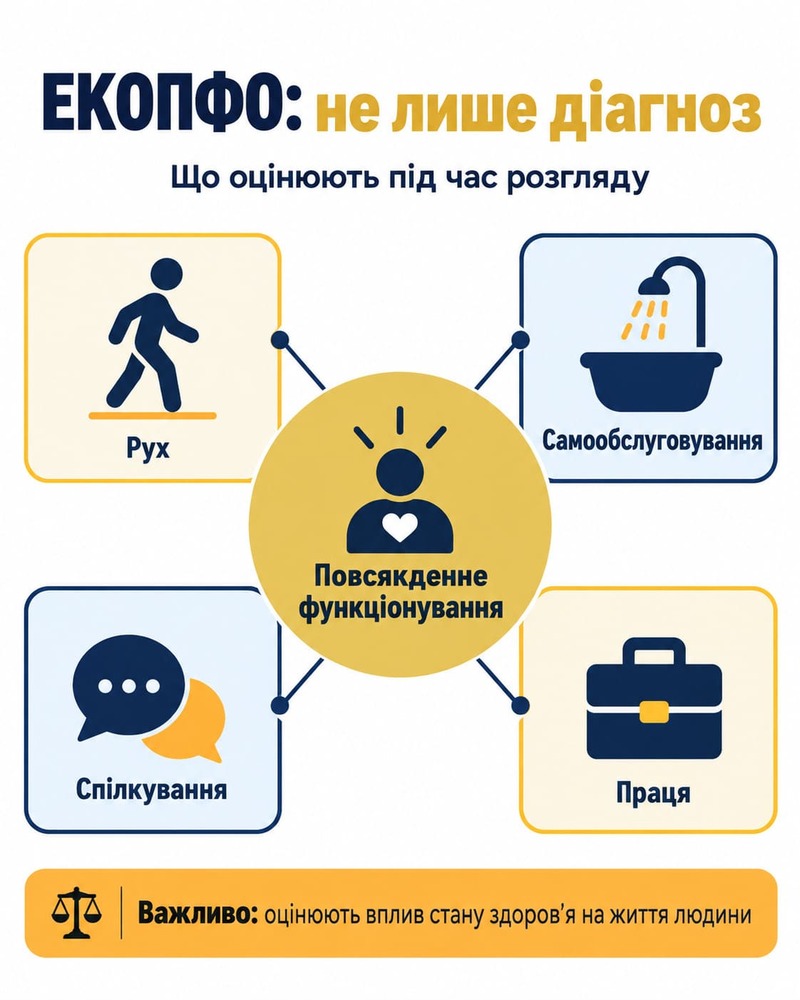
The expert team considers the diagnosis, course of the disease, and treatment results, but the main factor is the degree of limitation of everyday functioning. In particular, the assessment covers a person's ability to move, care for themselves, communicate, study, work, navigate their surroundings, and perform everyday activities without outside assistance.
Therefore, what matters is not only the medical name of a condition but also documented functional impairments, their duration, and severity.
What Decisions Can EKOPFO Make?
Depending on the purpose of the referral, the expert team may:
- establish or refuse to establish disability and determine disability group I, II, or III;
- determine the cause, date of onset, and duration of disability, as well as the need for reassessment;
- establish the degree of permanent loss of occupational working capacity in applicable cases;
- consider matters relating to prolonged temporary incapacity for work as defined by law;
- provide recommendations regarding rehabilitation, assistive devices, care, and support.
Not every case covers all these matters: the scope of conclusions depends on the purpose of the referral and the documents collected.
How Does EKOPFO Differ from MSEC?
| Criterion | MSEC | EKOPFO |
|---|---|---|
| Who reviews the case | Medical and Social Expert Commission | Expert team at a healthcare facility |
| Referral | Primarily paper-based documentation | Electronic referral and case file |
| Subject of assessment | Medical and social examination | Impact of health conditions on everyday functioning |
| Assessment formats | Primarily in-person attendance | In-person, remote, on-site, and document-based |
| Final document | MSEC certificate and other documents | Decision, extract, and recommendations |
| Appealing a decision | Under the previous procedure | Through the Assessment Center or court |
If disability has been established indefinitely, the transition to EKOPFO alone does not require a person to undergo a new assessment.
When Is a Person Referred for EKOPFO?
Main Criteria for Referral
The grounds are established by the Criteria for Referral for Assessment of Everyday Functioning, approved by CMU Resolution No. 1338. The main situations are as follows:
- Persistent or irreversible impairments of bodily functions. If an illness, injury, or anatomical defect causes long-term functional limitations, the doctor checks whether the referral criteria are met.
- Prolonged temporary incapacity for work. The established thresholds include 120 calendar days of continuous incapacity for work or 150 calendar days with interruptions due to the relevant illness. Special rules apply to certain conditions; in particular, a period of 10 months is provided for tuberculosis.
- Reassessment. It is required within the established period if disability was not granted indefinitely, or on other grounds provided for by law, such as changes to certain circumstances recorded in the decision.
- Specified diseases, conditions, and medical interventions. In cases listed in the current criteria and annexes to Resolution No. 1338, there is no need to wait for the general period of incapacity for work.
The doctor determines whether the criteria are met based on current medical information rather than the diagnosis alone.
Who Is Authorized to Issue a Referral?
A referral is issued by the attending physician providing primary or specialized medical care who manages the person's underlying illness or injury. In cases provided for by law, it may be issued by the chairperson of a military medical commission, medical (military medical) commission, or another authorized medical expert commission.
A family doctor may issue a referral when they are responsible for managing the relevant condition and have the necessary documents. However, a family doctor is not obliged to refer every patient solely upon request without medical grounds.
Referral for EKOPFO: How It Is Issued
How an Electronic Referral Is Created
The doctor checks the criteria, determines the purpose of the assessment, completes the electronic form, and attaches documents to the case in the EKOPFO system. Together with the patient, they select a healthcare facility that has an expert team with the required specialization. There is no need to submit a separate paper case file to the former MSEC.
It is important to agree with the doctor in advance on the specific matter the team must decide: initial establishment of disability, reassessment, change of disability cause, determination of loss of working capacity, or another permitted purpose.
What Information Must the Referral Contain?
The form approved by Ministry of Health Order No. 2067 provides for personal and contact information, the purpose of the referral, information about the underlying illness or injury, associated conditions, treatment, examination results, and rehabilitation. Information about bodily function impairments and limitations in daily activities that justify the assessment is mandatory.
The old Form 088/o is not a universal referral form under the current procedure. Information is entered using the current electronic form.
What Documents Are Attached to the Referral?
The basic document package depends on the purpose of the assessment. It usually includes:
- an identity document and the necessary identification details;
- outpatient or inpatient treatment discharge summaries;
- conclusions from relevant medical specialists;
- results of laboratory, instrumental, and functional examinations;
- records of surgery, treatment, and rehabilitation;
- previous MSEC or EKOPFO decisions, if the assessment is repeated;
- other documents confirming the cause of disability or circumstances of the injury.
Check the dates, patient details, readability of scanned documents, and availability of examination results relevant to your condition.
What Happens If the Referral or Documents Are Incomplete?
The healthcare facility administrator may return the case to the doctor for revision, specifying the reasons. For example, mandatory information may be missing, the referral criteria may not be confirmed, or uploaded documents may be unreadable. It is necessary to clarify the deficiencies, supplement the medical records, and resubmit the referral.
Returning the documents is not a decision to deny disability status: the expert team has not yet assessed the merits of the case.
How EKOPFO Is Conducted: Step-by-Step Procedure
The general procedure consists of eight steps:
- The doctor establishes the medical grounds for referral.
- Medical documents are collected, and the purpose of the assessment is determined.
- An electronic referral is created, and a healthcare facility is selected.
- The administrator checks the materials and accepts the case for review.
- The case is added to the electronic queue, and the date and format are scheduled.
- The expert team reviews the documents and assesses the person's condition.
- If necessary, additional examinations are prescribed.
- The team makes a decision, and the person receives an extract and recommendations.
Choosing a Healthcare Facility
The facility is selected from the list of institutions with expert teams of the appropriate specialization. There is no exclusive territorial restriction based on the person's registered place of residence. However, a person cannot select an arbitrary facility that does not have a team with the required specialization.
The patient chooses the facility, not the individual members of the expert team. The Ministry of Health publishes the list of facilities and specializations. If the person's condition prevents them from attending in person, the assessment format should be discussed with the doctor when preparing the referral.
Administrative Review of the Case
Within five working days, the administrator checks the completeness of the documents, the correctness of the referral, and compliance with the established requirements. The administrator either accepts the case or returns it to the doctor with comments. Once accepted, the materials enter the electronic queue, where the review date and the composition of the team with the appropriate specialization are determined.
Notification of the Assessment Date and Format
After the case is accepted, information about the date, time, place, and format of the assessment is sent to the email address specified in the referral. If no email address is available, a registered letter is sent to the specified address. The doctor who issued the referral can also clarify this information.
EKOPFO Assessment Formats
| Format | How It Is Conducted | When It Is Used |
|---|---|---|
| In-person | The person visits the facility and meets with the team | When a direct assessment and examination are required |
| Remote | Video communication with the team using telemedicine | In specified cases, including residence abroad or certain assessment purposes |
| On-site | The team assesses the person at their place of residence, stay, or treatment | When inability to attend is documented or other established grounds apply |
| Document-based | Documents are reviewed without the person's presence | When the case meets the criteria for document-based assessment |
The format is determined according to the criteria of Resolution No. 1338, taking into account the person's condition and medical records. The patient may express a preference but does not have an unconditional right to choose any assessment format.
How Long Does the Case Review Take?
As a general rule, the review must be completed no later than 30 calendar days from the date the healthcare facility accepts the electronic referral for consideration. This is not the date of the first doctor's visit and not necessarily the date the referral was created. The starting point is the administrator's confirmation that the completed case has been accepted.
If additional examinations are required, the review is suspended, and a separate 30-day period applies after they are completed. The procedure provides special rules for postponement or suspension in other objective circumstances.
When Can Additional Examinations Be Required?
Additional examinations are prescribed if the available information is insufficient for a well-founded decision: for example, an important examination result is missing, documents contradict one another, or the degree of functional impairment needs clarification. As a general rule, such a referral is allowed once; a repeated referral is permitted only in specified exceptional circumstances.
EKOPFO for Servicemembers
Servicemembers undergo assessment under Resolution No. 1338, but the referral process and required documents may differ from those for civilians. Not only the medical consequences of an injury matter, but also documents concerning the circumstances of the injury and its causal connection with military service.
Who Refers a Servicemember for EKOPFO?
The electronic referral is created by the attending physician managing the underlying illness or injury, or by the chairperson of the VLK in cases provided for by law, based on the results of a military medical examination.
The commander and military unit do not independently create EKOPFO referrals. They may organize referrals for treatment, VLK examinations, and preparation of service-related documents. In addition, servicemembers do not always need to wait for the general 120-day period of incapacity for work: other referral criteria apply to certain conditions.
If the Servicemember Is Receiving Inpatient Treatment
During treatment following an injury or illness, it is advisable to contact the attending specialist. The doctor assesses whether there are grounds for EKOPFO, analyzes treatment results and identified functional impairments, and prepares an electronic referral.
The practical procedure is to inform the doctor of the need for assessment; check the availability of discharge summaries and examination results; provide VLK documents and records concerning the circumstances of the injury, if relevant; and agree on the facility and permissible assessment format. If the person cannot move independently, this should be medically documented to determine whether an on-site or another permitted assessment format is appropriate.
If the Servicemember Is at a Military Unit
If a servicemember is serving in a military unit and experiences consequences of an injury or illness, the first step is usually to seek medical care. If necessary, they submit a written report requesting treatment or a referral to the VLK, attaching available medical documents.
If the EKOPFO criteria are met, the referral is issued by an authorized doctor or the VLK chairperson in the relevant case. A report submitted to the commander is not an electronic referral for assessment.
If the Servicemember Has Already Been Discharged from Service
After discharge, a person may contact a civilian healthcare facility and an attending physician who manages the consequences of the injury or illness. The doctor creates an electronic referral under the general procedure if the medical criteria are met.
It is advisable to retain and provide hospital discharge summaries, VLK resolutions, documents confirming causal connection, treatment, and rehabilitation. At the same time, EKOPFO does not replace the procedure for confirming causal connection, which falls within the competence of the VLK.
What Documents Does a Servicemember Need?
Depending on the purpose of the assessment, the following may be required:
- passport and military registration documents, if relevant to the case;
- hospital discharge summaries, specialist conclusions, and examination results;
- medical certificate of illness, certificate, or other VLK documents;
- an extract from the protocol of the regular VLK concerning causal connection;
- a certificate of the circumstances of injury, wound, concussion, or bodily harm;
- documents confirming participation in combat operations or performance of national defense duties;
- records of treatment, prosthetics, and rehabilitation;
- previous MSEC or EKOPFO decisions, if available.
This is a list of potentially required documents, not a mandatory list for every servicemember. For example, documents concerning a combat injury are important for establishing the corresponding cause of disability but are unnecessary for someone whose case is unrelated to such circumstances.
Pay particular attention to the wording of the causal connection. A VLK conclusion establishing that an injury is related to the defense of the Homeland and other formulations may have different legal consequences when applying for payments.
VLK and EKOPFO: What Is the Difference?
| VLK | EKOPFO |
|---|---|
| Conducts military medical examinations | Assesses everyday functioning |
| Determines fitness for military service | Determines whether disability should be established |
| Establishes the causal connection of illnesses and injuries with service within its competence | Considers relevant documents when determining the cause of disability |
| Issues VLK resolutions and documents | Issues decisions, extracts, and recommendations |
| Does not establish a disability group | Does not determine fitness for military service |
Having a disability does not in itself constitute a resolution declaring a person unfit for military service or an order of discharge.
If a servicemember disagrees with a VLK resolution, they may use the procedure for appealing a VLK decision.
Rights During the EKOPFO Assessment
A person has the right to be informed about the date and format of the assessment, submit relevant documents, receive the result, and use the available mechanisms for appealing it. During an in-person, on-site, or remote assessment, an authorized representative, including an attorney, may be present, provided that their authority and the required application have been properly documented.
The person or their representative may make audio and video recordings in accordance with the procedure established by law and record permitted documents. Since January 1, 2026, audio recording of in-person, on-site, and remote assessments by the expert team itself has been mandatory; this requirement does not apply to document-based assessments. A copy of the recording may be requested from the healthcare facility under the established procedure. Following the assessment, the person receives an extract from the decision and relevant recommendations.
What Decision Does EKOPFO Make?
What May Be Included in the Decision?
The content depends on the purpose of the referral. In a disability case, the decision may include a conclusion on whether disability is established, the disability group, cause, date of onset, duration, and other required information. For other purposes, it may determine the degree of permanent loss of occupational working capacity, matters relating to prolonged temporary incapacity for work, the need for care, and recommendations regarding rehabilitation or support.
When disability is established, separate recommendations are prepared as part of the individual rehabilitation program.
When Is the Decision Made?
The team analyzes the materials and makes a collective decision during the case review; the relevant information is entered into the electronic system. If additional examinations are prescribed, the review is suspended until the results are received, after which it is completed within the prescribed period.
Extract from an EKOPFO Decision: What Is This Document?
An extract from an EKOPFO decision is an official document in the prescribed form that reflects the assessment results. However, there are differences between the documents:
- Expert team decision — the complete formalized result of the case review.
- Extract from the decision — information provided in the prescribed form and issued to the person for subsequent procedures.
- Recommendations — a separate document concerning rehabilitation and other needs; when disability is established, they form part of the individual rehabilitation program.
The extract is prepared using the form established by Ministry of Health Order No. 2067, and the information it contains depends on the decision actually made.
What Does the EKOPFO Extract Contain?
Under the current form, the extract contains the person's identification details, information about the assessment and expert team's decision, the decision date, and other required details. Depending on the purpose of the assessment, it specifies whether disability was established, its group, cause, date of onset, and duration, results concerning occupational working capacity, or other relevant circumstances.
Servicemembers should pay particular attention to checking the established cause of disability and its consistency with VLK documents.
How to Obtain an Extract
After the decision is finalized, the extract and, if available, recommendations are sent to the email address specified in the referral. The electronic PDF is certified with the electronic seal of the Ministry of Health. If no email address is available, the documents may be sent by registered mail to the specified address within the established five-day period.
A paper extract may be obtained upon request through the doctor who referred the person for assessment or an authorized representative of the healthcare facility where the team operated. The printed document is certified in accordance with Order No. 2067. Losing the paper copy does not invalidate the decision itself: the extract can be obtained again under the established procedure.
What Is the Extract Needed For?
The extract and information about the decision may be used when applying for a disability pension, social assistance, benefits, rehabilitation, assistive devices, and other procedures requiring confirmation of established circumstances.
For servicemembers, the extract is also important when applying for applicable payments and social guarantees related to disability. However, the extract alone does not guarantee automatic approval of a particular benefit: a VLK resolution, documents confirming causal connection and military service, and other evidence may also be required.
What to Do After Receiving the EKOPFO Extract
Check the document immediately, before submitting it for pension or social benefit procedures:
- Verify your full name, date of birth, and other personal details.
- Compare the decision with your medical documents.
- Check the disability group, cause, date of onset, duration, and other established circumstances.
- Read the recommendations concerning rehabilitation and support.
- Save the electronic copy and obtain a paper copy if necessary.
- Clarify the document package required for the specific pension, payment, or service.
If the extract is intended for a servicemember, separately verify that the cause of disability corresponds to the VLK conclusions.
What to Do If the Extract Contains an Error or You Disagree with the Decision
Technical Error in the Extract
A spelling error in the person's name, an incorrect date, or another technical inaccuracy is not the same as disagreement with a medical conclusion. Contact the healthcare facility where the expert team operated and provide evidence of the correct information. The procedure provides for correcting clerical and arithmetic errors without repeating the full assessment.
Appealing an EKOPFO Decision
If you disagree with the decision, you may file a complaint with the Center for Assessment of a Person's Functional Condition or challenge the decision in court. The complaint must be submitted within 40 calendar days from the date the extract was sent to the person or their representative, together with justification and supporting documents.
Common Mistakes During the EKOPFO Assessment
- Focusing only on the diagnosis. A diagnosis without information about functional impairments does not show how much the condition limits everyday life. Medically documented consequences are required.
- Failing to check the referral attachments. The team may not receive important examination results or discharge summaries. Before submission, clarify the contents of the electronic case file with the doctor.
- Waiting for a referral from the commander. A military unit does not create electronic EKOPFO referrals. Contact the attending physician or the VLK when the relevant grounds exist.
- Confusing the VLK with EKOPFO. Fitness for military service is not determined by the expert team, and the VLK does not establish a disability group.
- Following outdated MSEC instructions. Requirements to always submit Form 088/o or undergo unnecessary commissions may not comply with the current procedure.
- Not reading the extract after receiving it. An incorrectly specified disability duration or cause may complicate payment applications. Check the document immediately.
- Appealing a clerical error instead of correcting it, or vice versa. A technical inaccuracy and disagreement with a medical decision require different actions; first determine the nature of the problem.

Frequently Asked Questions About EKOPFO
Is It Necessary to Undergo EKOPFO Again If MSEC Established Disability Indefinitely?
No. Replacing MSEC with the EKOPFO system does not in itself require people with indefinitely established disability to undergo reassessment. Previously issued documents remain valid. A new review is possible on separate grounds provided by law, including when established circumstances need to be changed.
Can a Person Undergo EKOPFO While Abroad?
Yes. The procedure depends on the country of residence, international agreements, and the type of benefits. Medical documents, their proper translation into Ukrainian, and submission to the doctor or through a mechanism established by an international agreement are usually required. Under specified conditions, the assessment may be conducted without personal attendance or using telemedicine; a person cannot freely choose any format.
What If the Phone Number or Email Address Changes After the Referral Is Created?
Inform the doctor who issued the referral or the healthcare facility administrator. Ask them to check and, if possible, update the contact information according to the stage of the case. Otherwise, you may miss the assessment notification or the extract from the decision.
Can the Healthcare Facility Be Changed After the Referral Has Been Accepted?
Once the case has been accepted, changing the facility is not simply a matter of selecting another hospital. Contact the administrator and the doctor who created the referral to clarify the permitted procedure for changing the facility or resubmitting documents. The possibility depends on the stage of the review and specific circumstances.
What If a Person Cannot Attend the Assessment on the Scheduled Date Due to Illness, Hospitalization, or Other Valid Circumstances?
Notify the administrator in advance and provide documents confirming the reason for non-attendance. The review may be postponed if valid circumstances exist. If the person fails to report the situation and repeatedly does not appear, this may lead to termination of the current review and the need to submit a new referral.
Can an Authorized Representative Obtain the Decision Extract on Behalf of the Person?
Yes, if the representative has properly confirmed their authority, for example, through legal representation documents, a power of attorney, or attorney credentials. The specific method of issuance should be agreed with the healthcare facility; access to medical information without an appropriate legal basis is not permitted.
Does an EKOPFO Decision Become Invalid If the Paper Extract Is Lost?
No. Losing the paper copy does not invalidate the decision, information about which remains in the electronic system. Request a new extract from the doctor or an authorized representative of the relevant healthcare facility. The validity of the established disability depends on the decision and the law, not on keeping the paper document.
Do Employers, Banks, or the TCC Have Direct Access to the Full EKOPFO Decision?
They do not have general unrestricted access to the full decision and all medical information. Employers and banks may obtain only documents or information necessary for a lawful purpose. Special information exchange and separate forms of transmitting results are provided for the TCC and SP, but this does not mean unrestricted access to the entire medical case file.

Leave a request for consultation and our specialist will contact you soon!
Leave a request and our specialist will contact you soon!




Fill out the form or contact us in any way convenient for you
Choose the nearest office to you and receive consultations in a convenient format for you