

Prenuptial Agreement: What to Include and How to Draft It
A prenuptial agreement in Ukraine helps spouses determine who owns specific property, how joint expenses will be covered, and what happens to assets in the event of divorce. It can be concluded either before or after marriage registration, but only within the limits established by the Family Code of Ukraine.
Key Points at a Glance:
- Defines property rights, including ownership, division of assets, financial support, and housing arrangements.
- Must be concluded in writing and notarized.
- If signed before marriage, it takes effect on the date of marriage registration; if signed during marriage, it takes effect on the date of notarization.
- Cannot regulate personal relationships, restrict children's rights, or directly transfer ownership of real estate.
- It is advisable to consult a lawyer before signing, especially if you own a business, have loans, or own real estate.

What Is a Prenuptial Agreement and Who Really Needs One?
A prenuptial agreement is a notarized agreement governing spouses' property rights and obligations under Articles 92–103 of the Family Code of Ukraine. It is voluntary and does not replace marriage registration.
It is particularly useful in the following situations:
- Business or company ownership: when it is necessary to determine the legal status of corporate assets and income.
- Real estate acquired before marriage: when spouses want to agree on its use, renovation, and related expenses.
- Second marriage and children from a previous relationship: when it is important to keep assets separate without attempting to replace a will.
- Loans: spouses can allocate financial obligations between themselves but cannot eliminate creditors' rights.
- Gifts from parents: when it is necessary to establish the intended recipient and the origin of funds or housing.
If there are no complex assets or debts and both spouses are satisfied with the statutory property regime, an agreement may not be necessary.
When Should You Sign an Agreement: Before or During Marriage?
An agreement may be concluded by engaged couples who have submitted an application for marriage registration or by spouses who are already legally married (Article 92 of the Family Code of Ukraine). Simply living together is not sufficient.
| Question | Before Marriage Registration | During Marriage |
|---|---|---|
| When it can be signed | After submitting an application to the Civil Registration Office | At any time during a legally registered marriage |
| When it takes effect | On the date of state marriage registration | On the date of notarization |
| What happens to previously acquired property | The legal status of premarital property is taken into account | It is necessary to verify separately whether the agreement covers previously acquired property |
If either party is a minor before marriage, notarized consent from their parents or legal guardian is required.
The agreement must be signed in person. According to the Supreme Court's position, concluding a prenuptial agreement through a representative acting under a power of attorney is grounds for declaring it invalid.
For previously acquired property, it is necessary to verify the acquisition date, source of funds, and whether the terms of the new agreement apply to that property.
What to Include in a Prenuptial Agreement: 8 Common Provisions
The provisions should be tailored to specific assets. A standard prenuptial agreement template cannot account for individual property arrangements and risks.
- Property ownership regime. Define joint ownership, shared ownership, and separate property, for example, regarding vehicles or a future home.
- Premarital property, gifts, and inheritance. Such assets are generally considered separate property under the law. The agreement clarifies their use, joint investments, and the ownership status of gifts received by both spouses.
- Property division upon divorce. Establish ownership shares, compensation payments, and settlement deadlines. The provisions must not place either party in an extremely disadvantageous position.
- Use of housing. Agree on living arrangements, housing expenses, and conditions for vacating the property after divorce, including possible compensation (Article 98 of the Family Code of Ukraine).
- Spousal maintenance and alimony. Establish the amounts and duration of spousal maintenance under Article 99 of the Family Code of Ukraine; children's property rights cannot be restricted.
- Loans and debts. Determine who makes payments and reimburses expenses; obligations to banks do not automatically disappear.
- Business interests and ownership shares. Clarify the status of interests in limited liability companies, dividends, investments, and income from sole proprietorships, taking corporate law restrictions into account.
- Duration of the agreement. Specify its overall duration and the period during which individual obligations remain effective, including after divorce.
For example, a couple plans to purchase an apartment, but one partner contributes 70% of the funds while the other contributes 30%. Without additional arrangements, housing acquired during marriage will generally be considered jointly owned marital property. A prenuptial agreement allows the spouses to establish a different ownership regime for the future purchase in advance, including each spouse's share. However, it is important to properly document the real estate purchase itself, since a prenuptial agreement does not replace property ownership documents.
Examples of provisions to discuss with a lawyer:
- «Property acquired by [name] after notarization of this agreement using their own funds shall constitute the separate personal property of [name], except for assets expressly designated by the parties as jointly owned.»
- «The parties shall cover the maintenance expenses of [property] in the proportions of [share] and [share], unless otherwise agreed in writing.»
- «In the event of divorce, [name] shall pay [name] compensation of UAH [amount] within [period] following the occurrence of the event specified in this agreement.»
- «[Name] shall provide [name] with monthly maintenance of UAH [amount] until [date/event].»
These are examples, not a ready-to-sign agreement. The final provisions must be reviewed for legality, clarity, and a fair balance of the parties' interests.
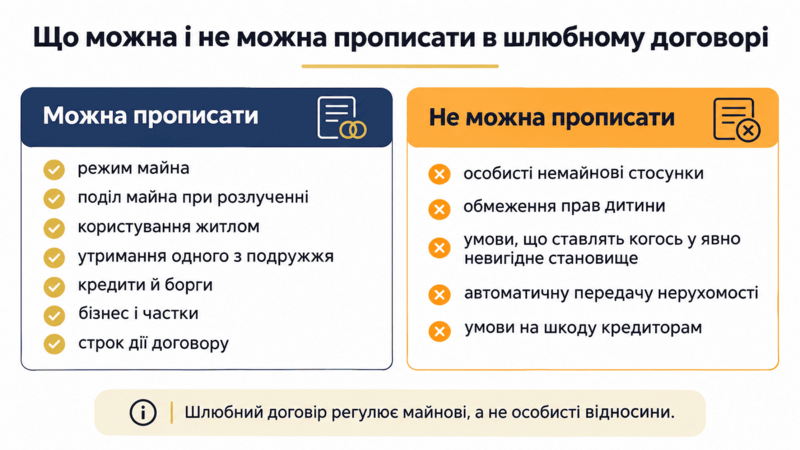
What Cannot Be Included in a Prenuptial Agreement?
Article 93 of the Family Code of Ukraine allows spouses to regulate property matters, but not every aspect of family life. Prohibited provisions include:
- Personal relationships: requirements to remain faithful or prepare dinner.
- Relationships with children: predetermining a child's place of residence or prohibiting contact with a parent.
- Restrictions on children's rights: releasing a parent from the obligation to provide financial support for a child.
- Extremely disadvantageous conditions: depriving one spouse of practically all property without sufficient grounds. Unequal ownership shares alone do not establish such disadvantage.
- Direct transfer of real estate: a provision stating that «the apartment shall become the property of [name]» does not replace a separate legal transaction and property registration.
- Harm to creditors: changing the ownership status of assets to avoid debt collection.
It is important to distinguish unequal property distribution from an extremely disadvantageous financial position. The law does not require each spouse to receive exactly half of the assets. The parties may voluntarily agree on different shares. However, if the provisions create a substantial property imbalance and effectively deprive one party of a significant portion of their property rights, this may give rise to a court dispute. The court evaluates not only an individual provision but also the circumstances of the case and evidence of its consequences.
A court may declare an individual provision or the entire agreement invalid, depending on the violation and whether the disputed provision can be separated from the rest of the agreement.
How to Conclude a Prenuptial Agreement: Step by Step
To conclude an agreement, the parties must agree on property-related provisions, prepare the necessary documents, and visit a notary.
- Discuss your property: list apartments, vehicles, deposits, business interests, and loans.
- Prepare a draft: document the terms, deadlines, exceptions, property division arrangements, and payments.
- Gather documents: verify personal information and property ownership rights.
- Visit a notary: the notary will verify the parties' identities and review the agreement's provisions.
- Sign the agreement: each party receives an original copy, while the notary retains the third.
Document checklist:
- passport or ID card of each party;
- taxpayer identification number (RNOKPP), if applicable and subject to statutory exceptions;
- marriage certificate or confirmation that an application for marriage registration has been submitted;
- ownership documents for the assets mentioned in the agreement and, where necessary, information about loans and corporate rights;
- notarized consent from parents or a legal guardian if required for a minor.
If the draft is ready, notarization may be completed during a single visit. Negotiating complex provisions may take longer. There is no fixed timeframe.
How Much Does a Prenuptial Agreement Cost?
There is no single fixed price. The cost depends on the notary, preparation of the draft, and additional services.
| Cost Component | How the Cost Is Determined |
|---|---|
| State duty | For notarization of relevant agreements not subject to valuation, the fee is one non-taxable minimum income amount, equivalent to UAH 17 as of November 11, 2026 |
| Additional services provided by a state notary | A separately established fee for legal and technical services |
| Private notary | The notarization fee is determined by agreement with the client; there is no universal rate |
| Lawyer or attorney | Fees for analyzing property, preparing the draft, and negotiating provisions are determined by agreement |
| Additional documents | Where necessary, fees for extracts, translations, document certification, and other separate procedures |
Sources: subparagraph «e» of paragraph 3 of Article 3 of the Cabinet of Ministers Decree «On State Duty», Articles 19 and 31 of the Law «On Notaries». UAH 17 is only the state duty, not the final cost of a prenuptial agreement. Request a complete cost estimate before notarization.
For complex arrangements, a family law attorney can help review the draft. «Pravovyi Lider» offers a free initial consultation.
If you are unsure whether the provisions are lawful, contact «Pravovyi Lider» for a free initial consultation.
How to Amend or Terminate a Prenuptial Agreement and What Happens Upon Divorce
The agreement may be amended through a joint notarized agreement. Unilateral amendments or withdrawal are prohibited, but spouses may jointly agree to terminate the agreement before a notary. Where substantial grounds exist, amendment or termination may be possible through court proceedings.
The need to review an agreement may arise after the birth of a child, the purchase of a new home, the establishment of a business, or a significant change in income. For example, previously agreed arrangements for covering family expenses may no longer reflect the spouses' financial circumstances. In such cases, the parties may agree on new terms and have the amendments notarized. Changes in life circumstances do not automatically terminate the agreement.
Divorce does not terminate provisions that are intended to remain effective after marriage under Article 96 of the Family Code of Ukraine. Therefore, the division of property upon divorce depends on both the applicable provisions of the agreement and the documents establishing ownership of the assets.
When Can a Prenuptial Agreement Be Declared Invalid?
Under Article 103 of the Family Code of Ukraine, an agreement may be challenged by either party or another person whose rights have been violated. Grounds under the Civil Code include:
- lack of notarization: the agreement is null and void;
- provisions that violate children's rights or the law;
- proven fraud, coercion, or violence;
- a proven extremely disadvantageous position for one party;
- signing through a representative or violating creditors' rights.
Examples from judicial practice:
- Case No. 757/10715/17-c, Supreme Court ruling of September 25, 2019 (Unified State Register of Court Decisions No. 85174248). The court invalidated an agreement signed by representatives of both parties under powers of attorney because such an agreement must be concluded personally.
- Case No. 755/3563/21, Supreme Court ruling of October 22, 2025 (Unified State Register of Court Decisions No. 131243920). The court upheld a decision invalidating an agreement that had been used to the detriment of a creditor to obstruct debt recovery. The decisive factors were the circumstances in which the agreement was concluded and its consequences for the creditor, rather than merely the existence of outstanding debt.
To challenge an agreement, it is not enough to claim that its provisions have become unfavorable. The claimant must substantiate the violation of their rights and provide evidence, such as property documents, financial obligations, circumstances surrounding the signing of the agreement, or proof of coercion. If the court declares the agreement invalid, it will not produce the legal consequences stipulated in it. The parties' property relations will be governed by the relevant legal provisions, and, where necessary, the return of assets or benefits received under the agreement will be addressed.
Disagreement with the distribution of property is not proof of invalidity. A valid legal ground and evidence of a violation are required.
If you are unsure whether the provisions are lawful, contact «Pravovyi Lider» for a free initial consultation.
When Is Legal Assistance Essential?
Legal assistance is particularly useful when an agreement involves multiple real estate properties, corporate rights, loans, or assets abroad. In such situations, it is important not merely to draft a general provision but to verify whether it will produce the intended legal consequences.
For real estate, a lawyer reviews ownership documents and renovation investments; for businesses, the company's charter, ownership structure, and potential corporate restrictions; for loans, bank agreements and risks to creditors; and for international matters, applicable law and the recognition of the agreement abroad. After reviewing the documents, the lawyer drafts or revises the agreement, coordinates the wording with the parties, and prepares it for notarization.
Frequently Asked Questions
Can You Sign a Prenuptial Agreement If One Spouse Is Abroad or Serving in the Military?
These circumstances do not eliminate the requirement to sign the agreement in person: it cannot be concluded through a representative acting under a power of attorney. The possibility of notarization, including through a consular institution, should be discussed in advance with an authorized official.
Can Inheritance Matters Be Regulated by a Prenuptial Agreement?
No. This document does not replace a will or an inheritance agreement and cannot designate heirs. However, the property ownership regime established by the agreement may affect which assets form part of the estate.
Can a Prenuptial Agreement Include Child Support Provisions?
Parents' financial obligations may be regulated, but without restricting the child's rights. To establish specific child support payment arrangements, it is advisable to conclude a separate agreement under Article 189 of the Family Code of Ukraine.
Is the Other Spouse's Consent Required to Sell Property Classified as Separate Property Under the Agreement?
Generally, no, provided the property is genuinely classified as separate property under a valid agreement. However, the notary must verify its legal status and supporting documents, so the wording of the agreement alone may not be sufficient.
Is a Prenuptial Agreement Worth Signing If One Spouse Owns a Business or Operates as a Sole Proprietor?
Yes, if it is necessary to separate business assets, income, and family expenses. However, the agreement does not eliminate a sole proprietor's obligations to creditors and does not replace corporate documents.
Can You Conclude a Prenuptial Agreement with a Foreign National?
Yes. Foreign citizenship is not an obstacle. It is necessary to verify document translation requirements, applicable law, and whether the agreement's provisions can be recognized in the country where the assets are located.

Leave a request for consultation and our specialist will contact you soon!
Leave a request and our specialist will contact you soon!




Fill out the form or contact us in any way convenient for you
Choose the nearest office to you and receive consultations in a convenient format for you