

The Ukrainian Code of Bankruptcy Procedures: A Simple Explanation for Debtors and Creditors
The Code of Ukraine on Bankruptcy Procedures defines how cases involving the bankruptcy of legal entities and the insolvency of individuals are handled in Ukraine. It is important for debtors, creditors, individual entrepreneurs, banks, MFIs, suppliers, tax authorities, and other participants who have monetary claims or debts.
For the debtor, the Code may be a way to legally settle debts, stop chaotic collection, go through restructuring, or complete a debt repayment procedure. For the creditor, it is a mechanism to file claims, participate in the case, control the procedure, and claim debt repayment in the manner established by law.

What the Code of Ukraine on Bankruptcy Procedures is
The Code of Ukraine on Bankruptcy Procedures is a legislative act that defines the procedure for restoring a debtor’s solvency, bankruptcy of a legal entity, and insolvency of an individual. In simple terms, it explains how the debtor and creditors should act when debts can no longer be repaid in the usual way and the issue must be resolved through a commercial court.
The Code regulates:
- who can be a debtor in a bankruptcy or insolvency case;
- who has the right to apply to court;
- which procedures apply to legal entities, individuals, and individual entrepreneurs;
- what rights the debtor, creditors, and insolvency officer have;
- how creditors’ claims are filed and checked;
- when a moratorium on satisfying creditors’ claims is introduced;
- how restructuring, rehabilitation, liquidation, or debt repayment takes place;
- how the debtor’s property is sold;
- what consequences the completion of the procedure has.
When and why the Code on Bankruptcy Procedures was adopted
The Code of Ukraine on Bankruptcy Procedures was adopted to replace the old bankruptcy law and unite the rules for debtors and creditors in a single act. Importantly, the Code regulated not only enterprise bankruptcy, but also the insolvency of individuals.
Its purpose is not simply to liquidate the debtor or write off debts, but to legally settle the situation through court: for businesses — through rehabilitation or liquidation, and for individuals — through restructuring or debt repayment. For creditors, the Code defines the procedure for filing claims, participating in the case, and controlling the procedure.
How the Code differs from the old bankruptcy law
The main difference of the Code is that it comprehensively regulated not only enterprise bankruptcy, but also the insolvency of individuals. Thanks to this, an ordinary person with debts to banks, MFIs, or other creditors received a separate judicial mechanism for legally settling debts.
The Code also systematized procedural rules: the role of the insolvency officer, the procedure for filing creditors’ claims, the effect of the moratorium, sale of property, electronic auctions, and the consequences of case completion. This made the procedures more structured and understandable for debtors and creditors.
Structure of the Code of Ukraine on Bankruptcy Procedures
The Code contains general rules, provisions on the insolvency officer, procedures for legal entities, individuals, and individual entrepreneurs, as well as the procedure for restructuring, liquidation, and sale of property.
| Part of the Code | What it regulates | Who it is important for |
| General part | Terms, principles, jurisdiction, venue, general rules for case consideration | Debtors, creditors, lawyers, courts |
| Insolvency officer | Status, rights, duties, liability, remuneration, control over activity | Insolvency officers, debtors, creditors |
| Preventive restructuring | Mechanism for early settlement of solvency problems before classic bankruptcy | Businesses, individual entrepreneurs, creditors |
| Bankruptcy of legal entities | Asset management, rehabilitation, liquidation, declaration of bankruptcy | Enterprises, business owners, creditors |
| Insolvency of individuals | Debt restructuring, debt repayment, consequences of the procedure | Individuals, individual entrepreneurs, banks, MFIs, private creditors |
| Sale of property | Procedure for forming the liquidation estate, sale of assets, electronic auctions | Debtors, creditors, property buyers |
| Creditors’ rights | Filing claims, participation in meetings, voting, control over the procedure | Banks, MFIs, suppliers, employees, tax authorities |
| Consequences of procedure completion | Case closure, repayment of claims, restrictions for the debtor | Debtors, creditors, guarantors, counterparties |
The main thing is to correctly determine the type of debtor, because the rules for an enterprise, an individual entrepreneur, and an individual differ.
Who the Code on Bankruptcy Procedures concerns
The Code concerns not only companies, but also individual entrepreneurs, individuals, banks, MFIs, suppliers, employees, tax authorities, and other creditors.
The procedure involves the debtor, creditors, insolvency officer, and court. The debtor settles debts, creditors file claims, the insolvency officer organizes the procedure, and the court controls its legality.
Debtor — legal entity
A debtor legal entity may be an enterprise that cannot fulfill its monetary obligations to creditors. This may be debt under supply agreements, loans, leases, taxes, wages, court decisions, or other obligations.
For a legal entity, the bankruptcy procedure may be needed in several situations. The first is when the enterprise can no longer repay debts. The second is when there is a threat of insolvency, meaning the company understands that in the near future it will not be able to fulfill its obligations. The third is when it is necessary not simply to “close the business,” but to go through a legal procedure so that creditors can file claims, property is recorded, and officials’ liability does not arise due to chaotic or illegal actions.
The procedure for a legal entity does not always end in liquidation. In some cases, the goal may be restoration of solvency, rehabilitation, sale of part of the assets, change of the debt repayment schedule, or other measures that allow the business to be preserved.
Debtor — individual
An individual debtor is a person who has debts and cannot service them in the usual manner. These may be bank loans, MFI loans, debts under agreements, debt to other persons, or other monetary obligations.
Bankruptcy of an individual is possible only through court. It is not an application to a bank, not a letter to an MFI, and not an agreement with collectors. The person must prepare documents, submit an application to the commercial court, disclose information about debts, property, income, creditors, and other circumstances relevant to the case.
It is important to understand that the purpose of the procedure is not always to “reset” all debts. In fact, the procedure is aimed at legally settling the debt situation. First, restructuring may be considered: a payment plan, repayment schedule, realistic assessment of income and expenses. If restructuring is impossible or is not performed, the debt repayment procedure may be applied.
Individual entrepreneur
An individual entrepreneur has a special status because their debts may be related both to business activity and personal obligations. For example, one debt may arise under a supply agreement for business, another under a personal loan, and a third to the tax authority.
Because of this, before submitting an application, it is necessary to analyze the nature of each obligation. It is important to understand which debts are business-related, which are personal, whether there is collateral property, whether enforcement proceedings have been opened, whether there is tax debt, and whether the individual entrepreneur continues to operate.
For an individual entrepreneur, the procedure may have additional nuances due to entrepreneur status. The rules for an ordinary individual or enterprise cannot be automatically transferred without analyzing the documents. That is why, in individual entrepreneur cases, it is especially important to properly prepare the list of creditors, property inventory, income data, and explanations of the reasons for insolvency.
Creditors
Creditors in bankruptcy procedures may be different persons and organizations. These are not only banks. A creditor is anyone to whom the debtor has a monetary obligation that must be confirmed and filed in the established manner.
Creditors may include:
- banks;
- microfinance organizations;
- suppliers of goods or services;
- contractual counterparties;
- employees with wage arrears;
- tax authorities;
- landlords;
- private lenders;
- other persons to whom monetary obligations exist.
For a creditor, it is important to file claims on time and correctly. If an application is submitted late or with errors, the creditor may lose influence over the procedure.
In bankruptcy, not only the debt itself matters, but also evidence: agreement, acts, invoices, court decision, debt calculation, documents regarding pledge or mortgage.

What procedures are provided for legal entities
For legal entities, the Code provides several procedures that are applied depending on the debtor’s financial condition, availability of property, creditors’ position, and possibility of restoring solvency.
Asset management is the initial stage at which the financial condition of the enterprise is analyzed, creditors are identified, a register of their claims is formed, and the debtor’s property is checked. At this stage, there is no automatic liquidation of the business yet.
Rehabilitation is applied if there is a chance to restore the enterprise’s solvency. It may provide for debt restructuring, sale of part of the assets, attraction of an investor, change of the payment schedule, or other measures to preserve the business.
Liquidation is applied when restoring solvency is impossible. In that case, the debtor is declared bankrupt, its property is sold, and the proceeds are directed to repayment of creditors’ claims in the priority established by law.
Preventive restructuring may also be applied separately — a mechanism for early debt settlement when the debtor already sees a risk of insolvency but still has a chance to reach an agreement with creditors before full bankruptcy.
What procedures are provided for individuals
For an individual, the Code provides two main procedures: debt restructuring and debt repayment by the debtor. Both take place through a commercial court and require full disclosure of information about debts, income, property, and creditors.
Debt restructuring of an individual
Debt restructuring of an individual is an attempt to settle debts without immediate sale of all property. For this purpose, a restructuring plan is prepared, defining the timeframes, payment schedule, sources of repayment, and settlement terms with creditors.
During restructuring, the debtor’s income, property, family circumstances, number of creditors, and real ability to perform the proposed plan are taken into account. If the plan is unrealistic or not approved in the established manner, the case may move to the debt repayment procedure.
Debt repayment by the debtor
Debt repayment is applied if restructuring is impossible or has not been performed. In this procedure, the main focus is on the debtor’s property, which may be used to satisfy creditors’ claims.
Property may be sold under the rules of the Code, and the proceeds are directed to creditors. After completion of the procedure, part of the claims may actually be repaid or recognized as repaid within the law, but this does not mean automatic write-off of all debts in any situation.
Why a creditor cannot “file for bankruptcy” of an individual on their own
For an individual, insolvency proceedings are opened only upon the application of the debtor themselves. A bank, MFI, collection company, or other creditor cannot independently initiate bankruptcy of an individual.
A creditor may collect the debt by other legal means: apply to court, obtain an enforcement document, open enforcement proceedings, or participate in the case if it was initiated by the debtor. This is one of the key differences between insolvency of an individual and bankruptcy of a legal entity.
Who can initiate a bankruptcy case
| Who the debtor is | Who can submit an application | Where it is submitted | Important nuance |
| Legal entity | Debtor or creditor | Commercial court | Debt or threat of insolvency must be confirmed |
| Individual | Only the debtor themselves | Commercial court | A creditor cannot independently initiate bankruptcy of an individual |
| Individual entrepreneur | Debtor | Commercial court | Personal and business obligations must be analyzed |
For a legal entity, the application may be submitted by the debtor themselves or by a creditor, if there is confirmed debt or a threat of insolvency.
For an individual, only the debtor themselves may be the applicant. They submit documents, explain the grounds for insolvency, and disclose their financial condition.
What documents are needed to open a case
The list of documents depends on who applies to court: a legal entity, an individual, or an individual entrepreneur. The general purpose of the document package is to confirm the existence of debts, the composition of creditors, the debtor’s financial condition, property, income, and grounds for opening proceedings.
Practical checklist:
- application to the commercial court;
- documents confirming identity or legal entity status;
- evidence of the existence of debts;
- list of creditors;
- debt calculation;
- information about property;
- information about income;
- documents regarding pledge, mortgage, or other encumbrances;
- court decisions or enforcement documents, if available;
- evidence of sending documents to other participants, if required;
- documents confirming payment of the court fee and advance payment of expenses, if provided by law;
- other documents depending on the specific situation.
Documents for a legal entity
For a legal entity, the application must contain data about the debtor, the commercial court, the circumstances that became the grounds for applying, and the list of documents. If the application is submitted by a creditor, they must confirm their claims against the debtor.
Usually, the following are needed:
- founding and registration data of the enterprise;
- documents confirming the representative’s authority;
- agreements, acts, invoices, accounts, court decisions, or other evidence of debt;
- debt calculation;
- information about creditors;
- financial statements;
- data on assets and liabilities;
- information about property, accounts, receivables;
- documents regarding pledge or mortgage;
- evidence of payment of the court fee;
- evidence of advance payment of the insolvency officer’s remuneration, if needed;
- evidence of sending copies of the application and attachments.
Documents for an individual
For an individual, the document package is usually more personalized. The court needs to see not only the total debt amount, but also the person’s real financial situation: income, property, family status, creditors, obligations, and the existence of enforcement proceedings.
Usually, the following are needed:
- application to open proceedings in an insolvency case;
- passport data and identification code;
- documents on the presence or absence of individual entrepreneur status;
- specified list of creditors and debtors;
- debt calculation for each creditor;
- loan agreements, loan contracts, court decisions, enforcement documents;
- description of the debtor’s property;
- documents confirming ownership of property;
- information about pledged or mortgaged property;
- income data;
- information about accounts;
- information about family members to the extent relevant to the procedure;
- draft restructuring plan, if it is prepared;
- evidence of payment of required payments and advance payment of expenses, if provided.
A common mistake by many debtors is submitting an application without a full analysis of debts. For example, a person indicates only banks, but forgets MFIs, private loans, court decisions, or enforcement proceedings. In the insolvency procedure, such incompleteness may create problems.
What happens after proceedings are opened
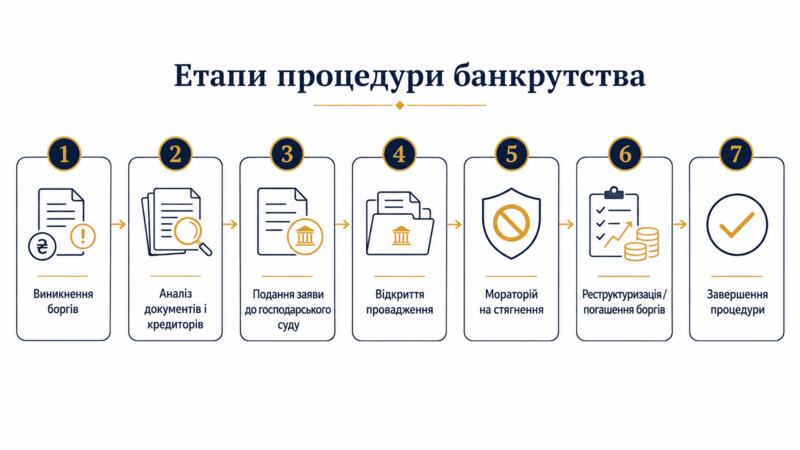
After proceedings are opened, the case moves into a controlled judicial procedure. The court appoints an insolvency officer, introduces a moratorium, determines the further course of action, and the debtor and creditors act within the Code.
For a legal entity
For a legal entity, after proceedings are opened, the following steps usually take place:
- The court opens proceedings in the case.
- A moratorium on satisfying creditors’ claims is introduced.
- An insolvency officer is appointed.
- A notice of case opening is published.
- Creditors submit their claims.
- The insolvency officer analyzes the claims and financial condition of the debtor.
- A register of creditors’ claims is formed.
- Creditors’ meetings are held.
- The issue of rehabilitation or liquidation is decided.
- If restoring solvency is impossible, the debtor may be declared bankrupt and move to liquidation.
For an individual
For an individual, after proceedings are opened, the court usually introduces the debt restructuring procedure, appoints a restructuring officer, and introduces a moratorium on satisfying creditors’ claims.
Next, the following steps take place:
- Creditors are identified.
- The debtor’s debts, property, and income are analyzed.
- A restructuring plan is prepared or clarified.
- Creditors review the plan.
- The court approves the plan or the case moves to the debt repayment procedure.
The individual must provide complete and truthful information about their financial condition. Incomplete or false data may complicate the procedure.
Insolvency officer: who they are and why they are needed
An insolvency officer is an independent specialist who participates in bankruptcy and insolvency procedures. In different procedures, they may perform different roles: asset manager, rehabilitation manager, liquidator, restructuring officer, or property realization officer.
Their task is not to be the “debtor’s lawyer” or “creditor’s representative.” The insolvency officer must act within the Code, organize the procedure, check property, analyze creditors’ claims, prepare reports, control the sale of assets, and perform other functions determined by the court and law.
For the debtor, the insolvency officer is important because without them the procedure cannot move normally. For creditors, they are important as a person who must ensure transparency of the procedure, identification of property, and proper verification of claims.
If the insolvency officer acts improperly, their actions may be appealed. Creditors and the debtor have the right to respond to violations, submit applications, complaints, objections, and demand judicial control.
Rights of the debtor and creditors in the bankruptcy procedure
Rights of the debtor
The debtor has the right to submit applications, explanations, evidence, objections, participate in court hearings, and appeal decisions and actions of participants in the procedure. An individual may propose a restructuring plan and explain the reasons for insolvency.
At the same time, the debtor is obliged to act in good faith: not to hide property, not to provide false information, not to withdraw assets, and to comply with court rulings.
Rights of creditors
Creditors have the right to file monetary claims, submit evidence, participate in court hearings, receive information about the case, vote at creditors’ meetings, and appeal actions of the debtor or insolvency officer.
For a creditor, documents are of key importance. Claims must be confirmed by agreements, acts, calculations, court decisions, enforcement documents, or other evidence of debt.
Moratorium on satisfying creditors’ claims
A moratorium on satisfying creditors’ claims is a temporary suspension of the performance of certain monetary obligations of the debtor and enforcement measures regarding them. In simple terms, after proceedings are opened, creditors can no longer act chaotically and separately from one another: claims must be considered within the case.
For the debtor, the moratorium may be important protection against simultaneous pressure from several creditors, enforcement proceedings, seizures, and compulsory collection. It allows the situation to move from constant “firefighting” into a court procedure.
For creditors, the moratorium means that they must act within the case, file claims, participate in the procedure, and wait for the satisfaction procedure established by law. This may look like a restriction, but at the same time it ensures equality of creditors and prevents a situation where one creditor is the first to take all property while others receive nothing.
At the same time, the moratorium should not be understood as complete release of the debtor from all obligations. It has limits, exceptions, and procedural consequences. Therefore, before submitting an application, it is necessary to separately assess which specific obligations will fall under the moratorium and which may have another regime.
Sale of the debtor’s property and electronic auctions
If the procedure reaches the sale of property, this does not happen arbitrarily, but according to the rules of the Code. The debtor’s property is identified, described, evaluated, and included in the relevant estate for sale. The sale must be transparent, which is why electronic auctions play a significant role.
Various assets may be sold through electronic auctions: real estate, vehicles, equipment, inventory, property rights, corporate rights, and other property that may be realized to repay creditors’ claims.
For the debtor, the sale of property is a sensitive stage because it directly affects the loss of assets. For creditors, it is a key stage because the sale price determines how much money will be directed to debt repayment. For buyers, it is an opportunity to purchase property through an open system, but documents, encumbrances, asset condition, and auction terms must be checked carefully.
A typical mistake is to believe that after a case is opened, property can be quickly transferred to relatives or sold “retroactively.” Such actions may be challenged, and transactions may be called into question. If the debtor is planning bankruptcy or insolvency proceedings, any property transactions must be analyzed very carefully.
Typical mistakes of debtors and creditors
Mistakes of debtors
Most often, debtors submit an application without a full analysis of debts, property, income, and consequences of the procedure. Because of this, problems with documents or grounds for opening the case may arise at the very start.
Another mistake is hiding property, income, or individual creditors. In the insolvency procedure, the court and insolvency officer check the debtor’s financial condition, so false information may cause significant harm.
Also risky are transferring property before submitting an application, expecting automatic write-off of all debts, and contacting a lawyer only after procedural mistakes have already been made.
Mistakes of creditors
Creditors often miss the deadlines for filing claims or submit them without sufficient evidence. In a bankruptcy case, it is important not only to have a debt, but also to properly confirm it with documents.
Another mistake is passivity after filing claims. If a creditor does not participate in meetings, does not control the actions of the insolvency officer, and does not respond to questionable actions of the debtor, they may lose real influence over the procedure.
It is also worth remembering separately: a creditor cannot independently initiate bankruptcy of an individual. If the debtor is an individual, the creditor may use other lawful methods of collection, but may not launch the insolvency procedure instead of the debtor.
When to contact a bankruptcy lawyer
You should contact a bankruptcy lawyer before submitting an application to court. This will help assess debts, property, documents, risks, timeframes, and understand whether the procedure is truly suitable in the specific situation.
A debtor needs help if there are several creditors, overdue loans, debts to MFIs, account seizures, enforcement proceedings, tax debt, or a risk of losing property. A creditor needs help to correctly file claims, not miss deadlines, confirm the debt, and control the procedure.
If you are not sure whether the bankruptcy procedure is suitable for you, you should not submit an application “blindly.” A lawyer will help assess debts, property, creditors, risks, and determine whether it makes sense to launch the procedure under the Code of Ukraine on Bankruptcy Procedures.
Frequently asked questions — short answers
Does the Code apply only to enterprises?
No. The Code applies not only to legal entities, but also to individuals and individual entrepreneurs. Each category of debtors has its own rules and specifics.
What procedures are provided for an individual?
For an individual, the main procedures are debt restructuring and debt repayment by the debtor. Usually, the possibility of restructuring is assessed first, and if it is impossible or not performed, debt repayment may be applied.
Can a creditor file for bankruptcy of an individual?
No. An insolvency case of an individual may be initiated only by the individual debtor themselves. The creditor may collect the debt by other lawful means, but cannot independently “launch” bankruptcy of an individual.
Does bankruptcy mean automatic write-off of all debts?
No. Bankruptcy or insolvency is a judicial procedure, not an automatic write-off. The court checks documents, debts, property, income, the debtor’s behavior, and other circumstances.
What is a moratorium on satisfying creditors’ claims?
A moratorium is a temporary suspension of the performance of certain monetary obligations and enforcement measures after proceedings are opened. It is needed so that creditors’ claims are considered within a single procedure.
Which court considers bankruptcy cases?
Bankruptcy and insolvency cases are considered by commercial courts. For a legal entity, the debtor’s location matters, and for an individual or individual entrepreneur — the place of residence.

Leave a request for consultation and our specialist will contact you soon!
Leave a request and our specialist will contact you soon!




Fill out the form or contact us in any way convenient for you
Choose the nearest office to you and receive consultations in a convenient format for you