

Pension Without Insurance Coverage: What Can Be Done Legally in 2026
In 2026, to retire at age 60, a person must have at least 33 years of insurance record; at age 63 — from 23 years; at age 65 — from 15 years. If the insurance record is insufficient, it is possible to confirm uncounted periods, continue official employment, or pay voluntary contributions. An unfounded refusal by the Pension Fund of Ukraine can be appealed, and if there is no right to a pension after age 65, the possibility of receiving social assistance should be checked.
What insurance record is and why it matters
Insurance record is the period during which a person was subject to compulsory state pension insurance and insurance contributions were paid for them or by them independently. It is the insurance record that determines whether a person has the right to an old-age pension and at what age they can apply for it.
After January 1, 2004, not only the fact of employment is important, but also the payment of insurance contributions. If a person worked unofficially or the employer did not report their income, the relevant period may be absent from the register of insured persons.
Insurance record is calculated in months. If a contribution lower than the minimum was paid for a month, as a general rule only a proportional part of the month is included in the record. In certain cases, a person may make an additional payment up to the minimum insurance contribution to receive a full month of insurance record.

How insurance record differs from employment record
Employment record is the period during which a person actually worked, served, studied, or engaged in other activities that were counted under the legislation of the relevant time. The main document confirming it is the employment record book.
Insurance record is linked to the payment of insurance contributions. After January 1, 2004, an entry in the employment record book alone is not enough: the relevant period must be reflected in the personalized accounting system of the Pension Fund of Ukraine.
Periods of work before 2004 are counted on the basis of the employment record book, archival certificates, orders, and other documents. If the employment record does not match the Pension Fund data, it is necessary to determine which periods were not counted and how to confirm them.
Which laws regulate pension assignment
The main regulatory act is Law of Ukraine No. 1058-IV “On Compulsory State Pension Insurance”. It defines the concept of insurance record, the requirements for retirement at 60, 63, and 65 years of age, the rules for calculating insurance record, and pension assignment.
Additionally, the following apply:
- Law of Ukraine No. 2464-VI on the collection and accounting of the unified social contribution — regulates voluntary participation and one-time payment of contributions for past periods;
- Resolution of the Cabinet of Ministers of Ukraine No. 637 — determines the procedure for confirming insurance record in the absence of an employment record book or required entries;
- Resolution of the Cabinet of Ministers of Ukraine No. 562 of May 16, 2025 — regulates confirmation of work in other states;
- Law of Ukraine No. 1727-IV — provides for social assistance to persons who are not entitled to a pension;
- Resolution of the Board of the Pension Fund of Ukraine No. 21-1 of June 13, 2025 — establishes the current procedure for administrative appeal of decisions, actions, and inaction of Pension Fund bodies;
- Code of Administrative Procedure of Ukraine — regulates judicial appeal of a refusal to assign a pension.
When resolving a specific case, the version of the legislation in force at the time the relevant legal relations arose must be applied.
What insurance record is required for retirement in 2026
The conditions for assigning a pension depend on a person’s age and the number of years of insurance record. The requirements are the same for men and women.
Minimum insurance record
In 2026, an old-age pension can be assigned:
| Age | Required insurance record in 2026 |
|---|---|
| 60 years | at least 33 years |
| 63 years | from 23 to 33 years |
| 65 years | from 15 to 23 years |
Under Article 26 of Law No. 1058-IV, with 31 years of insurance record, a pension will not be assigned at age 60, but it can be assigned after reaching age 63. If at age 65 the insurance record is less than 15 years, it is worth considering the possibility of acquiring it or applying for state social assistance.
How retirement age depends on insurance record
It is important to consider not only the year of applying to the Pension Fund, but also the date when the relevant retirement age is reached. The law provides that the required length of insurance record is determined according to the requirements that were in force on the date when the person reached 60, 63, or 65 years of age.
If the required insurance record was not available on the date of reaching the relevant age, the pension may be assigned later — after acquiring the required amount of insurance record. Therefore, a person who received a refusal at age 60 does not lose the right to a pension forever. They may continue official employment, pay voluntary contributions, or confirm previously uncounted periods.
You should not automatically wait until age 63 or 65. First, it is necessary to check whether the Pension Fund calculated the insurance record correctly. Sometimes, after counting archival periods, military service, education, or work abroad, a person acquires the right to a pension earlier.
What to do if the insurance record is insufficient
There is no universal way to solve the problem. The correct option depends on how much insurance record is missing, which periods were not counted, and whether the person has reached retirement age.
What to do if there is not enough insurance record?
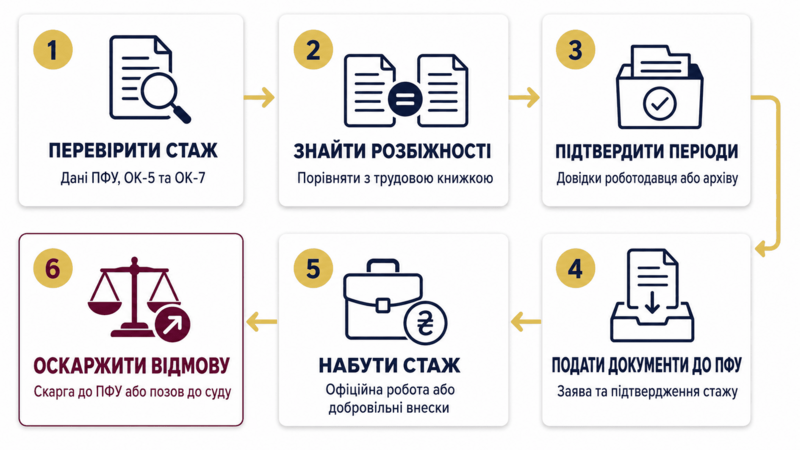
Continue official employment
The simplest option is to continue official employment until the required insurance record is acquired. Provided that at least the minimum insurance contribution is paid, each month of work is counted as a full month of insurance record.
This method is appropriate if several months or one or two years are missing and the person is able to work. At the same time, it is worth regularly checking whether the employer submits reports and whether contributions are reflected in the Pension Fund register.
If the contribution for a month is lower than the minimum, the month may not be counted in full. If there are legal grounds, it is possible to contact the Pension Fund regarding an additional payment up to the minimum contribution.
Voluntary participation in the compulsory state social insurance system
If a person is not officially employed, they may voluntarily pay contributions to acquire insurance record. In 2026, the minimum contribution for one full month is UAH 1,902.34 — 22% of the minimum wage. An electronic agreement can be concluded through the Pension Fund web portal using a qualified electronic signature or Diia.Signature.
For past periods starting from January 1, 2004, insurance record can be purchased through an agreement with the tax authority. The minimum cost of one month in 2026 is UAH 3,804.68, that is, a double insurance contribution. The amount is paid for the entire selected period.
Before payment, it is worth checking whether there are uncounted periods that can be confirmed by documents without additional costs. It should also be taken into account that purchasing insurance record helps obtain the right to a pension but does not guarantee a high pension amount.
Social assistance instead of a pension
If, after reaching age 65, a person has less than 15 years of insurance record, an old-age pension is not assigned. However, they can check the right to state social assistance to a person who is not entitled to a pension.
According to Law of Ukraine No. 1727-IV, such assistance may be assigned to a person who has reached age 65, does not receive a pension, and is low-income. During consideration of the application, income, property status, and other circumstances provided by law are taken into account.
Social assistance is not a pension and has different conditions for assignment and determining the amount. Therefore, it should not be confused with an old-age pension or considered an automatic payment for every person without insurance record.
How to check your insurance record
Through the Pension Fund portal
On the Pension Fund electronic services web portal, you can view information about employment activity, salary, payment of contributions, and acquired insurance record. You can log in using a qualified electronic signature, BankID, ID.GOV.UA, or Diia.Signature.
After logging in, you need to check:
- the total length of insurance record;
- employer data;
- salary amounts;
- payment of contributions for each month;
- availability of a digitized employment record book;
- periods with zero or incomplete contributions.
Particular attention should be paid to periods of job changes, entrepreneurial activity, military service, maternity leave, and periods when the enterprise delayed reporting.
Through the Diia application or portal
In Diia, you can order OK-5 and OK-7 certificates, as well as an extract from the register of insured persons. The document is generated electronically on the basis of Pension Fund data.
If the data in Diia is incomplete, this does not always mean that the insurance record is finally lost. The electronic document reflects information that is already in the register. Periods before the introduction of personalized accounting may require separate confirmation.
Using OK-5 and OK-7 certificates
OK-5 contains individual information about the insured person, including data on earnings, insurance contributions, and insurance record. OK-7 also shows information about accrued income, payment of the unified social contribution, and insurance record.
The certificates can be obtained through the Pension Fund portal, Diia, or at a Pension Fund service center. For pension analysis, they should be compared with the employment record book, orders, and other documents.
If a certain employer or month is missing, the reason must be determined: failure to submit reports, an error in personal data, non-payment of contributions, or a technical discrepancy.
How to confirm insurance record if it was not counted
The absence of a period in the electronic register does not always mean that it cannot be counted. Legislation provides several ways to confirm employment activity.
Archival documents
If the enterprise has been liquidated, documents may be stored in a state, labor, sectoral, or local archive. It is necessary to determine where the employer’s personnel and accounting documents were transferred.
An archival certificate must contain:
- the full name of the enterprise;
- the employee’s surname, first name, and patronymic;
- position or profession;
- dates of hiring and dismissal;
- numbers and dates of orders;
- grounds for issuing the certificate.
If the archive reported the absence of documents, the response must be kept. It may confirm the impossibility of obtaining written evidence and be important for using other ways to confirm insurance record.
Employer documents
If the enterprise operates or has a legal successor, you can obtain a clarifying certificate, copies of orders, a personal card, an employment contract, extracts from payroll records, or personal accounts.
Resolution of the Cabinet of Ministers of Ukraine No. 637 allows the use not only of the employment record book but also extracts from orders, personal accounts, payroll statements, written employment contracts, certificates, references, and other documents that contain information about periods of work.
If the employer refuses to issue documents, it is necessary to apply in writing and keep proof of sending the request. Later, documents can be requested through an attorney’s request or the court.
Witness testimony, if allowed by law
Witness testimony is not used in every situation. It may be used if employment documents have not been preserved and it is impossible to obtain them due to liquidation of the enterprise or absence of archival data.
As a general rule, testimony of at least two witnesses is required, who worked with the applicant at the same enterprise or in the same system and have their own documents about work for the relevant period. Only the period confirmed by two or more witnesses is counted.
Oral explanations from relatives or acquaintances alone are not enough. The Pension Fund checks whether the witnesses meet the requirements of Procedure No. 637 and whether they have documents about their own work.
Other supporting documents
Depending on the circumstances, evidence may include:
- military ID and certificates of service;
- diploma, archival certificate, or documents from an educational institution;
- child’s birth certificate and care documents;
- documents on entrepreneurial activity and payment of contributions;
- certificates of registration with an employment center;
- documents on change of surname;
- trade union membership card with contribution marks;
- court decision on the ownership of a document by a specific person.
Since 2025, periods of work in another state may be counted for determining the right to a pension if it is confirmed that they are included in the insurance record under the legislation of the relevant state. If an international treaty has been concluded with the country, its terms apply. For other states, the procedure approved by Resolution of the Cabinet of Ministers of Ukraine No. 562 applies.
How to appeal a refusal by the Pension Fund
An oral notification by a Pension Fund employee is not a proper refusal. It is necessary to obtain a written decision indicating the reasons, uncounted periods, duration of the recognized insurance record, and legal provisions.
Administrative appeal
Since 2025, a new Procedure for appealing decisions, actions, or inaction of territorial bodies of the Pension Fund of Ukraine has been in effect. A complaint against a decision of an official is submitted to the head of the relevant body. If the decision was made by the head of a territorial body, it can be appealed to the Pension Fund of Ukraine and/or directly to an administrative court.
The complaint can be submitted in person, by post, or electronically, including through the Pension Fund web portal. It must state:
- applicant data;
- the Pension Fund body that made the decision;
- date and number of the challenged decision;
- circumstances of the case;
- specific insurance record periods that were not counted;
- legal provisions that were violated;
- the applicant’s demand;
- list of attached documents.
The complaint is submitted within one year from the date of the decision, but no later than 30 calendar days from the date of becoming familiar with it. A missed deadline for a valid reason may be restored.
The Pension Fund must make a reasoned decision no later than 30 calendar days after receiving the complaint. The term may be extended once by no more than 15 calendar days with written notification to the applicant.
Applying to court
A refusal to assign a pension or failure to count insurance record can be appealed to the district administrative court. A pre-trial complaint is not always mandatory, so depending on the circumstances, a claim may be filed without first applying to a higher Pension Fund body.
In the claim, you may ask to:
- recognize the Pension Fund decision as unlawful and cancel it;
- oblige the Fund to count specific periods toward the insurance record;
- oblige the Fund to reconsider the application taking into account the court’s legal assessment;
- oblige the Fund to assign a pension from the date established by law if all conditions are confirmed.
The general time limit for applying to an administrative court is six months from the day the person learned about the violation. After administrative appeal, the time limit may be shorter.
The claim should include the Pension Fund decision, employment record book, OK-5 or OK-7 certificates, archival and other documents confirming insurance record.
Court practice on confirming insurance record
Courts assess not only formal defects in documents but also the entire body of evidence. The result depends on whether actual employment activity has been confirmed and whether the Pension Fund had legal grounds to refuse to count the relevant period.
Typical grounds for granting a claim
Claims are most often granted when:
- the employment record book contains entries about work, but the Pension Fund refused due to formal defects;
- errors in documents arose through the employer’s fault, not the employee’s;
- archival certificates, orders, and records confirm the disputed period;
- the Pension Fund did not examine the submitted documents or did not justify rejecting them;
- the absence of archival data was caused by liquidation of the enterprise;
- the applicant confirmed a change of surname or ownership of a document;
- the Pension Fund body applied the wrong version of the legislation;
- the refusal decision does not contain a clear calculation of insurance record.
At the same time, a statement about actual work alone is not enough. Documents, admissible witness testimony, or other proper evidence are required.
Supreme Court practice
The Supreme Court consistently states that an employee should not be responsible for the employer’s improper maintenance of the employment record book or accounting documentation. Formal violations committed by the enterprise administration by themselves cannot deprive a person of the constitutional right to social protection.
In particular, in case No. 300/860/17, the Supreme Court proceeded from the fact that non-compliance with the rules for maintaining an employment record book has negative consequences for the guilty official, not for the employee. The absence of documents in the archive because the enterprise did not transfer them also does not prove the absence of work.
At the same time, clarifying certificates are needed mainly when the employment record book does not contain information necessary to confirm special or preferential insurance record. If an ordinary period of work is properly entered in the employment record book, the Pension Fund should not groundlessly require documents that are objectively impossible to obtain.
Common mistakes when applying for a pension
Which documents are most often missing
The most common problems are:
- missing hiring or dismissal orders;
- the employment record book has no seal, signature, or order number;
- the surname in documents does not match passport data;
- the enterprise changed its name, but there is no certificate of renaming;
- the archival certificate does not contain the grounds for its issuance;
- documents on military service, education, or childcare are missing;
- payment of contributions by an entrepreneur is not confirmed;
- documents on work abroad have not been provided;
- the applicant relies only on entries in the employment record book for periods after 2004.
Another mistake is submitting only originals to the Pension Fund without keeping copies and proof of acceptance of documents.
How to avoid refusal
Before applying, you need to independently or together with a lawyer prepare a chronology of employment activity. Opposite each period, it is worth indicating which document confirms it and whether it is reflected in the Pension Fund register.
If there are discrepancies, documents should be obtained in advance. Requests to archives may take a long time, and the enterprise may be in the process of liquidation.
The application to the Pension Fund should be submitted officially. On a paper copy, it is advisable to obtain an acceptance mark, and during electronic submission — to save the receipt and registration number.
Checklist before applying to the Pension Fund
Before submitting an application, check:
- passport or another identity document;
- taxpayer registration number;
- employment record book and its digitization;
- OK-5 and OK-7 certificates;
- correspondence of surname, first name, and patronymic in all documents;
- orders on hiring, transfer, and dismissal;
- archival certificates for disputed periods;
- documents on military service;
- documents on education for periods that may be counted;
- certificates and documents on change of surname;
- documents on care for a child or a person who needed care;
- information on entrepreneurial activity and payment of contributions;
- confirmation of work abroad;
- documents on salary before July 1, 2000, if their use is appropriate;
- your own monthly calculation of insurance record;
- copies of all documents;
- proof of sending previous requests to employers and archives.
If the Pension Fund did not count part of the insurance record, demand a written decision, a full calculation, and a specific explanation for each disputed period.

Conclusions
The absence of the required insurance record does not always mean loss of the right to a pension. First, it is worth checking the Pension Fund data, the employment record book, and documents for all periods of work. Uncounted insurance record can be confirmed by archival certificates, employer documents, and other evidence provided by law.
If the insurance record is truly missing, it can be acquired through official employment or voluntary contribution payments. An unfounded refusal by the Pension Fund can be appealed administratively or in court, and after age 65, if there is no right to a pension, the possibility of applying for state social assistance should be checked.
Frequently asked questions
Can a person receive a pension without insurance record?
No, but after age 65, under certain conditions, state social assistance can be arranged.
How much insurance record is needed in 2026?
To retire at age 60, at least 33 years of insurance record are required; at age 63 — from 23 years; at age 65 — from 15 years.
Can insurance record be purchased?
Yes, for past periods from 2004 — for a double minimum insurance contribution.
How to check your insurance record?
Data can be checked on the Pension Fund web portal or in the Pension Fund application, as well as through Diia by ordering an OK-5 certificate, OK-7 certificate, or an extract from the register of insured persons.
What to do if the Pension Fund did not count part of the insurance record?
Submit supporting documents, and in case of refusal — a complaint or a claim to court.
How to confirm insurance record if the enterprise has been liquidated?
With archival documents, and if they are absent — with testimony of at least two witnesses under the conditions of Procedure No. 637.
Can one go to court to confirm insurance record?
Yes, in court it is possible to appeal the Pension Fund’s refusal and demand that the confirmed period be counted.
Is work abroad counted toward insurance record?
Yes, if the period of work is confirmed in accordance with an international treaty or Resolution of the Cabinet of Ministers of Ukraine No. 562.
What documents are needed to assign a pension?
Passport, tax number, employment record book, and documents confirming insurance record.
Can social assistance be received if a pension has not been assigned?
Yes, after age 65, provided the requirements regarding income, property, and other circumstances are met.

Leave a request for consultation and our specialist will contact you soon!
Leave a request and our specialist will contact you soon!
More useful information




Fill out the form or contact us in any way convenient for you
Choose the nearest office to you and receive consultations in a convenient format for you