

Termination by Mutual Agreement: Step-by-Step Guide, Employee Rights, and Sample Letter
Dismissal by agreement of the parties is possible only when the employee and the employer have agreed on the very basis for terminating the employment contract and the dismissal date. There is no two-week “working off” period: the parties may determine any date, even the day the application is submitted. On the day of dismissal, the employer must issue a copy of the order, notify the employee in writing of all accrued amounts, and make the final settlement. After an agreement has been reached, the employee cannot cancel it unilaterally — the employer’s consent is required for cancellation. Therefore, before submitting an application, it is worth recording the date, payments, and other important conditions in writing.

What dismissal by agreement of the parties is
In everyday speech, people often say “dismissal by mutual consent,” but the Labor Code uses the legal wording “agreement of the parties.” This is not dismissal solely at the employee’s request and not a unilateral decision of the employer. Employment relations are terminated because both parties have agreed on a joint decision and a specific day for ending work.
Legal definition
According to paragraph 1 of part one of Article 36 of the Labor Code of Ukraine, agreement of the parties is an independent ground for terminating an employment contract. The law does not establish a mandatory list of reasons: the parties may agree due to a change in the employee’s plans, work reorganization, transfer to another position in another company, or for any other lawful reasons.
The key conditions are voluntariness and coincidence of the parties’ will. The employee must understand that they agree specifically to paragraph 1 of part one of Article 36 of the Labor Code, and the employer must accept this ground and the proposed or agreed date. Agreement only with the fact that a person stops working does not yet prove an agreement specifically on dismissal by agreement of the parties.
Which rules regulate it
The main rule is paragraph 1 of part one of Article 36 of the Labor Code. Separate stages of the procedure are also regulated by Article 47 regarding documents on the day of dismissal, Article 83 regarding compensation for unused vacation, Articles 116–117 regarding settlement and liability for its delay, and Articles 233–234 regarding time limits for applying to court.
Unlike dismissal at the employer’s initiative, this ground generally does not require redundancy notices, an offer of another job, or prior trade union consent. At the same time, the employer cannot disguise forced dismissal as agreement of the parties. Voluntariness must be confirmed by the content of the application, agreement, correspondence, order, and the parties’ behavior.
When dismissal by agreement of the parties is used
This option is convenient when the parties want to end employment relations within an agreed period without a two-week notice period. For example, the employee needs to start a new job the next day, the employer is ready to quickly transfer duties, or the parties want to secure additional compensation. This ground may be applied both to an open-ended employment contract and to a fixed-term employment contract before its term ends.
Who can initiate it
The initiator may be the employee or the employer. The employee usually submits an application with a proposed date. The employer may send a written proposal, a draft agreement, or discuss the terms with the employee. An oral agreement is not always void, but it creates problems with proof, so all essential terms are better recorded in writing.
- The employee should record: the ground, exact dismissal date, agreed additional payments, and method of transferring documents.
- The employer should record: acceptance of the proposal without changing its terms or a counterproposal separately approved by the employee.
Is the employer’s consent required?
Yes. The employee’s application alone is not enough, because an agreement requires the will of two parties. If the employer does not agree with the ground or the date, they may refuse. Then the employee, if there is an open-ended contract, may use Article 38 of the Labor Code and resign at their own request, as a rule by notifying the employer in writing two weeks in advance, or ask for another date if there is a valid reason.
Important: the employer’s silence should not be considered acceptance of the application. Until confirmation, an agreed agreement, or an order is received, the employee must continue performing employment duties; otherwise, absence may be regarded as absenteeism.
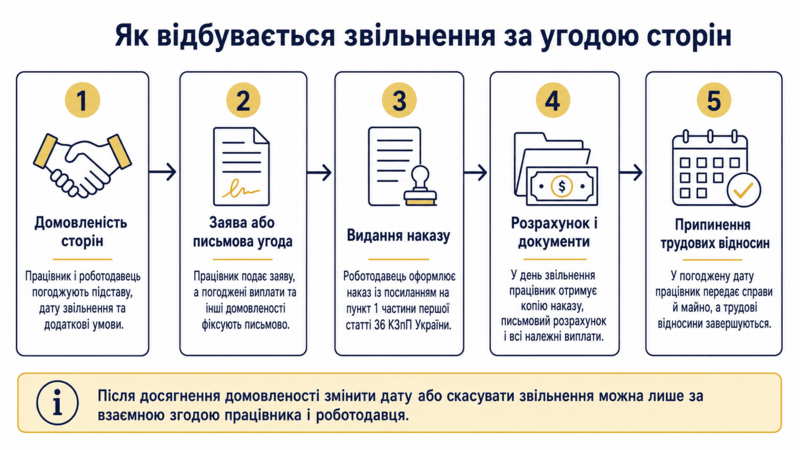
Step-by-step instructions for dismissal
Step 1. Agreement of the parties
First, the parties agree on two basic conditions: termination of the employment contract specifically under paragraph 1 of part one of Article 36 of the Labor Code and a specific date. Additionally, they may agree on handover of duties, return of property, payment of a bonus or separate compensation, preservation of corporate health insurance until a certain date, issuing a recommendation, etc. Conditions that worsen the employee’s rights guaranteed by law do not apply.
Step 2. Submission of the application
The application is addressed to the manager or another authorized person. It must clearly state “I request dismissal by agreement of the parties,” indicate paragraph 1 of part one of Article 36 of the Labor Code, and specify the exact date. The wording “from such-and-such date” may cause a dispute, so it is better to use the unambiguous wording “dismiss on July 31, 2026.”
The employee should keep a copy with an incoming number and registration date or send the document in a way that confirms its receipt. If there are additional conditions, it is safer to prepare a separate written agreement signed by both parties rather than relying only on oral promises.
Step 3. Issuance of the order
Based on the application and/or written agreement, the employer issues an order. It states the employee’s full name and position, the agreed date, the ground “agreement of the parties, paragraph 1 of part one of Article 36 of the Labor Code of Ukraine,” and the details of the application or agreement. The employee is familiarized with the order, and on the day of dismissal, its copy must be issued.
Step 4. Final settlement
Under Article 116 of the Labor Code of Ukraine, all amounts due are paid on the day of dismissal. If the employee did not work that day, payment is made no later than the next day after the employee presents a demand for settlement. The employer informs the employee in writing about each type of accrual: salary, vacation compensation, bonuses, incentives, and other payments. Even if there is a dispute, the undisputed amount must be paid on time.
Step 5. Completion of employment relations
The agreed date is the last day of employment relations. The employer issues a copy of the order and a written settlement statement, transfers the required documents, and, at the employee’s request, makes a dismissal entry in the paper employment record book if it is kept by the employee. The employee completes the handover of duties and returns property under an act. At the same time, the employer has no right to delay salary or documents due to non-return of property: compensation for damage is resolved separately under the law.
Sample application for dismissal by agreement of the parties
Ready-made template
|
Sample: To the Director of LLC “Company Name” Full name of the manager from [position, full name of the employee] APPLICATION I request to be dismissed from the position of [position name] on July 31, 2026 by agreement of the parties on the basis of paragraph 1 of part one of Article 36 of the Labor Code of Ukraine. I request that on the day of dismissal I be issued a copy of the dismissal order, written notification of the accrued and paid amounts, and that the final settlement be made in accordance with Articles 47 and 116 of the Labor Code of Ukraine. July 14, 2026 ____________ [signature] [full name] |
How to fill it in correctly
- Addressee. Indicate the employer or manager authorized to make HR decisions.
- Ground. Write specifically “by agreement of the parties” and provide a full reference to paragraph 1 of part one of Article 36 of the Labor Code of Ukraine.
- Date. Specify one specific calendar day without ambiguous constructions.
- Additional conditions. If compensation or other guarantees have been agreed, record them in a separate bilateral agreement or directly in a document signed by both parties.
- Confirmation of submission. Keep a copy with a registration mark, electronic confirmation, or postal attachment description.
Sample dismissal order
|
Order template: LLC “Company Name”
ORDER On dismissal of [full name] DISMISS: The accounting department shall make the final settlement, pay salary for the time actually worked, monetary compensation for all unused vacation days, and other amounts due to the employee. Ground: application of [full name] dated July 14, 2026; agreement on termination of the employment contract dated July 14, 2026 No. 1, if available. Director ____________ [full name] |
The employer may use its own order form or standard form No. P-4. What matters is not the name of the form, but the correct details, unambiguous date, and exact wording of the ground. It is not allowed to change the agreed date in the order or replace “agreement of the parties” with “resignation at own request” without the employee’s consent.
What payments are due to the employee
Salary
The employee is paid salary for the time actually worked up to and including the day of dismissal, supplements, allowances, and other components of remuneration. If the bonus regulations provide for a bonus for already achieved performance indicators, it must also be accrued in the established procedure. The employer must provide a written breakdown of all amounts.
Compensation for unused vacation
Under Article 83 of the Labor Code of Ukraine, upon dismissal, monetary compensation is paid for all unused annual vacation days, as well as for the additional vacation provided by law to employees who have children or an adult child with a disability from childhood of subgroup A, group I. Compensation does not depend on who initiated the agreement or how quickly the dismissal took place.
Other payments
The Labor Code does not establish automatic severance pay solely due to dismissal by agreement of the parties. It is due when it is directly provided for by an employment or collective agreement, internal act, or separate agreement of the parties. Agreed compensation, a bonus, assistance, or reimbursement of expenses may also be paid in the same way.
If the employer delays the amounts due through their own fault, Article 117 of the Labor Code provides for average earnings for the delay period until the day of actual settlement, but for no more than six months. The existence of a dispute does not release the employer from the obligation to pay the undisputed part on time.
How dismissal by agreement of the parties differs from resignation at own request
Despite the similar result, dismissal by agreement of the parties and resignation at own request differ in procedure, time limits, the possibility of withdrawing the application, and the employer’s role.
| Criterion | By agreement of the parties | At own request |
|---|---|---|
| Labor Code provision | Para. 1, part 1, Art. 36 | Art. 38; for a fixed-term contract — Art. 39 |
| Whose will is required | Employee and employer | Employee; the employer receives notice |
| Dismissal date | Any date agreed by the parties | As a rule, after two weeks’ notice; earlier — for a valid reason or with the employer’s consent |
| Two weeks | Do not apply | General rule for an open-ended contract |
| Withdrawal | Only by mutual consent after an agreement has been reached | Usually possible before the end of the notice period, except for exceptions established by law |
| Severance pay | Not mandatory, but may be agreed | Not mandatory on this ground alone |
| Main risk | After agreement, it is difficult to change the decision unilaterally | The notice period and withdrawal rules must be observed |
Can the application be withdrawn?
An application for withdrawal can be submitted, but this does not automatically mean cancellation of the dismissal. After the parties have reached an agreement on the ground and date, it can be canceled only by mutual consent. The employer is not obliged to accept a unilateral change of the employee’s decision.
An employee who has changed their mind should immediately submit a written proposal to cancel the agreement and obtain written confirmation from the employer. If the order has already been issued, it is advisable to issue an order canceling it. If there was actually no agreement — for example, the application did not contain a date or concerned resignation at own request — the situation is assessed differently, because the employer cannot independently substitute the ground.
Typical mistakes of employees and employers
- No specific date. A phrase without a dismissal day does not confirm agreement on an essential condition and creates the risk of an unlawful order.
- Confusion between Articles 36 and 38 of the Labor Code. An application “at own request” does not give the employer the right to formalize “agreement of the parties” without the employee’s separate consent.
- Oral promises of compensation. Without a written agreement, it is harder for the employee to prove the amount and deadline of the additional payment.
- Stopping work before agreement. Submitting an application does not by itself terminate employment relations; unauthorized absence creates disciplinary risks.
- Attempt to withdraw the agreement unilaterally. The rules for withdrawing an application at own request cannot be automatically transferred to agreement of the parties.
- Coercion or an application “in advance.” Forcing an employee to sign an undated application by threatening negative consequences is a serious risk of a court dispute.
- Incorrect order. Discrepancies in the date, ground, or document details call into question the existence of a real agreement.
- Delay in settlement. Salary and vacation compensation cannot be withheld until equipment is returned, an exit clearance sheet is signed, or an audit is completed.
- No written notification of payments. On the day of payment, the employer must separately break down all accrued and paid amounts.
Court practice
Position of the Supreme Court
The Supreme Court consistently proceeds from the fact that the court must verify the reality of the agreement, the employee’s expression of will at the time the order was issued, the existence of an application for cancellation, and the employer’s consent to such cancellation. In its ruling of August 31, 2020 in case No. 359/5905/18, the Court emphasized: a later change of the employee’s decision by itself does not terminate the validity of the agreement reached; the employer’s consent is required for this.
At the same time, a formal reference to Article 36 in the order does not replace a genuine agreement. In its ruling of December 1, 2021 in case No. 591/1375/19, the Supreme Court noted that the absence of a specific dismissal date in the application may indicate the absence of an expression of will to terminate the contract by mutual agreement. And in case No. 487/5015/16-c, the Court confirmed: an application for resignation at own request does not allow the employer to independently formalize dismissal by agreement of the parties.
Claims of psychological pressure also require evidence. The court assesses correspondence, audio recordings, testimony, medical documents, circumstances of signing the application, and the parties’ behavior. Mere dissatisfaction with the consequences or a later change of decision does not prove coercion.
Typical disputes
- whether the employee agreed specifically to paragraph 1 of part one of Article 36 of the Labor Code, and not another ground;
- whether the parties agreed on a specific dismissal day;
- whether the application was written voluntarily and without pressure;
- whether the employer agreed to withdrawal or change of date;
- whether salary, vacation compensation, and additional payment were calculated correctly;
- whether a copy of the order was issued and whether the final settlement deadline was observed.
In dismissal cases, the employee must apply to court within one month from the day the copy of the order is delivered. Under Article 234 of the Labor Code of Ukraine, a deadline missed for valid reasons may be renewed if no more than one year has passed since receiving the order. Therefore, an appeal should not be postponed. For disputes regarding payments due upon dismissal, the current version of Article 233 of the Labor Code and the decision of the Constitutional Court of Ukraine of December 11, 2025 No. 1-r/2025 should be taken into account separately.

Conclusions
Dismissal by agreement of the parties makes it possible to quickly and flexibly end employment relations, but it works only if there is a genuine bilateral agreement. The safe algorithm is simple: agree on the exact date and conditions, record them in writing, check the wording of the order, and on the day of dismissal receive a copy of the order, settlement statement, and all payments due.
The employee should not sign an application without a date, rely on an oral promise of compensation, or expect that the application can be unconditionally withdrawn. The employer must not substitute the dismissal ground, apply pressure, or fail to document each stage of the procedure. If there is already a conflict between the parties regarding voluntariness, payment amounts, or the date, the documents should be checked before the order is issued.
Frequently asked questions
What does dismissal by agreement of the parties mean?
It is termination of an employment contract by mutual agreement of the employee and employer. The legally correct wording in the Labor Code is “by agreement of the parties.”
Which article of the Labor Code regulates dismissal by agreement of the parties?
The ground is established by paragraph 1 of part one of Article 36 of the Labor Code of Ukraine. Settlement and documents are regulated, in particular, by Articles 47, 83, 116, and 117 of the Labor Code.
Is it necessary to work two weeks?
No. The parties independently agree on the date, so dismissal is possible even on the day the application is submitted. Without the employer’s consent, the rules will be different.
Who can initiate dismissal?
The initiative may be proposed by both the employee and the employer. But the final decision requires the voluntary consent of both.
Can the application be withdrawn?
Withdrawal can be proposed, but after an agreement has been reached, its cancellation requires the employer’s consent. Unilateral withdrawal does not automatically cancel the agreement.
Does the employer have the right to refuse dismissal?
Yes, if the employer does not agree with the agreement or the date. Then the employee may consider resignation at own request under Article 38 of the Labor Code.
What payments does the employee receive upon dismissal?
Salary, compensation for all due unused vacation days, and other payments provided by contract or law. There is no mandatory severance pay solely because of this ground.
How to correctly write an application for dismissal by agreement of the parties?
Indicate the employer, a request for dismissal by agreement of the parties, paragraph 1 of part one of Article 36 of the Labor Code, and the exact date. Add the date of preparation and signature.
How does dismissal by agreement of the parties differ from resignation at own request?
Agreement requires the consent of two parties and does not provide for a mandatory two-week period. Resignation at own request is the employee’s unilateral initiative and usually requires written notice two weeks in advance.
What risks exist for the employee during dismissal by agreement of the parties?
The main risks are the inability to unilaterally withdraw the agreement, loss of compensation agreed only orally, an incorrect date or ground in the order, and difficulty proving pressure without evidence. Before dismissal, it is also worth checking the current conditions for receiving unemployment benefits.

Leave a request for consultation and our specialist will contact you soon!
Leave a request and our specialist will contact you soon!
Fill out the form or contact us in any way convenient for you
Choose the nearest office to you and receive consultations in a convenient format for you