

MAC: What It Is, Why It's Needed, and How to Obtain a Report
MAC is the medical advisory commission of a healthcare facility, which collegially reviews certain medical issues and issues conclusions provided for by law. Depending on the situation, these may be documents regarding permanent outside care, temporary incapacity for work, the health condition of a child, treatment, or other matters within the commission’s competence. Usually, the review is initiated through a family doctor or attending physician, who assesses the patient’s condition and prepares the necessary medical documentation. For the MAC, a medical record, extracts, examination results, and conclusions of specialized doctors are needed, while the exact package depends on the purpose of the application. Based on the review, the commission issues the relevant conclusion.

What is MAC and what is it needed for?
MAC stands for medical advisory commission. It is not a separate state body like the VLK or the system of expert teams, but a collegial mechanism within a healthcare facility used when a certain medical issue must, under the law, be decided not by one doctor but by a commission.
MACs operate at healthcare facilities and consider issues of temporary incapacity for work, permanent outside care, children’s health condition, and other cases directly provided for by law. There is no universal list of «all MAC certificates»: the powers depend on the specific procedure.
The composition of the commission is determined by the facility depending on the issue, and competent doctors are involved in the review. The MAC does not replace the VLK or expert teams.
What certificates and conclusions the MAC issues
An MAC conclusion is needed not only by elderly people or persons arranging care. The commission may be involved in various medical procedures, but the specific document must always correspond to the purpose of the application.
| Type of conclusion | What it is needed for | Who may need it |
|---|---|---|
| On permanent outside care | Confirms impairments of body functions due to which a person cannot move independently and/or perform self-care and needs permanent assistance | People with severe functional limitations, elderly people, persons with cognitive impairments, as well as their relatives for further social or legal procedures |
| Regarding temporary incapacity for work | Used in cases where the issue of the duration of incapacity for work or further medical tactics must be decided collegially | Employees and insured persons during long-term treatment or a complicated course of disease |
| Regarding treatment and rehabilitation | May confirm medical indications or recommendations when the relevant procedure requires an MAC decision | Patients who need specialized treatment, rehabilitation, or preparation of documents for specific programs |
| For children | Used, in particular, to establish the category of «child with disability», issue the relevant medical conclusion, and address other matters provided for by law | Children under 18 and their legal representatives |
| Other conclusions | Issued in cases where legislation directly requires a decision of a medical commission | Patients depending on diagnosis, age, purpose of application, and the specific administrative or social procedure |
For children, the role of the MAC remains even after the reform of the adult disability determination system. In 2026, it is the MAC of a healthcare facility that determines the presence of a persistent disorder of body functions in a child and issues a medical conclusion on a child with disability according to the established procedure.
MAC conclusion under form No. 080-4/o
To whom and for what form No. 080-4/o is issued
Form No. 080-4/o has the official name «Conclusion on the presence of impairment of body functions due to which a person cannot move independently and/or perform self-care and needs permanent outside care». It is issued by the MAC when it is necessary to medically record specifically a person’s need for permanent outside care.
The key importance lies not in the diagnosis itself, but in its consequences: whether the person can move independently, care for themselves, and meet basic needs. A severe diagnosis does not guarantee issuance of the conclusion, and the absence of disability by itself does not exclude it.
The document is used for social and other legal procedures where the law requires confirmation of the need for permanent care. In military law, it is only part of the evidence package.
How form No. 080-4/o is issued
The conclusion is issued by members of the MAC on the basis of medical documentation. After the changes of December 27, 2025, data from form No. 025/o «Medical Record of an Outpatient» or form No. 027/o — an extract from the medical record — are used.
Since December 27, 2025, the separate form No. 080-2/o, which was previously used for elderly citizens with cognitive impairments, has also been abolished. Now such cases are covered by the single form No. 080-4/o. In addition, the new form does not require specifying the particular body to which it is submitted, and when issued electronically, MAC members may affix electronic signatures. Conclusions under the old forms No. 080-4/o and No. 080-2/o issued before the changes came into force remain valid for the period for which they were issued.
The validity period of the form depends on the person’s status. If disability is established indefinitely, the conclusion is also issued indefinitely. If disability is established for a fixed period, the conclusion is valid no longer than that period, but not less than 12 months. For other persons, form No. 080-4/o is issued for 12 months from the date of issue.
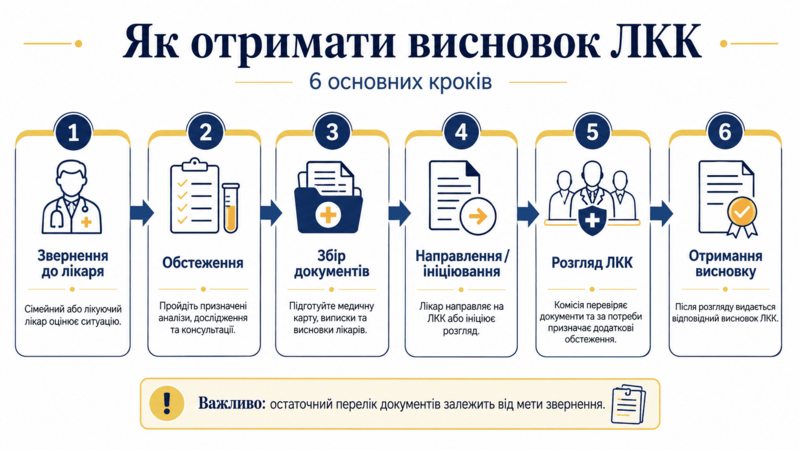
How to obtain an MAC conclusion
Before undergoing the MAC, it is important to properly prepare medical documents and undergo the necessary examinations, since it is on their basis that the commission assesses the health condition and decides whether to issue a conclusion.
- Contact a family doctor or attending physician. It is necessary to explain which specific conclusion is needed and for what purpose. The doctor will assess the health condition and determine whether there are grounds for commission review.
- Undergo the prescribed examinations. If the available data are insufficient, the doctor may refer the patient to specialized specialists, laboratory tests, or instrumental examinations.
- Collect medical documents. The case should include documents that not only confirm the diagnosis, but also show the course of the disease, the treatment provided, and the actual limitations of body functions.
- Obtain a referral or initiate review. The procedure depends on the type of conclusion and the internal organization of the facility. In most cases, the issue is brought before the MAC by the attending physician.
- Undergo commission review. The MAC analyzes medical data, assesses the patient’s condition if necessary, and may request clarification of information or additional examinations.
- Receive the conclusion. If the medical grounds are confirmed, the commission issues a document of the established form. Before using it, it is worth checking the full name, date, wording, validity period, signatures, and other mandatory details.
What documents are needed to undergo the MAC
There is no universal package for any MAC. Usually, it is worth preparing:
- a passport or another identity document;
- a medical record;
- extracts from medical documentation;
- conclusions of specialized doctors;
- test results and instrumental examination results;
- a referral, if it is required for the specific procedure.
Additionally, documents on disability, previous conclusions, surgeries, inpatient treatment, or rehabilitation may be needed. The final package depends on the purpose of the application. For form No. 080-4/o, it is important that the documents describe not only the diagnosis but also impairments in mobility and self-care.
How the MAC takes place and how long it takes
Personal presence. The same rule does not apply to every conclusion. The review procedure is determined by the specific procedure and medical circumstances. If the commission needs an examination to make a decision, the patient may be invited in person. At the same time, some decisions may be based primarily on properly issued medical documentation. Therefore, it is better to clarify the issue of presence with the attending physician or at the facility conducting the MAC.
What the commission checks. The MAC analyzes the medical record, extracts, studies, specialist conclusions, and data on functional condition.
Additional examinations. If information is insufficient or contradictory, the patient may be referred for additional examinations or consultations.
Review period. Legislation does not establish a single period «for any MAC». The duration depends on the type of conclusion, meeting schedule, completeness of medical documentation, and the need for additional examinations. Therefore, a promise to obtain any MAC certificate in one or two days without taking into account the specific procedure is incorrect.
Validity period. It also depends on the type of document. For form No. 080-4/o, special rules apply: indefinitely in case of indefinite disability, within the period of established disability for fixed-term disability, but not less than 12 months, or 12 months for other persons. After the period expires, if the need remains, it is necessary to contact a doctor again and undergo the procedure for issuing an up-to-date conclusion.
How the MAC differs from the VLK and expert teams
The MAC, VLK, and expert teams have different powers, so it is important to understand which body considers a specific medical or legally significant issue.
| Body or system | What issues it considers |
|---|---|
| MAC | Medical issues within the commission’s powers, including certain conclusions regarding care, temporary incapacity for work, and children |
| VLK | Determining fitness for military service and other issues of military medical examination |
| Expert teams | Assessment of everyday functioning of an adult, including establishment of disability and determination of certain needs |
The MAC and VLK have different tasks. If a person needs to establish fitness or unfitness for military service, an MAC conclusion does not resolve this issue — a military medical commission is needed.
Likewise, in 2026, the MAC does not establish disability for an adult. Since January 1, 2025, the system of assessment of everyday functioning has operated for adults, and decisions are made by expert teams.
Therefore, current materials should not state that in 2026 a person is «referred to MSEC» for initial establishment of disability: this system has been replaced. At the same time, old MSEC documents issued before the reform do not disappear merely because the system name changed and are used according to the rules of their validity.
MAC conclusion for permanent care and military law
MAC conclusion on the need for permanent care
To confirm the need for permanent outside care, the MAC assesses not merely the presence of a disease, but impairments of body functions due to which a person cannot move independently and/or perform self-care. In the general case, form No. 080-4/o is used for this. A separate form is retained for persons with group I or II disability due to a mental disorder — under Order of the Ministry of Health No. 667.
There is no mandatory condition to «first obtain disability, and then MAC» for form No. 080-4/o. The Ministry of Health directly distinguishes situations where the need for care is determined by an expert team during the assessment of everyday functioning and cases where it is established or recorded by the MAC.
If the purpose of the application is connected specifically with organizing assistance for a close person, it is also worth checking the procedure for arranging permanent care, since the medical conclusion is only one element of the procedure.
MAC conclusion for deferment or discharge from service
An MAC conclusion by itself does not create an automatic right either to deferment from mobilization or to discharge of a servicemember from service. It confirms a medical circumstance — another person’s need for permanent care. Next, it is necessary to check whether the family and factual circumstances meet the specific legal ground, and also submit other documents provided for by the relevant procedure.
For example, for deferment, the degree of kinship, the fact of providing care, and other confirmations may matter. This is discussed in more detail in the materials on deferment from mobilization in 2026 and deferment for parental care under Resolution No. 560. For active servicemembers, the grounds and documents for discharge from military service during the war must be checked separately.
What to do if the MAC refused to issue a conclusion
Reasons for refusal and repeat application
If the MAC did not confirm the necessary medical circumstance, first of all, it is worth finding out what the decision is based on. Ask for the decision and the reasons why the conclusion was not issued to be provided or properly recorded. An oral statement that «the commission did not approve it» does not make it possible to properly assess the lawfulness of the refusal.
After that, check the medical documentation. If it does not sufficiently describe functional impairments or the need for assistance, it is worth adding new examinations, extracts, or conclusions of specialized doctors and initiating a repeat review.
How to appeal an MAC decision
It is worth starting with a written application to the head of the healthcare facility where the MAC operates. In the application, it is advisable to state which decision is being appealed, why the applicant considers it unfounded, which medical documents were not taken into account, and what exactly he or she asks to be done.
If the issue is not resolved at the facility level, one may apply to the relevant healthcare management body or another competent body depending on the subordination of the medical facility. The Ministry of Health also recommends that patients, in case of unlawful decisions, first submit a registered written complaint to the head of the facility.
Judicial appeal is also possible, but the method of protection depends on the status of the facility and the nature of the dispute. Before applying to court, it is worth collecting the MAC decision, medical documents, submitted complaints, and received responses.
Frequently Asked Questions about the MAC
Can the MAC be undergone in a private medical facility?
Yes, in certain procedures, the form of ownership of the facility is not in itself an obstacle. But a private clinic must have the right to conduct the relevant procedure, have a properly established MAC, and issue exactly the document you need. Before applying, clarify whether the facility issues the form you need.
Is it mandatory to be personally present at the MAC meeting?
Not always. It depends on the type of conclusion, the patient’s condition, and the rules of the specific procedure. If the commission needs a personal examination, the patient will be invited; in other cases, properly issued medical documentation may be the basis for the decision.
Can the MAC establish disability?
For an adult — no. Since January 1, 2025, disability for adults is established by expert teams within the framework of assessment of everyday functioning. For children under 18, the MAC continues to perform the functions provided by law regarding establishment of the category «child with disability».
Is disability needed for a conclusion on permanent care?
No, the mere presence of established disability is not a universal mandatory condition for form No. 080-4/o. The decisive factors are impairments of body functions and the actual inability of the person to move independently and/or perform self-care, due to which they need permanent outside care.
Is an MAC conclusion sufficient to arrange deferment?
No. An MAC conclusion may confirm a relative’s need for permanent care, but the right to deferment arises only if there is a specific ground provided by law and after all necessary circumstances are confirmed. Therefore, along with the medical document, documents on kinship, actual care, and other confirmations may be needed depending on the ground.

Leave a request for consultation and our specialist will contact you soon!
Leave a request and our specialist will contact you soon!


Fill out the form or contact us in any way convenient for you
Choose the nearest office to you and receive consultations in a convenient format for you