

Deferment from Mobilization for Students, Graduate Students, and Faculty Members
Deferment from mobilization for students, postgraduate students, and teachers in 2026 is provided for by Article 23 of the Law of Ukraine «On Mobilization Preparation and Mobilization». However, enrollment at a university or employment at a school does not in itself guarantee deferment. For students, the form of study, previously obtained education level, and information in the USEDE are important. For education employees, the legally defined category of their position, primary place of employment, workload expressed as a fraction of a full-time position, and, in some cases, an academic degree are relevant.

Applications are mainly processed through Reserve+. If online verification does not confirm eligibility or the relevant service is unavailable, an application can be submitted through an Administrative Services Center (ASC). We will examine the conditions for each category, the procedure for checking registers, the required documents, and what to do in case of refusal.
Who Is Eligible for Deferment Due to Education or Employment in the Education Sector?
| Category | Main Conditions | Proof of Eligibility |
|---|---|---|
| Students | Full-time or dual education; education level higher than previously obtained | USEDE records, certificate confirming student status |
| Postgraduate students | Status as a student at the third level of higher education, appropriate form of study, and educational progression | USEDE records, certificate confirming student status |
| Doctoral researchers | Appropriate doctoral researcher status; a separate category established by law | USEDE records and the certificate required by Procedure No. 560 |
| Teaching staff | Relevant position at an eligible institution, primary place of employment, at least 0.75 of a full-time position | Employer's certificate, personnel records, and register data |
| Research and academic teaching staff | Relevant position and institution, academic degree, primary place of employment, at least 0.75 of a full-time position | Certificate confirming position and workload, academic degree diploma, register data |
Students
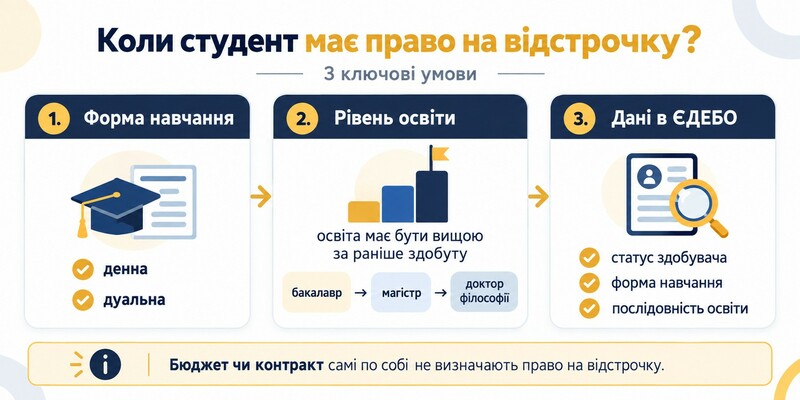
A student must check two key conditions: their officially registered form of study and whether their current education level is higher than the one already obtained. For example, full-time master's studies after obtaining a bachelor's degree generally meet the educational progression requirement. However, pursuing a second bachelor's degree after already obtaining one does not create a new ground for deferment merely because the studies are full-time.
Postgraduate Students
A postgraduate student is a student at the third (educational and scientific) level of higher education, which leads to a Doctor of Philosophy degree. A person does not need to already hold a PhD to qualify for deferment. The relevant criteria are current student status, full-time or dual education, and compliance with the educational progression requirements of Article 23.
Lecturers, Schoolteachers, and Researchers
The word «lecturer» in an employment record or everyday conversation is not an independent ground for deferment. It is necessary to establish whether the position is legally classified as teaching, research, or academic teaching and whether Article 23 covers the particular type of educational institution.
A schoolteacher and a university associate professor may qualify under different sets of conditions. An academic degree is not a general requirement for school teaching staff, whereas it is required for university academic teaching staff.
Deferment for Students: Main Conditions
Full-Time and Dual Education
Article 23 covers students of vocational, professional pre-higher, and higher education who study full-time or under a dual education system. Full-time education involves studying according to an approved educational program and an organized schedule. Dual education combines training at an educational institution with workplace-based learning under the relevant program.
Part-time, correspondence, and evening forms of study do not in themselves meet this requirement. However, attending classes remotely does not always mean that a person is officially enrolled in a distance-learning program.
Educational Progression
The law requires students to pursue an education level higher than the one previously obtained, following the sequence established by part two of Article 10 of the Law of Ukraine «On Education». In simplified form, the educational pathway can be presented as follows: vocational or professional pre-higher education → bachelor's degree → master's degree → Doctor of Philosophy. In individual cases, the complete list of education levels must be considered rather than applying this simplified scheme mechanically.
For example, entering a master's program after obtaining a bachelor's degree represents progression to a higher level. Entering a bachelor's program after already obtaining a master's degree does not. Switching from economics to law does not create a new education level if both programs lead to bachelor's degrees.
Does a Second Higher Education Degree Qualify for Deferment?
The term «second higher education» does not determine eligibility by itself. Three situations must be distinguished.
- Studying at a higher level. A person already has a bachelor's degree and is pursuing a master's degree for the first time. If the form-of-study requirement is met, this education may qualify for deferment, even if the new specialization is different.
- Repeated study at the same level. A person already holds a master's degree and enrolls in another master's program. The current level is not higher than the level already obtained, so this program alone does not establish student eligibility.
- Studying at a lower level. After obtaining a master's degree, a person enrolls in a bachelor's program or an institution of professional pre-higher education. Such enrollment also fails to meet the requirement to progress to a higher education level.
State-Funded and Tuition-Paying Education
Tuition-paying education does not deprive a student of the right to deferment. Article 23 does not make the general right to student deferment dependent on studying in a state-funded place. Tuition may be paid by the state, the student, their family, or an enterprise.
For comparison, a student pursuing a tuition-paying, full-time master's degree after a bachelor's degree may meet the conditions. A student pursuing a second state-funded bachelor's degree after already obtaining a bachelor's diploma does not meet the requirement for a higher education level.
What Does «Does Not Violate Educational Progression» Mean?
The certificate confirming student status, generated based on USEDE records, contains information used to assess educational progression. The entry «Yes, does not violate» means that, according to the available records, the current education meets the relevant criterion. The entry «No, violates» indicates that the register does not confirm compliance.
However, this entry does not replace a legal assessment. A negative result may be caused by a previously obtained diploma, but sometimes it results from incorrect data, duplicate records, or inaccurate information about unfinished studies. The information should be compared with education documents, expulsion orders, and the person's actual student status.
Deferment for Postgraduate Students
Which Postgraduate Students Are Eligible for Deferment?
A postgraduate student must confirm current enrollment in a Doctor of Philosophy program, the appropriate form of study, and compliance with the educational progression requirement. A typical situation involves holding a master's diploma and subsequently pursuing full-time postgraduate studies without previously obtaining a PhD.
The information must be up to date in the USEDE. Sometimes, after a transfer, change of research institution, or issuance of an enrollment order, the system continues to display the previous status. In such cases, automatic verification may fail to confirm eligibility even though the education documents exist.
Tuition-Paying Postgraduate Studies and Deferment
Tuition-paying postgraduate studies do not in themselves exclude deferment. The law distinguishes between the source of funding and the requirements for education-based eligibility: student status, form of study, and education level are relevant. Therefore, the statement that «only state-funded postgraduate students qualify for deferment» is incorrect as a general rule.
At the same time, eligibility for admission to a particular form of postgraduate study and eligibility for deferment are separate matters. In 2026, admission, transfer, and reinstatement rules may contain special restrictions.
Repeated Admission or Reinstatement in Postgraduate Studies
In this situation, it is necessary to check not only the new enrollment order but also previous USEDE records. If a person has already obtained a Doctor of Philosophy degree, repeated study at the same level generally does not meet the educational progression requirement. However, if the person was previously expelled without defending a dissertation and without being awarded the degree, the mere fact of previous studies does not automatically justify that conclusion.
In addition, Ministry of Education and Science Order No. 687 of April 27, 2026, establishes special rules for reinstatement and changes in student status during martial law. In particular, certain cases of reinstatement after completing postgraduate studies without defending a dissertation provide for correspondence or evening forms of study, which are not equivalent to full-time education for deferment purposes. The rules concerning academic leave also contain exceptions.
Deferment for Lecturers, Schoolteachers, and Researchers
Which Teaching Staff Are Eligible for Deferment?
General secondary education institutions. Schoolteachers and other employees whose positions are legally classified as teaching positions may qualify for deferment if the institution is their primary place of employment and they work at least 0.75 of a full-time position. The subject they teach is not decisive.
Vocational education institutions. Eligibility extends to teaching staff of the relevant institutions, including those providing theoretical or practical training in teaching positions. The official job title must be checked against the established list, and it must be confirmed that the institution legally belongs to an eligible category.
Professional pre-higher education institutions. A college lecturer may also qualify for deferment as a teaching employee. However, a college may also have academic teaching positions subject to an additional academic degree requirement. Therefore, what matters is not the designation «college» but the employee's specific legal employment status.
Research and Academic Teaching Staff
The law covers research and academic teaching staff at higher and professional pre-higher education institutions, research institutions, and organizations. This may include researchers at research institutions and university employees who combine educational, methodological, and scientific activities in relevant positions.
This category must confirm an academic degree, an eligible position, employment at their primary workplace, and a workload of at least 0.75 of a full-time position. Teaching at a university, publishing articles, or participating in research does not replace these requirements.
The 0.75 Full-Time Position Requirement
Article 23 requires employment at the primary workplace for at least 0.75 of a full-time position. If the documents indicate 1.0 or 0.75 of a full-time position, the quantitative requirement is met. If they indicate 0.5, it is not met, even if the person actually teaches many classes.
The fraction of a full-time position and the number of teaching hours are not identical measures. For example, additional hourly paid teaching hours do not always increase the officially registered fraction of a full-time staff position.
Primary Employment and Secondary Employment
Deferment is linked to the primary place of employment. Secondary employment constitutes a separate employment relationship and does not become primary employment simply because it involves more working hours or higher pay.
Example: a lecturer works at 0.5 of a full-time position at a university as their primary employment and 0.25 at a college as secondary employment. Mathematically, this totals 0.75, but the law does not automatically allow combining positions with different employers to meet the requirement at the primary workplace.
Who Needs an Academic Degree?
Research and academic teaching staff covered by the relevant category of Article 23 must hold an academic degree. This is confirmed by an appropriate diploma of Candidate of Sciences, Doctor of Philosophy, or Doctor of Sciences. An academic title and an academic degree are different legal concepts: the title of associate professor alone, without the required degree, does not replace the statutory requirement.
The law does not impose a general requirement to hold a PhD or Candidate of Sciences degree on teaching staff at general secondary, vocational, and professional pre-higher education institutions. A schoolteacher does not need to obtain an academic degree solely to apply for deferment.
USEDE and Deferment from Mobilization
What Student Information Is Checked in the USEDE?
The most important information includes the educational institution, current education level, form of study, student status, and education history. These records are used to establish whether the person is currently studying, whether the form of study meets legal requirements, and whether the new level is higher than the one previously obtained. Personal data should also be checked for accuracy: discrepancies between documents may prevent records from being matched.
What to Do If USEDE Records Are Incorrect
The correction procedure depends on the source of the error. There is no general rule under which every record can be changed exclusively by the university or exclusively by the Ministry of Education and Science.
- Identify the specific discrepancy. This may be an incorrect form of study, inaccurate status, missing diploma, duplicate education record, or negative educational progression verification result.
- Contact the educational institution. Ask the institution to check the information it creates and updates and explain why the records appear as they do.
- Identify who is responsible for the record. If the error originates from a previous institution, the current university may not have the authority to change it. The source of the information must be established.
- Contact the Ministry of Education and Science if necessary. This is relevant when the issue goes beyond a technical correction by the institution or concerns the application of educational progression rules.
- Consider applying to an administrative court. If an authorized body unlawfully refuses to act or fails to act, the available legal remedy will depend on the subject of the dispute and the appropriate defendant.
What Documents Are Required for Deferment?
Documents for Students and Postgraduate Students
For students, the main supporting document is a certificate confirming student status, generated in the USEDE according to the form in Annex 9 to Procedure No. 560. It reflects current education records and is used to verify the relevant grounds for deferment. Doctoral researchers must also provide confirmation of their status under the current procedure.
When applying in person, the applicant must have identification documents and a military registration document, along with the supporting documents required for their specific category. If there is a dispute concerning the records, it is advisable to prepare diplomas, enrollment or expulsion orders, and documents concerning changes to personal information.
A student ID card is not the primary document proving compliance with Article 23. By itself, it confirms neither educational progression nor a current USEDE record.
Documents for Teaching and Research Staff
A teaching employee must provide confirmation of their position at their primary workplace and the fraction of a full-time position they hold. This information is usually contained in a certificate issued by the educational institution, prepared in accordance with the requirements of Procedure No. 560. If necessary, the personnel documents on which the certificate was based are also checked.
Research or academic teaching staff must additionally provide an academic degree diploma, since it confirms a separate statutory requirement. An academic title or a list of publications should not be submitted instead of the required degree document.
How to Apply for Student or Postgraduate Deferment in 2026
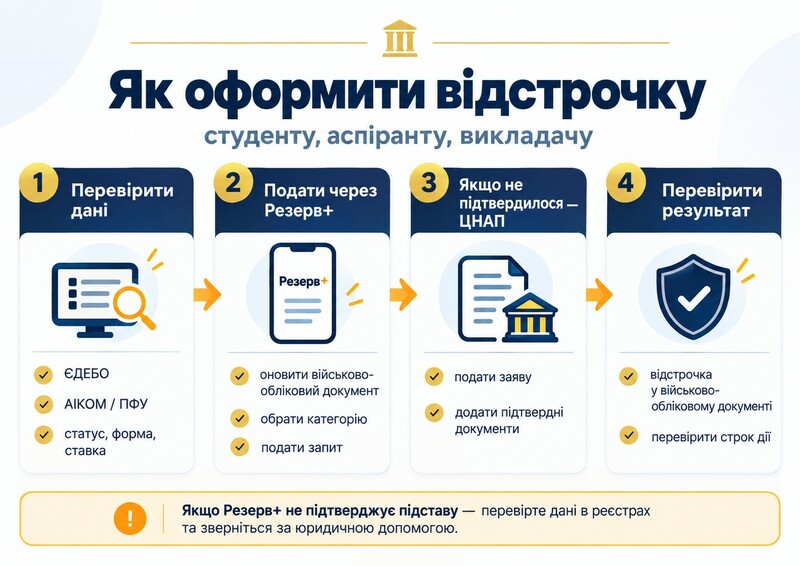
Applying Through Reserve+
- Update your electronic military registration document. Log in to the application and check your personal information to avoid submitting a request with outdated details.
- Open the deferment service. On the main screen, go to «Services» → «Deferment Request».
- Select the education category. Choose the grounds corresponding to your actual student or postgraduate student status.
- Submit the request. Check the information, confirm it, and send the request using the appropriate button.
- Wait for register verification. The application checks information, including USEDE records, and notifies you of the result. Having a student ID card does not replace this verification.
- Check the updated document. After a positive result, update your military registration document and make sure the deferment and its validity period are displayed correctly.
If the request is unsuccessful, save the system message. It will help distinguish a technical error from a missing education record or a negative educational progression entry.
When Should You Apply Through an ASC?
An Administrative Services Center (ASC) is needed if the online service is unavailable, the application cannot confirm eligibility through the registers, or the specific situation requires a review of supporting documents. This option is also available to people who cannot use a smartphone or the relevant online service.
The administrator accepts the application and required documents and forwards them for consideration to the authorized TCC and SP. The ASC does not decide whether to grant deferment and does not independently determine whether educational progression requirements have been met.
Is It Necessary to Submit Documents Directly to the TCC?
No. Under the standard procedure effective from November 1, 2025, deferment applications are submitted through Reserve+ or an ASC, rather than directly to the TCC and SP. These rules were introduced by amendments to Procedure No. 560 under Cabinet of Ministers Resolution No. 1364.
The TCC continues to perform its legally defined functions concerning consideration and registration but is not the usual point for accepting such applications. Specific exceptions may be established by regulations for certain special categories; they should not be applied to all students.
At the same time, the deferment application procedure should not be confused with the rules for military registration.
How Can a Lecturer or Schoolteacher Apply for Deferment?
Applying Through Reserve+
As of October 13, 2026, Reserve+ offers online deferment applications for specified categories of higher education, professional pre-higher education, and vocational education employees, as well as researchers. Availability for a specific category should be checked against the list in the application and the applicable register verification requirements.
Since September 10, 2026, the online service has also been available to schoolteachers and other teaching staff at general secondary education institutions. They use the category «Teachers and Other Teaching Staff of General Secondary Education Institutions».
The system checks AICOM — the Automated Information Complex of Educational Management — and data from the Pension Fund of Ukraine. The school must be registered as the primary place of employment, the position must be classified as a teaching position, the workload must be at least 0.75 of a full-time position, and the employer's details, including the EDRPOU code, must match.
When Is an ASC Required?
Applying through an ASC is advisable when Reserve+ cannot verify the position, primary place of employment, or workload, or when online applications are unavailable for the specific situation.
After verification, information may be corrected through the administration, personnel department, or accounting department. If the digital procedure does not support the situation or the documents require individual assessment, an application through an ASC with the evidence required by Procedure No. 560 is available.
What to Check with the Personnel Department Before Applying
Ask the personnel department to verify the exact job title, its teaching or academic teaching classification, primary place of employment, and fraction of a full-time position. These details must correspond to employment orders, labor records, and reporting data. It is especially important to identify situations where an employee officially holds 0.75 of a full-time position, but the system shows a lower workload.
Separately check the employer's EDRPOU code, the accuracy of your surname, and other personal details. For schools, check AICOM and Pension Fund records; for other institutions, check the relevant registers and personnel records.
How Long Is Deferment Granted to Students, Postgraduate Students, and Teachers?
Duration of Deferment for Students
Under the rules effective from September 1, 2026, deferment for eligible students is granted for an academic semester, but for no more than six months. This is not the same as deferment for the entire bachelor's, master's, or postgraduate program. Even when a program lasts several years, the expiration date of the current deferment must be monitored separately.
For example, a student may continue studying full-time even after their previously granted deferment expires. In that case, they should check whether it has been automatically extended or initiate an application under the current procedure.
Duration of Deferment for Teaching and Research Staff
For employees covered by the relevant subparagraph of Annex 5 to Procedure No. 560, deferment is granted for one year, but it cannot extend beyond the mobilization period established by a presidential decree or the date on which the lawful grounds cease to exist.
Therefore, receiving deferment does not provide unconditional protection for 12 months regardless of circumstances. If a lecturer resigns, transfers to an ineligible position, or has their workload reduced below 0.75 of a full-time position, the grounds may cease to exist earlier.
How Automatic Extension Works
Following the amendments effective from November 1, 2025, deferments whose grounds can be verified through state registers may be extended automatically. The application should display updated information after the relevant verification.
For students, USEDE records are essential. For education employees, the relevant information includes employment, position, workload, and other mandatory conditions. After an extension, the military registration document must be updated and the date checked; an old screenshot is not sufficient.
When Can a Student or Postgraduate Student Lose the Right to Deferment?
The grounds may cease to exist due to graduation, expulsion, loss of student status, transfer from full-time or dual education to correspondence education, or changes in education history that result in failure to meet the education-level requirement. After completing a bachelor's degree, merely intending to enroll in a master's program does not extend deferment: the new grounds require actual enrollment.
Academic leave must be assessed separately. It is not always equivalent to expulsion, but it does not guarantee continued deferment regardless of circumstances. The reason for the break, current USEDE status, and applicable provisions, including Ministry of Education and Science Order No. 687 on reinstatement procedures, must be checked. After a status change, it is also important to check the electronic military registration document.
When Can a Lecturer Lose the Right to Deferment?
The grounds may cease to exist in the event of dismissal, a change in primary place of employment, transfer to a position outside the legally defined category, reduction of the workload below 0.75 of a full-time position, or loss of another mandatory condition. For example, a schoolteacher transferred from a full-time to a half-time position no longer meets the employment requirement.
When transferring to another institution, the legal status of the new position and employer must be verified, and register information must be updated. A previously granted deferment does not remain valid unconditionally after circumstances change.
What to Do If Reserve+ Does Not Confirm Deferment
Check Records in the USEDE, AICOM, or Pension Fund
Students and postgraduate students should first check their USEDE records: form of study, education level, current status, and educational progression entry. Schoolteachers should check AICOM and Pension Fund records, particularly their position, workload, and primary employer. Other lecturers and researchers should check the registers used for their category and the relevant personnel documents.
Check the actual source of the information: a university certificate will not correct an error concerning primary employment in Pension Fund records, while a school's accounting department cannot change a student's education history in the USEDE.
Correct Inaccurate Information
Contact the institution responsible for the specific information. For a current education record, this may be the educational institution; for an older record, the previous institution or another authorized body. For AICOM, contact the responsible school employee. For employment information in the Pension Fund, contact the employer's personnel or accounting department and, if necessary, the authorized authority.
Request written confirmation of the reason for the error and the result of the correction. If the discrepancy remains unresolved, another request through Reserve+ may again fail verification.
Submit an Application Through an ASC
If online processing is unavailable or eligibility requires documentary assessment, apply through an ASC. Prepare the documents specified in Annex 5 to Procedure No. 560 for your own category; do not copy another applicant's document package.
The administrator will forward the application to the competent authority for consideration. Keep proof of submission and check whether the result appears in your military registration document.
What to Do in Case of an Official Refusal
Obtain the decision and establish the reasons: an ineligible form of study, violation of educational progression requirements, insufficient supporting documents, a register error, or another reason. Compare the authority's conclusions with Article 23 and the documents. If there are no lawful grounds for refusal, possible options include an administrative appeal, correction of errors followed by a new application, or a lawsuit before an administrative court.
It is important to define the subject of the dispute: challenging the refusal to grant deferment and requesting correction of USEDE records may require different defendants and evidence. Read more about eligibility and appeals in our article «Deferment from Mobilization: Grounds and Eligibility».
Common Mistakes About Student and Teacher Deferment
- Myth: «A student ID card automatically grants deferment». In fact, an eligible form and level of education must be confirmed by register data.
- Myth: «Any full-time education qualifies for deferment regardless of previous diplomas». The legally required educational progression must be maintained.
- Myth: «Tuition-paying students are not eligible for deferment». The source of funding does not in itself determine eligibility.
- Myth: «Every university lecturer qualifies for deferment». The position, workload, primary place of employment, and academic degree, where required, are considered.
- Myth: «A 0.5 position plus 0.25 at another institution meets the required 0.75». At least 0.75 of a full-time position must be held at the primary workplace.
- Myth: «All teaching staff need an academic degree». There is no such general requirement for schoolteachers.
- Myth: «Documents must be submitted directly to the TCC». Standard applications are submitted through Reserve+ or an ASC.
- Myth: «If deferment was displayed in Reserve+, there is no need to check its validity period». The current expiration date and grounds must be monitored.
FAQ: Frequently Asked Questions
Is a Ukrainian Student Studying at a Foreign University Eligible for Deferment?
Studying abroad does not automatically confirm eligibility for deferment in Ukrainian registers. It is necessary to separately assess the requirements of Article 23, foreign education documents, the form of study, and whether those documents can be used under the current Procedure No. 560. A foreign university generally does not issue a standard USEDE certificate; therefore, a certificate issued abroad alone does not guarantee approval.
Does Official Employment Affect a Student's or Postgraduate Student's Right to Education-Based Deferment?
Employment does not in itself cancel education-based eligibility. If the person continues studying in an eligible form and meets the education-level requirements, having an employment contract is not an independent ground for refusal. It is important that the actual employment relationship does not result in a change to the officially registered form of study or loss of student status.
Is Deferment Available Between Completing a Bachelor's Degree and Actual Enrollment in a Master's Program?
There is no automatic student deferment «during the admission campaign». After completing a bachelor's degree, the corresponding grounds cease to exist, while the intention to enroll, submission of an application, or recommendation for admission does not yet constitute master's student status. New grounds arise after proper enrollment, provided that the legal requirements are met.
Can a Student Study at Two Institutions Simultaneously, and Which Education Is Considered for Deferment?
Simultaneous studies at two institutions do not create double or longer deferment. What matters is having at least one valid ground under Article 23. For each program, the form of study, education level, and education history in the USEDE should be checked, including previously obtained diplomas.
Is a Teaching Employee at a Private School or Private College Eligible for Deferment?
Such eligibility is possible: private ownership alone is not an obstacle. The institution must belong to a category provided for by law, the position must be classified as teaching, the employee must have it as their primary place of employment, and the workload must be at least 0.75 of a full-time position. For colleges, it is important not to confuse teaching and academic teaching positions, since their documentary requirements differ.
Does Additional Secondary Employment Prevent a Lecturer from Obtaining Deferment If They Work at Least 0.75 of a Full-Time Position at Their Primary Workplace?
No. If the primary employment meets all the requirements of Article 23, additional secondary employment does not in itself deprive the person of eligibility. However, secondary employment cannot compensate for an insufficient workload at the primary workplace.
What Happens If a Person Qualifies for Deferment Both as a Student and as a Teacher?
Having two grounds does not mean their validity periods are added together. It is necessary to determine which ground is already reflected in the military registration document and, if needed, use the procedure for changing the registered grounds. Before making a change, it is important to assess the stability of each: student status ends after graduation, while teaching eligibility depends on employment, position, and workload.
Can a Person Voluntarily Give Up an Already Granted Deferment Based on Education or Employment in the Education Sector?
It is necessary to distinguish between the desire to voluntarily perform military service and the legal termination of an existing deferment. Deleting Reserve+, refusing to show the document, or making a verbal statement does not in itself cancel the register entry. If a person plans to enter military service, they must clarify the applicable procedure and the possibility of signing a contract, taking their status into account. Any change must be formalized officially.

Leave a request for consultation and our specialist will contact you soon!
Leave a request and our specialist will contact you soon!




Fill out the form or contact us in any way convenient for you
Choose the nearest office to you and receive consultations in a convenient format for you