

Article 190 of the Criminal Code of Ukraine: Liability for Fraud, Qualifying Elements, and Case Law
Article 190 of the Criminal Code of Ukraine provides liability for taking possession of another person’s property or the right to it by deception or abuse of trust. Qualification depends on the method of actions, intent, amount of damage, and other circumstances.
Fraud may fall under one of five parts of Article 190 of the Criminal Code of Ukraine — from the basic offense to acts committed on an especially large scale or by an organized group.

What is fraud under Article 190 of the Criminal Code of Ukraine?
Fraud is taking possession of another person’s property or acquiring the right to property by deception or abuse of trust. Its key feature is that the victim personally transfers the property or creates the possibility of acquiring the right to it, but does so because of a false perception formed by the guilty person.
It is this externally voluntary transfer that distinguishes classic fraud, in particular, from theft, where property is taken without the owner’s expression of will.
What is considered deception?
Deception consists of deliberately misleading another person in order to induce them to transfer property or the right to it.
It may be manifested in communicating knowingly false information, using invented facts, creating a false impression about a person, product, service, authority, or intentions, as well as concealing essential circumstances.
Active deception involves certain actions: a false story, a fictitious advertisement, demonstration of fake documents, or impersonating another person. Passive deception may consist of intentionally withholding circumstances, knowledge of which could have changed the victim’s decision.
It is important that the deception itself influenced the victim’s decision to dispose of the property.
What abuse of trust means
Abuse of trust means using already existing trust-based relationships to take possession of property. Their source may be personal, family, friendly, business, official, or other relationships.
For example, a person may receive money precisely because the victim has known them for a long time, cooperates with them, or relies on their professional or official status. If such trust is deliberately used as a way to take possession of property, this may constitute fraud.
When fraud is considered completed
Fraud involving taking possession of property is considered completed when the guilty person has actually received the property and acquired a real opportunity to dispose of it as their own. If it concerns acquiring the right to property, what matters is acquiring a real opportunity to exercise the relevant right.
If a person has already begun implementing a fraudulent plan but did not receive the property due to circumstances beyond their control, this may constitute an attempted criminal offense under the general provisions of the Criminal Code of Ukraine on unfinished criminal offenses.
Elements of the criminal offense under Article 190 of the Criminal Code of Ukraine
Object and subject matter of fraud
The object of fraud is legally protected property relations.
The subject matter may be another person’s property — money, things, and other material assets — or the right to property. The second option covers situations where, through deception, a person obtains not the thing itself, but the legal possibility to claim or dispose of it.
Objective side
The objective side consists of taking possession of another person’s property or acquiring the right to property by deception or abuse of trust.
Therefore, it is not enough to establish only that the victim transferred money and the other party did not return it. A causal link must be proven: the property was transferred specifically because the victim was misled or their trust was abused.
Subject of fraud
As a general rule, the subject of fraud is a sane natural person who was 16 years old at the time of committing it. Article 190 is not included in the list of offenses for which the Criminal Code of Ukraine provides liability from the age of 14.
Subjective side
Fraud is characterized by direct intent: the person realizes that, by means of deception or abuse of trust, they are taking possession of another person’s property and desires this.
The property-oriented nature of the actions is obvious, but a selfish motive should not be mechanically called a mandatory formal feature of every offense involving taking possession of another person’s property. The Joint Chamber of the Criminal Cassation Court of the Supreme Court, in its ruling of June 1, 2026 in case No. 369/11891/22, emphasized the decisive importance of direct intent to unlawfully and irreversibly take possession of another person’s property; the specific motive may matter, in particular, for individualizing liability.
The moment when intent arises is especially important. If a person really planned to perform the contract when receiving the money, but later failed to do so due to financial problems, conflict, or other circumstances, the mere non-performance of an obligation is not enough for Article 190 of the Criminal Code of Ukraine.
Another situation is when, even before receiving the property, the person decided to appropriate it, and the contract, loan, order, or other legal relationship was used only as a way to obtain that property.
Qualifying features of fraud under Article 190 of the Criminal Code of Ukraine
Article 190 provides for a gradual increase in liability depending on repetition, participation of several persons, amount of damage, method of commission, and other features.
| Part of the article | Qualifying features | Maximum sanction |
| Part 1 | Basic offense of fraud | restriction of liberty for up to 3 years |
| Part 2 | repeatedly; by prior conspiracy by a group of persons; significant damage | imprisonment for up to 3 years or restriction of liberty for up to 5 years |
| Part 3 | under martial law or a state of emergency and causing significant damage | imprisonment for up to 5 years |
| Part 4 | large scale; illegal operations using electronic computing equipment | imprisonment for up to 8 years |
| Part 5 | especially large scale; organized group | imprisonment for up to 12 years with confiscation of property |
Repeated fraud
Repetition in this case is a legal concept, not simply a situation where a person “did the same thing twice”.
For Articles 185, 186, 189–191 of the Criminal Code, a criminal offense is recognized as repeated if committed by a person who previously committed any of the offenses provided for by these articles or Articles 187 or 262 of the Criminal Code of Ukraine. At the same time, the general rules of the Criminal Code regarding repetition must also be taken into account.
Fraud by prior conspiracy by a group of persons
This feature provides for the participation of at least two persons who, in advance, before the criminal offense began, agreed to commit it jointly.
The simultaneous participation of several people without proven prior agreement does not in itself mean that this qualifying feature is present.
Fraud causing significant damage to the victim
Significant damage is one of the features of Part 2 of Article 190. It is determined not only by a mathematical threshold, but also taking into account the victim’s financial situation.
The Criminal Code of Ukraine establishes the relevant range for this category in tax-free minimum incomes of citizens.
Fraud under martial law or a state of emergency
The mere fact that fraud was committed during martial law does not mean automatic qualification under Part 3 of Article 190 of the Criminal Code of Ukraine.
The current wording of the provision requires two features at the same time: the act committed under martial law or a state of emergency and the causing of significant damage to the victim. If there is no significant damage, qualification under Part 3 solely because of the fact of martial law is incorrect.
Fraud on a large scale
Large scale is an independent ground for qualification under Part 4 of Article 190 of the Criminal Code of Ukraine.
The relevant threshold is determined by the number of tax-free minimum incomes of citizens established by the note to Article 185 of the Criminal Code, and its monetary equivalent must be determined according to the rules in force at the time the act was committed.
Fraud using electronic computing equipment
Part 4 of Article 190 covers fraud committed through illegal operations using electronic computing equipment.
What matters is not simply the use of a phone or the internet, but the nature of the operations: for example, illegal use of software, remote banking, or electronic means for actual disposal of another person’s funds.
Fraud on an especially large scale
Fraud on an especially large scale is qualified under Part 5 of Article 190 of the Criminal Code of Ukraine. The threshold is also determined through the tax-free minimum income of citizens and must be calculated according to the rules in force at the time of the offense.
Fraud committed by an organized group
An organized group differs from an ordinary group acting by prior conspiracy by a higher level of organization.
Under Article 28 of the Criminal Code of Ukraine, this refers to three or more persons who previously organized themselves into a stable association, have a single plan known to the participants, and distribute functions among themselves. Fraud committed by an organized group is covered by Part 5 of Article 190.
Liability and punishment for fraud
The specific punishment depends on the part of Article 190 under which the actions are qualified, as well as on the circumstances of the proceedings, the offender’s personality, and mitigating and aggravating circumstances.
| Part | What liability is provided for | Types of punishment |
| Part 1 of Article 190 | basic offense of fraud | fine of 2,000–3,000 tax-free minimum incomes; community service for 200–240 hours; correctional labor for up to 2 years; probation supervision for up to 3 years; restriction of liberty for up to 3 years |
| Part 2 of Article 190 | repetition, prior conspiracy by a group of persons, or significant damage | fine of 3,000–4,000 tax-free minimum incomes; correctional labor from 1 to 2 years; restriction of liberty for up to 5 years; imprisonment for up to 3 years |
| Part 3 of Article 190 | martial law/state of emergency + significant damage | fine of 4,000–8,000 tax-free minimum incomes or imprisonment for 3 to 5 years |
| Part 4 of Article 190 | large scale or illegal operations using electronic computing equipment | imprisonment for 3 to 8 years |
| Part 5 of Article 190 | especially large scale or organized group | imprisonment for 5 to 12 years with confiscation of property |
Significant damage, large and especially large scale: how they are determined
For Article 190 of the Criminal Code of Ukraine, the boundaries of significant damage, large scale, and especially large scale are determined through the note to Article 185 of the Criminal Code of Ukraine.
| Category | Criterion under the Criminal Code of Ukraine | What is taken into account |
| Significant damage | from 100 to 250 tax-free minimum incomes | also the victim’s financial situation |
| Large scale | 250 or more tax-free minimum incomes | value of the property at the time of committing the offense |
| Especially large scale | 600 or more tax-free minimum incomes | value of the property at the time of committing the offense |
For qualification, it is not possible to simply multiply the tax-free minimum income by UAH 17. The hryvnia threshold is determined according to the rules of the Tax Code for the year in which the offense was committed.
What is considered significant damage
For significant damage, not only the legally established quantitative range is important. The Criminal Code directly requires taking into account the victim’s financial situation.
Therefore, assessment of damage must be carried out taking into account the specific circumstances, not only by mechanically comparing the amount with the general threshold.
What is considered large scale
Large scale for fraud is taking possession of property in an amount that reaches the threshold established by the note to Article 185 of the Criminal Code — 250 or more tax-free minimum incomes for purposes of criminal law qualification.
This feature transfers fraud to Part 4 of Article 190.
What is considered especially large scale
Especially large scale begins from 600 tax-free minimum incomes for purposes of qualification. If this feature is present, the act falls under Part 5 of Article 190 of the Criminal Code of Ukraine.
Internet fraud: what liability is provided
Which internet fraud schemes are most common?
In practice, fraudulent deception may be carried out through phishing websites, fictitious online stores, false advertisements on marketplaces, fake bank pages, obtaining bank details, or confirmation codes.
Hacked social media accounts are also used, from which money is requested in the owners’ names, as well as fictitious charity fundraisers, pseudo-investment, and cryptocurrency projects.
But for criminal law assessment, what matters is not the name of the scheme, but how exactly the property was taken.
When internet fraud may be qualified under Part 4 of Article 190
Part 4 may apply if possession was obtained through illegal operations using electronic computing equipment.
A demonstrative example is the ruling of the Criminal Cassation Court of the Supreme Court of March 9, 2026 in case No. 712/6681/23. The person used the victim’s phone, financial number, software, and internet banking, impersonated the account owner, and conducted financial transactions without the owner’s consent. The Supreme Court confirmed the fraudulent method of taking possession of funds using electronic means.
At the time those actions were committed, the relevant qualifying feature was contained in another part of Article 190. In the current structure of the article, it is provided for by Part 4.
Why not every fraud committed through the internet is automatically Part 4 of Article 190
If a fraudster simply posted a false advertisement on a social network, convinced a person to transfer an advance payment, and disappeared, the internet may have been only a means of communication.
This is fundamentally different from a situation where a person illegally uses electronic systems, banking services, software, or obtained access to accounts without the owner’s will.
Therefore, qualification is determined by the actual mechanism of taking possession of funds, not by the mere presence of correspondence in Telegram, Viber, Instagram, on a marketplace, or another website.
How fraud differs from other offenses
For correct qualification, it is important to establish exactly how the property left the victim’s possession.
| Offense | How property is taken | Key difference |
| Fraud, Article 190 | the victim transfers property under the influence of deception or abuse of trust | deception determines the decision to transfer |
| Theft, Article 185 | property is secretly taken | the victim does not transfer it to the guilty person |
| Appropriation/misappropriation, Article 191 | property that had already been entrusted to the person or was under their control is unlawfully converted | before the illegal actions, the property was held by the person on an appropriate legal basis |
| Extortion, Article 189 | the person is forced to transfer property by threat | the expression of will is formed under coercion, not deception |
| Forgery of documents, Article 358 | a document is forged or a forged document is used | the encroachment has independent features; combination with Article 190 is possible |
Fraud and theft
The main question is whether the victim transferred the property specifically to the guilty person under the influence of deception.
If deception merely helped gain access to another person’s property, after which the person independently stole it, this may be theft.
This is exactly the approach the Criminal Cassation Court of the Supreme Court applied in case No. 655/289/17: a man introduced himself as the son of the owner of a bag in order to take it from a bus driver. The victim did not transfer the bag to the guilty person and was not misled by him — deception of a third person was only a way to gain access to the property. The court upheld the qualification as theft.
Fraud and appropriation or misappropriation under Article 191 of the Criminal Code of Ukraine
In fraud, the guilty person receives another person’s property as a result of deception or abuse of trust.
In appropriation or misappropriation, before the illegal actions began, the property had already been entrusted to the person or was under their control on an appropriate legal basis. Therefore, the legal status of the property before the criminal intent arose is of key importance.
Fraud and extortion
In fraud, the victim transfers property because they were misled. In extortion, the transfer is connected with a demand supported by threats provided for by Article 189 of the Criminal Code of Ukraine.
That is, voluntariness in fraud is a consequence of deception, while in extortion the victim’s will is suppressed by threat.
Fraud and forgery of documents
A forged document may be an instrument of deception: for example, it may be used to confirm non-existent powers, rights, or circumstances.
If there is simultaneously an independent offense of forgery or use of a forged document, the actions may require qualification under a combination of Article 190 and the relevant part of Article 358 of the Criminal Code of Ukraine. The specific qualification depends on who made the document, how it was used, and what specific actions the person committed.
When non-performance of a contract is fraud and when it is a civil dispute
The mere fact of non-performance of a contract does not turn the legal relationship into criminal proceedings under Article 190 of the Criminal Code of Ukraine. What is decisive is proving that, at the moment of receiving the property, the person already had fraudulent intent.
Why failure to repay a debt is not fraud by itself
A borrower may fail to return money due to job loss, business bankruptcy, conflict with the creditor, an error in financial calculations, or other circumstances.
This may be grounds for debt recovery in civil proceedings, but does not automatically prove the existence of fraud.
What importance intent has at the moment of receiving money or property
If, at the moment of receiving money, the person intended to fulfill their obligations, and refusal or inability to perform arose later, this is significantly different from an initial fraudulent plan.
If, however, the contract was from the very beginning only a pretext to obtain another person’s property and not return it, the civil-law form of the relationship does not exclude criminal liability.
What circumstances may indicate initial fraudulent intent
It may be indicated by knowingly false information before the transfer of money, absence of any real ability to fulfill what was promised, use of fictitious documents, concealment of essential circumstances, a fictitious person or company, as well as similar actions toward other victims.
None of these circumstances by itself means automatic proof of fraud. Intent is assessed based on the totality of evidence.
What evidence matters in fraud cases
Documents and financial transactions
These may include contracts, receipts, invoices, acts, payment confirmations, bank statements, transfers between accounts, checks, data on the movement of funds, and other documents.
They help establish the amount, date, and basis for transferring the property, as well as the subsequent movement of the received funds.
Correspondence and electronic evidence
Correspondence in messengers, emails, advertisements, web pages, personal account data, audio recordings, and other digital information may be significant.
However, it is not enough to simply show a separate screenshot. For evidentiary value, the source of information, the ability to identify the participants in the communication, the integrity of the data, and compliance with the procedural order for obtaining and examining them are important.
Evidence of initial intent
The most difficult issue is proving that fraudulent intent already existed at the moment of receiving the property.
Therefore, actions before the transfer of funds are analyzed: what exactly the person promised, whether they had resources to fulfill what was promised, what information they provided, whether it was true, what they concealed, how they acted immediately after receiving the money, and whether similar episodes existed.

Court practice under Article 190 of the Criminal Code of Ukraine
Supreme Court practice shows that, for qualification under Article 190, not only the fact of property loss matters, but also the method of obtaining it and the direction of intent.
Fraud or civil-law dispute
Ruling of the Criminal Cassation Court of the Supreme Court dated November 8, 2023, case No. 161/1826/19.
A person received USD 40,000 as a loan, but the courts established that from the beginning they had no intention of fulfilling their obligations. The Supreme Court noted: the mere existence of a contract does not exclude fraud if civil-law relations were used to implement an initial intent to take possession of property.
A similar significance of the moment when intent arises can be traced in the ruling of the Criminal Cassation Court of the Supreme Court dated March 10, 2026 in case No. 138/1733/25. The court established that the person was genuinely preparing to organize illegal border crossing, so receiving money was not recognized as fraud.
Fraud or theft
Ruling of the Criminal Cassation Court of the Supreme Court dated April 2, 2019, case No. 655/289/17.
A man introduced himself as the son of the owner of a bag and received it from a bus driver. The Supreme Court upheld the qualification as theft, since the victim did not transfer the property to the guilty person under the influence of deception — the deception only provided access to the item.
Fraud or extortion
Ruling of the Criminal Cassation Court of the Supreme Court dated June 25, 2026, case No. 686/14719/19.
In some episodes, money was obtained through false information about the sale of fuel, which was qualified as fraud. In another episode, money was demanded using violence and threats, which constituted extortion.
The case demonstrates the key difference: in fraud, the transfer of property is caused by deception, while in extortion — by threat or violence.
Practice regarding qualified types of fraud
Ruling of the Criminal Cassation Court of the Supreme Court dated March 9, 2026, case No. 712/6681/23.
The convicted person used the victim’s phone, financial number, and internet banking to conduct transactions without the owner’s permission. The Supreme Court confirmed the fraudulent method of taking possession of funds using electronic means.
In the current wording of Article 190, this qualifying feature is provided for by Part 4.
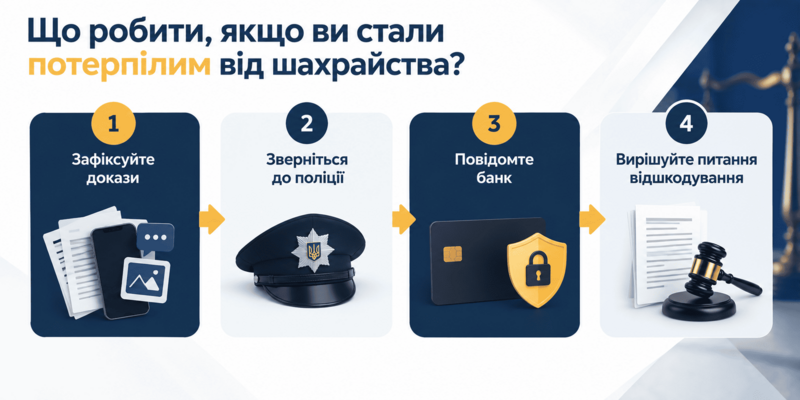
What to do if you have become a victim of fraud
The sooner the circumstances of fraud and the movement of funds are recorded, the more information can be used during the investigation.
- Record and preserve evidence. Do not delete correspondence, advertisements, emails, checks, account details, phone numbers, or links. If possible, save the original files and devices containing the information.
- Contact the police or cyber police. In the application, it is worth consistently describing the method of deception, the moment and amount of the transfer of funds, known data about the person, accounts, and other evidence.
- Immediately contact the bank in case of a fraudulent payment transaction. If a third party gained access to a card, account, or banking application, it is necessary to notify the bank, block the relevant instruments, and find out the possibility of disputing the transaction.
- Resolve the issue of compensation for damage. The victim may use the legal methods of compensation for losses, including a civil claim in criminal proceedings. The mere fact of opening criminal proceedings does not guarantee automatic return of money.
Limitation periods in fraud cases
The limitation period depends not on the general name “fraud”, but on the part of Article 190 and the category of the criminal offense under Articles 12 and 49 of the Criminal Code of Ukraine.
| Part of Article 190 | Category under the current wording of the Criminal Code | General limitation period |
| Part 1 | criminal misdemeanor punishable by restriction of liberty | 3 years |
| Part 2 | minor crime | 5 years |
| Part 3 | minor crime | 5 years |
| Part 4 | serious crime | 10 years |
| Part 5 | especially serious crime | 15 years |
These are the basic periods under the current wording of the Criminal Code of Ukraine. Their running may be suspended or interrupted in cases provided by law, in particular depending on the person’s behavior and commission of a new criminal offense.
In addition, for acts committed before changes to the wording of Article 190 or the sanctions of its individual parts, the rules on the effect of the criminal liability law over time are analyzed separately. Therefore, the current table cannot be mechanically applied to an old episode.
Common mistakes in interpreting Article 190 of the Criminal Code of Ukraine
- “Did not repay a debt — therefore a fraudster”. Not always. For Article 190, it is necessary to prove that intent to take possession of property by deception or abuse of trust already existed at the moment of receiving the money.
- “Any internet fraud is Part 4”. No. The website, messenger, or social network itself may be only a communication channel. For the relevant feature of Part 4, illegal operations using electronic computing equipment are required.
- “Any fraud during war is Part 3”. No. The current Part 3 simultaneously requires fraud to be committed under martial law or a state of emergency and significant damage to be caused to the victim.
- “If the victim voluntarily transferred the money, there is no fraud”. On the contrary, an externally voluntary transfer under the influence of deception or abuse of trust is a characteristic feature of fraud.
- “The amount of damage can be determined by any amount current today”. No. The threshold is determined according to the rules applicable to the relevant period when the offense was committed.
- “If there is a contract, there can be no criminal liability”. The existence of a contract by itself does not exclude fraud. It is important to establish whether it was used as an ordinary civil-law transaction or from the beginning as a means of implementing fraudulent intent.
Frequently Asked Questions
Can a civil claim for the return of money be filed within criminal proceedings under Article 190?
Yes. The victim may file a civil claim for compensation for property and moral damage within criminal proceedings.
Does voluntary compensation for damage to the victim affect punishment?
Yes. Voluntary compensation for losses may be taken into account by the court as a circumstance mitigating punishment.
Is reconciliation with the victim and release from criminal liability for fraud possible?
In certain cases — yes. This depends on the part of Article 190, the circumstances of the case, the fact of reconciliation, and compensation for damage.
Can one fraudulent scheme be qualified simultaneously under Article 190 and other articles of the Criminal Code of Ukraine?
Yes. If other independent criminal offenses were committed alongside fraud, qualification under a combination of articles is possible.
Is a person liable if they provided fraudsters with their bank card or account but did not personally communicate with the victim?
This depends on their intent and role in the scheme. The mere fact that an account was used does not prove complicity in fraud.
What to do if the person who received the money is abroad?
It is still possible to file a report of a criminal offense in Ukraine. Further actions depend on the person’s location and the possibilities of international cooperation.
Can moral damages be claimed in a fraud case?
Yes. The victim may claim compensation for moral damage if they substantiate the fact and amount of such damage.
What to do if the police do not enter a fraud report into the URPTI?
Inaction regarding failure to enter information into the URPTI may be appealed to an investigating judge in the manner provided by the Criminal Procedure Code of Ukraine.

Leave a request for consultation and our specialist will contact you soon!
Leave a request and our specialist will contact you soon!




Fill out the form or contact us in any way convenient for you
Choose the nearest office to you and receive consultations in a convenient format for you