

Exemption from Military Registration: Grounds Related to Health and Age
Exclusion from military registration in 2026 is possible, in particular, on the grounds of unfitness for military service as determined by a military medical commission (MMB) or upon reaching the maximum age for remaining in the military reserve. For most persons liable for military service, this age is 60, while for higher-ranking officers it is 65. Age-based exclusion is carried out automatically through the «Oberih» register, and the current status can be checked in Reserve+. If the information has not been updated, the person should contact the TCR and SP to have it corrected.

What Does Exclusion from Military Registration Mean?
Exclusion from military registration means terminating a citizen's registration as a conscript, a person liable for military service, or a reservist. It is permitted only on grounds expressly established by law, including a determination of unfitness for military service or reaching the maximum age for remaining in the military reserve.
The main rules are set out in part 6 of Article 37 of the Law of Ukraine «On Military Duty and Military Service». The consequences of exclusion differ from those of deferment or reservation from mobilization: exclusion involves a change in a person's military registration status rather than a temporary exemption from conscription.
At the same time, the absence of information in Reserve+ does not mean that a person has been legally excluded from military registration. The application displays information from the «Oberih» register, where errors or delays in updating records may occur. Properly issued decisions, military registration records, and the military registration document (MRD) serve as confirmation of status. If these sources contain conflicting information, the grounds and date of exclusion should be verified rather than relying solely on the status displayed in the application.
How Does Exclusion Differ from Removal from Military Registration?
These terms are often used interchangeably, although the law distinguishes between them in parts 5 and 6 of Article 37. Removal from registration is generally associated with a change in the place or category of registration or other specified circumstances. Exclusion means terminating military registration on a particular lawful ground.
| Criterion | Removal from Registration | Exclusion from Registration |
|---|---|---|
| Military registration status | The person generally remains in the relevant category or moves to another registration category | Military registration is terminated |
| Re-registration | Required in applicable cases | Only where a lawful ground exists |
| Mobilization | Removal alone does not eliminate the possibility of conscription | A person lawfully excluded from registration is not subject to conscription as a person liable for military service |
| Typical grounds | Changes in registration, conscription into service, transfer between categories | Unfitness, maximum age, and other circumstances under part 6 of Article 37 |
| Entry in the MRD | Information about removal or a change of category | Information about exclusion and its grounds |
Why Does «Removed from Registration» Not Mean «Not Subject to Mobilization»?
For example, after moving to another location, a person liable for military service may be removed from registration at one TCR and registered at their new place of residence. This does not make the person unfit for service or exempt them from military duty. Therefore, an old «removed from registration» entry without an explanation of the reason does not confirm exemption from conscription. It is necessary to establish whether the person was actually excluded from military registration and on what grounds.
Grounds for Exclusion from Military Registration
The complete list of grounds is established by part 6 of Article 37 of the Law of Ukraine «On Military Duty and Military Service». As of October 2026, it provides for six circumstances.
| Grounds | Specific Requirements |
|---|---|
| Death, recognition as missing, or declaration of death | Appropriate official records or a court decision are required |
| Termination of Ukrainian citizenship | Citizenship must be legally terminated; merely moving abroad is insufficient |
| Determination of unfitness for military service | A MMB decision properly issued under the applicable rules is required |
| Reaching the maximum age for remaining in the military reserve | In 2026, automatic exclusion through «Oberih» applies |
| Rejection of a contract service candidate under part 10 of Article 20 of the Law | A special case involving candidates aged 60 and older |
| Discharge from contractual military service under subparagraphs «й» and «к» of paragraph 3, part 5, Article 26 | Special statutory grounds applicable to the relevant contract servicemembers |
The last two grounds relate to special rules for voluntary contractual military service and do not automatically apply to all persons liable for military service. Most questions concern two circumstances: medical unfitness and reaching the maximum age. Disability, employee reservation, or residence abroad cannot be independently added to the statutory list.
Exclusion from Military Registration on Health Grounds
A serious diagnosis, surgery, or prolonged treatment does not, in itself, terminate military registration. The legal basis is a determination of unfitness for military service by a military medical commission. The MMB assesses not only the medical diagnosis but also the severity of the condition, functional impairments, and examination results.
Proper completion of the decision-making procedure is also important. A person may receive preliminary information about the examination result, but changing their status requires a decision that has undergone the prescribed review and approval procedures, where applicable. The relevant information must then be entered into the military registration records.
Which MMB Conclusion Provides Grounds for Exclusion?
It is necessary to distinguish permanent unfitness from temporary restrictions and fitness for service in specific units.
| MMB Conclusion | Consequences for Military Registration |
|---|---|
| Unfit for military service | Grounds for exclusion after proper completion of the procedure |
| Temporarily unfit; requires treatment or reassessment | Does not constitute permanent exclusion |
| Fit for service in designated military units or subdivisions | The person remains fit for service within the specified limitations |
Temporary unfitness may be associated with treatment or recovery from an injury. If the decision requires a repeat medical examination, it cannot be treated as permanent exclusion. Similarly, fitness for service in support units, TCRs, communications units, or logistics units does not mean complete unfitness.
The designation «limited fitness» has been abolished as a current MMB examination result. If it remains recorded in an old military ID, current medical conclusions and reassessment rules must be checked rather than treating it as an automatic ground for exclusion.
Is Disability a Ground for Exclusion?
No. The establishment of Group I, II, or III disability is not equivalent to a MMB decision declaring a person unfit for military service. These are different procedures with different purposes and legal consequences.
Disability reflects long-term limitations in a person's daily functioning. Deferment establishes the right not to be conscripted under circumstances specified by law. The MMB determines a person's fitness for military service. Exclusion, in turn, terminates military registration on grounds listed in Article 37.
For example, a person with Group III disability may qualify for deferment while remaining liable for military service. Conversely, a person without an officially established disability may be declared unfit by the MMB. The main rule is that medical documents confirming disability have evidentiary value but do not replace the procedure for determining fitness for military service.
Which Medical Conditions May Lead to a Finding of Unfitness?
There is no single, simple «list of diseases for exclusion». The criteria are set out in the Schedule of Diseases attached to the Regulations on Military Medical Examination, approved by Ministry of Defense Order No. 402. They cover, among other conditions, heart diseases, disorders of the nervous system, respiratory diseases, cancer, and the consequences of severe injuries. However, having a diagnosis from one of these categories does not automatically mean unfitness.
For the MMB, the relevant article and paragraph of the Schedule of Diseases, stage of the disease, degree of functional impairment, examination results, and medical history are important. For example, the same diagnosis may lead to different conclusions depending on objectively established complications. Medical evidence must be assessed against regulatory criteria rather than lists found online.
The specifics of assessing medical conditions are explained in the article «Which Medical Conditions Exempt You from Mobilization in 2026?».
How Exclusion on Health Grounds Works
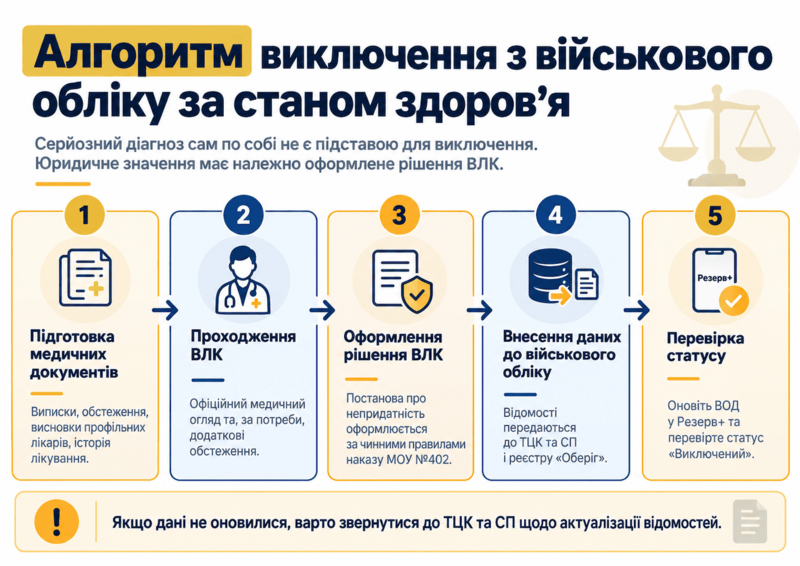
The procedure consists of medical and registration stages. Obtaining a conclusion of unfitness and verifying that the information has been entered correctly are separate tasks. If the process stops after the examination, the previous status may remain in the register.
Step 1. Preparing Medical Documents
Before undergoing a MMB examination, it is necessary to collect hospital discharge summaries, examination results, specialist medical opinions, and records of previous treatment. If a person has undergone surgery, sustained a serious injury, or has a chronic illness, the relevant medical records should also be prepared.
Documents confirming not only the diagnosis but also the degree of functional impairment are particularly important. This information helps the MMB determine fitness for military service in accordance with the Schedule of Diseases.
Step 2. Undergoing a MMB Examination
A person liable for military service undergoes an official medical examination based on the appropriate referral. Doctors review the submitted documents, assess the person's health, and order additional examinations if necessary.
Following the examination, the commission issues a decision on the person's degree of fitness for military service. Exclusion from military registration requires a finding of unfitness, rather than temporary restrictions or fitness for service in certain units.
Step 3. Formalizing the MMB Decision
A decision declaring a person unfit for military service is issued in accordance with the current Regulations on Military Medical Examination, approved by Ministry of Defense Order No. 402. Depending on the person's category and the type of decision, the prescribed documents are used, including a certificate of illness.
The decision undergoes the required review or approval stages under the established procedure. However, not every decision requires separate approval by the Central MMB. Before formalizing exclusion, it is important to ensure that all mandatory procedures have been completed.
Step 4. Entering Information into Military Registration Records
Once the MMB decision has been properly formalized, information about unfitness is submitted to update military registration records. For most persons liable for military service, the relevant actions are carried out through the TCR and SP using the «Oberih» register.
It is important that the register reflects not only the medical examination result but also the person's current registration status. If the information has not been updated, it is necessary to verify receipt of the documents and completion of the exclusion procedure.
Step 5. Checking the Status in the Military Registration Document and Reserve+
After the procedure is completed, the electronic military registration document in Reserve+ should be updated, and the presence of the «Excluded» status should be checked. If a paper military ID is available, its corresponding entries should also be verified.
If Reserve+ continues to display the status «Registered», the reason for the discrepancy must be established. If necessary, an application should be submitted to the TCR and SP requesting verification and correction of the information.
Which Documents Confirm Exclusion on Health Grounds?
There is no universal set of documents applicable to every period: the form depends on when the MMB examination took place and which version of the regulations was in force. A practical checklist of documents to verify and retain includes:
- MMB decision or certificate — confirms the medical commission's conclusion and its official details.
- Certificate of illness — important if this document was used to formalize unfitness under the applicable procedure.
- Military ID or another paper MRD — may contain an exclusion entry, date, and grounds.
- Electronic MRD — displays current information obtained from the «Oberih» register.
- Archived personal file and documents from the former military enlistment office — help prove an exclusion that occurred years earlier.
- Written responses from the TCR — document the authority's position in the event of a dispute or error.
For example, a person who was excluded long before Reserve+ was introduced may not have an electronic decision. This alone does not invalidate the earlier decision. However, an entry in an old military ID must be assessed together with the original grounds and the legislation applicable at that time.
Where possible, it is advisable to obtain a certified copy of the decision, preserve archival extracts, and make a copy of the military ID page containing the relevant entry. If the TCR claims that supporting evidence is missing, a written response will help determine which documents are needed and where to obtain them.
Exclusion from Military Registration Based on Age
The second main ground is reaching the maximum age for remaining in the military reserve. In this case, there is no need to prove a medical condition or undergo a MMB examination: the relevant legal fact is determined by age and military rank. Since September 11, 2026, the Ministry of Defense has implemented automatic exclusion through the «Oberih» register, so mandatory personal attendance at the TCR is not required for the standard procedure.
What Is the Maximum Age for Remaining in the Military Reserve?
Article 28 of the Law «On Military Duty and Military Service» establishes the following limits:
| Category | Maximum Age |
|---|---|
| Enlisted personnel, non-commissioned officers, and senior enlisted personnel | 60 years |
| Junior and senior officers | 60 years |
| Higher-ranking officers | 65 years |
| Reservists | According to the relevant category and rank: generally 60 years, or 65 years for higher-ranking officers |
Higher-ranking officers include, in particular, brigadier generals, major generals, lieutenant generals, generals, and the corresponding naval ranks. Reserve age categories and the maximum age for remaining in the reserve are not the same concept. A change in reserve category does not, in itself, result in exclusion from military registration.
Is It Necessary to Contact the TCR After Reaching the Maximum Age?
No, provided the register information is correct. Under the mechanism announced by the Ministry of Defense on September 11, 2026, «Oberih» checks dates of birth and military ranks daily. When a person reaches the applicable age limit and the register contains the necessary information, exclusion is carried out automatically without a separate application or a visit to the TCR.
This differs from outdated instructions requiring people to appear in person with their passports and military IDs. Contacting the TCR is now primarily necessary when the system cannot determine a person's status due to inaccurate or incomplete information.
What Happens in Reserve+ After Age-Based Exclusion?
The register changes the person's registration status, after which Reserve+ sends a notification. The user must update their electronic MRD: the status «Excluded» should appear in Reserve ID. If the person previously had a deferment or reservation, it is automatically canceled because it is no longer needed after exclusion.
An application notification is a convenient way to verify the change, but keeping an up-to-date electronic document is important. If no notification has been received, the information should be refreshed manually before concluding that exclusion has not occurred.
What Should You Do If You Have Already Turned 60 or 65 but Your Status Has Not Changed?
- Log in to Reserve+ again to load the latest information.
- Update your military registration document and check the status in Reserve ID.
- Verify your date of birth and military rank, as these determine automatic processing.
- If the status remains «Registered», contact the TCR and SP to request verification and correction of the information in «Oberih».
In your application, specify the date on which you reached the maximum age and request an explanation of which information is preventing exclusion. After the correction, update the MRD again. The requirement to undergo a MMB examination solely to confirm age does not arise from this procedure.
Can a Person Be Re-Registered for Military Service After Exclusion?
If the Person Was Excluded on Health Grounds
A lawful MMB decision declaring a person unfit for military service, on which the exclusion was based, retains its legal significance. The TCR cannot arbitrarily replace it with its own medical assessment or simply disregard the properly formalized exclusion. If there are doubts about the original decision, the authority's powers, grounds, and procedure for any potential review must be examined.
In disputes, it is necessary to establish whether a final decision of unfitness actually existed, whether the required formalities were completed, and whether a valid decision canceling it was subsequently issued. A new entry in «Oberih» alone does not prove the lawfulness of re-registration. Conversely, an incorrect or incomplete earlier procedure requires separate legal analysis.
If the Person Was Previously Excluded Under an Earlier Age Limit
A more complicated situation concerns people who were excluded under earlier versions of the law after reaching 40, 45, 50, or another age limit applicable at the time. The legislature subsequently increased the maximum age for remaining in the reserve, raising the question of whether the old exclusion entry remains decisive.
In its judgment of April 9, 2026, in case No. 280/6524/24, the Administrative Cassation Court within the Supreme Court stated that the new age rules apply to persons who had not reached the new maximum age when the amendments entered into force. Therefore, previous exclusion under an earlier age limit does not, in itself, prevent re-registration.
For example, if someone was excluded at the age of 45 but had not yet reached 60 after the law changed, the current Article 28 and the court's position must be considered. A proper assessment requires checking the date of the original exclusion, military rank, age when the legislation changed, and circumstances of re-registration. This conclusion should not automatically be applied to people excluded due to medical unfitness, because the legal grounds differ.
Military ID and Electronic MRD After Exclusion
A paper document and information in Reserve+ may have been created at different times. If they contain conflicting information, it is necessary to determine which document confirms the lawful grounds and which merely reflects the current state of the electronic register.
Is the Military Registration Document Confiscated?
No. Part 6 of Article 37 expressly provides that the MRD is not confiscated from citizens excluded due to unfitness for military service or reaching the maximum age for remaining in the reserve. Information about exclusion is entered into the document. Retaining a military ID after this procedure does not mean that the person remains liable for military service.
It is important that the document clearly indicates exclusion rather than another registration action. If the proper entry is missing, it is necessary to establish how the current status can be confirmed under the applicable rules.
What Should You Do with an Old Military ID?
Keep your old military ID, especially if the exclusion entry was made before the introduction of the «Oberih» register. In older cases, it may be crucial evidence containing the date, a reference to the MMB decision, the decision number, or information about the authority that issued it.
Copies should be made of pages containing personal information and the exclusion entry. If the paper document contradicts Reserve+, do not alter the entries yourself or surrender the original. Instead, officially establish the reason for the discrepancy.
What Should You Do If Your Military ID Shows Exclusion but Reserve+ Displays «Liable for Military Service»?
This discrepancy may arise from errors in transferring archival data, missing information about a MMB decision, or legislative amendments. The solution is not simply to demand that the old entry be copied into «Oberih». First, it is necessary to establish what the entry originally meant and whether its legal grounds remain valid.
- Check the wording in your military ID. Compare «removed from registration» and «excluded from registration», and locate the date, signature, stamp, decision number, and reference to the relevant legal provision. An entry showing removal due to a change of residence does not establish unfitness or attainment of the maximum age.
- Collect the original evidence. You will need the military ID, MMB decision or certificate of illness, archival certificates, and correspondence with the military enlistment office or TCR. If documents are missing, submit a request to the authority where the person was registered or the relevant archive. Copies should be organized by date.
- Establish the legal grounds for exclusion. In cases involving unfitness, examine the content and validity of the MMB decision. For an earlier age-based exclusion, review the legislation in force at that time, subsequent increases in the age limit, and relevant judicial practice. At this stage, it becomes clear whether the issue is a technical error or a dispute over legal status.
- Submit an application to update the information. In a written application to the TCR and SP, provide personal details, the date and grounds of the previous exclusion, and the discrepancy with Reserve+. Request verification of the original documents, an explanation of the current legal grounds for registration, and correction of inaccurate information if identified. Attach copies of supporting evidence.
- Obtain a written response. Keep proof of submission, the application registration number, and the authority's response. If the TCR refuses, it is important to know not only the outcome but also the legal provision and facts supporting the refusal. A verbal explanation from an employee does not replace an official decision.
- Appeal the decision or inaction if necessary. If valid documents confirm exclusion but the records remain uncorrected, an administrative complaint or lawsuit may be appropriate. The claim must be properly formulated: challenging re-registration, refusal to correct information, or inaction. However, if an earlier age-based ground has ceased to apply due to legislative changes, the mere presence of a stamp does not guarantee a successful dispute.
Errors in the register may affect document checks and interactions with the TCR. Therefore, contacting the application's technical support alone may be insufficient. If the underlying issue concerns registration records, the authorized authority must correct them.
What Should You Do If the TCR Refuses to Exclude You from Military Registration?
If You Have a MMB Decision Declaring You Unfit
Verify whether the decision has been properly formalized and whether the prescribed review procedure has been completed. If so, submit a written application to the TCR and SP stating the decision details and requesting that the correct exclusion information be entered. Attach copies of the documents and retain the originals.
Request registration of the application and keep confirmation of its receipt. If the response consists only of general explanations or the issue remains unresolved, the written documents will allow you to challenge the authority's inaction. If the MMB procedure has not been completed, the reason for the delay must first be established.
If the Problem Concerns the MMB Conclusion Itself
If the commission declared a person fit for service despite medical documents indicating possible unfitness, a request to the TCR for exclusion cannot replace a review of the medical conclusion. The MMB decision must first be appealed under the prescribed procedure, either to the competent higher-level commission or to a court.
Grounds may include disregarded documents, an incomplete examination, errors in applying the Schedule of Diseases, or procedural violations. The procedure is described on the page «Appealing a MMB Decision».
Judicial Appeal Against a TCR Decision or Inaction
If lawful grounds for exclusion are confirmed but the TCR refuses to update the information or fails to consider the application, the dispute may be resolved by an administrative court. Depending on the circumstances, the claim may concern the unlawfulness of a decision, refusal, or inaction and the obligation to perform an action required by law.
Evidence includes the MMB decision, military ID, electronic MRD, archival documents, applications, proof of their submission, and TCR responses. The court examines the lawfulness of the authority's decision or inaction rather than independently determining fitness for military service instead of the MMB. The appropriate remedy and filing deadlines must be determined based on the specific circumstances.
Can a Person Excluded from Military Registration Be Mobilized?
Where a lawful exclusion remains valid and has been properly formalized, the person is not subject to compulsory conscription as a person liable for military service or a reservist. However, an old entry in a military ID does not provide an absolute guarantee. The grounds for exclusion, their continuing validity, and the absence of lawful re-registration must first be verified.
| Status | Consequences for Mobilization |
|---|---|
| Excluded | Not subject to mobilization as a person liable for military service while the lawful exclusion remains valid |
| Removed from registration | Removal alone does not protect against conscription |
| Temporarily unfit | Restrictions and deferment apply for the relevant period based on properly issued documents |
| Has a deferment | Not subject to conscription while the lawful grounds for deferment remain valid |
| Reserved from mobilization | Protected from conscription for the duration of a valid reservation |
Exclusion should also not be confused with the rules for traveling abroad. The procedure for crossing the border and the list of required documents are regulated separately. A status displayed in Reserve+ alone may be insufficient to resolve this issue.
What Is NOT a Ground for Exclusion from Military Registration?
Deferment, medical status, or personal circumstances may affect mobilization but do not expand the list established by part 6 of Article 37 of the Law.
- Disability. Having any disability group does not, in itself, replace a MMB conclusion of unfitness. Disability may provide grounds for deferment, but this is a different legal mechanism.
- Serious medical condition. Having an illness without the relevant MMB decision does not terminate military registration, even if the person has undergone prolonged treatment.
- Temporary unfitness. This is a condition requiring treatment or reassessment, not permanent exclusion from registration.
- Deferment from mobilization. While the deferment remains valid, the person remains liable for military service. When the grounds for deferment cease to apply, their eligibility for conscription may change.
- Reservation from mobilization. An employee is not excluded from military registration merely because an enterprise or institution has reserved them.
- Permanent residence abroad. Moving abroad is not included in the current list of grounds for exclusion. Military registration rules for persons abroad are regulated separately.
- Turning 25. This relates to the transition from the conscript category to the category of persons liable for military service under established rules, not reaching the maximum reserve age.
If there is uncertainty about a particular ground, it is necessary to establish which legal consequence it provides: exclusion, removal, deferment, or a change in registration category. Mistakes at this stage lead to incorrect applications and unrealistic expectations of the TCR.
Frequently Asked Questions
Should an Employer Be Notified After Exclusion from Military Registration?
Yes. It is advisable to provide the employer with an up-to-date MRD or verified information confirming exclusion. This will allow the employer to update individual military registration records correctly.
Must an Employer Continue Maintaining an Employee's Individual Military Registration Records After Exclusion?
No. After exclusion has been confirmed, the employee's information is updated accordingly, while documents relating to previous registration are retained under the established rules.
Is an Existing Deferment or Reservation Canceled After Automatic Age-Based Exclusion?
Yes. The Ministry of Defense has confirmed that after automatic age-based exclusion, deferment or reservation is canceled because it is no longer necessary.
Does Exclusion from Military Registration Cancel Previous TCR Fines or Other Violations?
No. Previously recorded violations and related liability issues do not disappear automatically. They must be resolved or appealed separately.
Can a Person Excluded from Military Registration Voluntarily Enter Contractual Military Service?
Yes, in cases provided for by law. In particular, a special procedure for contractual military service applies to candidates aged 60 and older, subject to specified conditions and health requirements.
Must a Person Carry a Military Registration Document During Martial Law After Official Exclusion?
Men aged 18 to 60 are advised to carry an up-to-date MRD to confirm their status during document checks. The requirements for presenting documents are established by law.
What Should Relatives Do If a Person Has Died but Their Military Status Has Not Been Updated in Reserve+ or Other Registers?
They should contact the TCR and SP with a death certificate and an application to update the records. In the event of refusal or inaction, they should obtain a written response.
When Is a Servicemember Declared Unfit by the MMB Excluded from Military Registration: Before or After Discharge?
A MMB conclusion provides grounds for discharge from military service on health grounds but does not automatically terminate service on the day of the examination. Military registration procedures are completed after the appropriate discharge process has been finalized and the servicemember has been removed from the unit's personnel rolls.

Leave a request for consultation and our specialist will contact you soon!
Leave a request and our specialist will contact you soon!


Fill out the form or contact us in any way convenient for you
Choose the nearest office to you and receive consultations in a convenient format for you