

The 2026 Mobilization Act: Key Provisions, Recent Changes, and CMU Resolution No. 560
Ukraine's mobilization legislation in 2026 determines who may be conscripted for military service, what obligations persons liable for military service have, and under what conditions deferment is granted. The main legal framework remains the Law of Ukraine «On Mobilization Preparation and Mobilization» No. 3543-XII. Cabinet of Ministers Resolution No. 560 specifies how mobilization procedures are carried out, including notification, document verification, and deferment applications.
In 2026, certain provisions of Article 23, the procedure for changing the grounds for deferment, and employee reservation rules were amended. At the same time, reports about a «new law», electronic summonses, or the automatic conscription of all men of a certain age often confuse legislation currently in force with proposals that have not yet become law. We will examine the applicable rules and the practical consequences of these changes.

Which Law Regulates Mobilization in Ukraine in 2026?
The main document is Law No. 3543-XII of October 21, 1993. It establishes the legal framework for mobilization preparation and mobilization, the obligations of citizens, government authorities, and employers, grounds for deferment, and the general employee reservation mechanism. Other applicable legislation includes the laws «On Military Duty and Military Service» and «On the Defense of Ukraine», provisions of the Constitution, and subordinate regulations.
News reports often refer to amendments to Law No. 3543-XII or subordinate regulations as a «new law». To verify such information, it is important to check the document number, its current text, and the date it entered into force.
What Did Law No. 3633-IX Change?
Law No. 3633-IX of April 11, 2024, whose main provisions entered into force on May 18, 2024, substantially updated mobilization legislation. The reform concerned military registration, document checks, obligations of persons liable for military service, grounds for deferment, and digital tools. In particular, the law specified the requirement to carry a military registration document and present it to authorized persons, and amended Article 23 concerning persons who are not subject to conscription.
Fines were amended separately by Law No. 3696-IX. Earlier versions of Draft Law No. 10449 should not be cited as current law: only the final text of the adopted law has legal force.
Which Version of the Mobilization Law Is Currently in Force?
As of October 14, 2026, the current version of Law No. 3543-XII is dated July 31, 2026, following the adoption of Law No. 4742-IX. Earlier in 2026, versions dated March 11 and April 12 were in force. The amendment history can be viewed in the official document record on the Verkhovna Rada website.
When assessing an earlier TRC decision, it is necessary to check the version of the law in force on the date of the relevant action and, for ongoing procedures, the transitional provisions.
Latest Changes to the Mobilization Law in 2026
The amendments introduced in 2026 affected specific categories of citizens and deferment mechanisms. The main legislative acts currently in force are presented in the table.
| Effective Date | Document | What Changed | Who Is Affected |
|---|---|---|---|
| 11.03.2026 | Law No. 4782-IX | New 12-month guarantee following a specified one-year military contract | Certain persons liable for military service and reservists who entered service at the age of 18–25 |
| 12.04.2026 | Law No. 4826-IX | Clarification of part five of Article 23 following changes to citizen training | Persons subject to the relevant training rules |
| 31.07.2026 | Law No. 4742-IX | Expansion of a specific education- and research-related ground for deferment | Specified members and employees of the National Agency for Higher Education Quality Assurance |
| 02.08.2026 | Decree No. 597/2026, Law No. 4929-IX | Extension of general mobilization for 90 days | All participants in legal relations concerning mobilization |
The last entry does not amend the text of Law No. 3543-XII: the decree and the law approving it determine the duration of general mobilization rather than establishing a new list of conscription grounds.
Changes to Article 23 Concerning Deferment
Law No. 4782-IX added part seven to Article 23. It provides that persons liable for military service and reservists who signed a one-year contract during martial law at the age of 18 to 25 and were discharged on specific grounds established by Article 26 of the Law «On Military Duty and Military Service» are not subject to conscription for 12 months from the date of discharge. During this period, they may be conscripted only with their consent.
This guarantee does not automatically apply to everyone under 25, all former contract servicemembers, or every type of discharge from service. The person's age upon entering service, the duration and type of contract, the legal grounds for discharge, and supporting documents must be examined. The Cabinet of Ministers subsequently established a special procedure for obtaining this deferment under Resolution No. 467.
Other Amendments to Law No. 3543-XII in 2026
Law No. 4826-IX amended part five of Article 23 by removing the reference to basic combined arms training under Article 10-1 of another law. This clarification relates to the reform of citizen training for national resistance. It does not mean that age-related guarantees have been generally abolished or that all conscripts aged 18 and older can now be mobilized.
Law No. 4742-IX added members of the National Agency for Higher Education Quality Assurance and employees of its secretariat who hold an academic degree and work full-time at their primary place of employment to the relevant education and research category. This is a targeted ground for deferment, not a guarantee for all education employees.
Cabinet of Ministers Resolution No. 560: What Is It and How Does It Relate to the Mobilization Law?
Cabinet of Ministers Resolution No. 560 of May 16, 2024, approves the Procedure for Conscription of Citizens for Military Service During Mobilization, for a Special Period. It is a subordinate regulation that describes how the law's provisions are implemented in practice, but it cannot cancel or restrict rights established by law beyond the powers granted to the Cabinet of Ministers.
For example, Article 23 determines when a citizen is entitled to deferment due to family circumstances. Resolution No. 560 specifies where to apply, how to prove eligibility, who verifies the documents, and how information is entered into the register. If a provision of the resolution conflicts with the law, the law takes precedence.
What Does Resolution No. 560 Regulate?
The Procedure covers the organization of notifications, preparation and service of summonses, verification of military registration documents, cooperation between the TRC and the police, conscription procedures, and deferment matters. It regulates the work of commissions operating at TRCs, the use of state register data, consideration of applications, and documentation of decisions. Separate annexes contain document forms and lists of evidence required for different grounds for deferment.
Annex 5 lists the supporting documents for each category. For example, deferment based on caring for parents requires evidence of the legal grounds and the circumstances of care.
Which Version of Resolution No. 560 Is in Force in 2026?
As of October 14, 2026, the version of Resolution No. 560 dated August 15, 2026, is in force. In 2026, amendments were introduced by Resolutions No. 467, No. 978, and No. 1019. Before applying a particular procedure, its version on the relevant date should be checked.
Before applying the procedure in practice, it is necessary to check the version in force on the date of the relevant action rather than relying solely on the original text of the 2024 resolution. This is particularly important for applications submitted around the time of amendments, when the review procedure may have changed.
What Changed in Resolution No. 560 in 2026?
Resolution No. 467 of April 8, 2026
Resolution No. 467 introduced a special paragraph 66-1 into the Procedure for persons entitled to the 12-month guarantee following a specified one-year contract. Unlike the general mechanism through an Administrative Services Center (ASC), such applicants apply directly to the head of the TRC and SP at their place of military registration and submit documents confirming their contractual military service and the lawful grounds for discharge.
The application must be registered no later than the next working day, and the required information must be entered into the register within three working days after the documents are received. Special rules apply to the Security Service of Ukraine and intelligence agencies.
Resolution No. 978 of July 29, 2026
This resolution regulated situations in which a citizen already has a valid deferment but has acquired another lawful ground for it. An application to change the grounds for deferment can now be submitted through an ASC without first canceling the existing deferment. While the commission reviews the documents, the previous deferment remains valid. If the application is approved, it ends once the new ground is entered into the register. If the application is refused, the previous deferment remains valid until its expiration, provided there are no independent grounds for cancellation.
The commission considers an application within seven working days. If additional inquiries are required, the overall period may be extended to 15 working days. Changing the grounds for deferment should be distinguished from extending the same deferment: an extension application through an ASC may be submitted when 30 calendar days or fewer remain before expiration. This restriction does not apply to changing the grounds.
A personal deferment cannot be converted into employee reservation through an ASC: these are different mechanisms. If a person intends to obtain reservation, the separate procedure for arranging it must be considered, and the issue of the existing deferment must be resolved lawfully where necessary.
Resolution No. 1019 of August 13, 2026
Resolution No. 1019, effective from August 15, made targeted amendments to Annex 5. It clarified the category covering members of the National Agency for Higher Education Quality Assurance and employees of the agency's secretariat who hold an academic degree and work there full-time as their primary place of employment. A certificate from the agency confirming the person's position and an academic degree diploma are required to substantiate eligibility.
This amendment changed the list of supporting documents for a specific group of people. It did not introduce new rules for serving summonses, change the general conscription age, or restart the entire mobilization system.
Who Is Subject to Mobilization in 2026?
Men Liable for Military Service Aged 25 to 60
As a general rule, men aged 25–60 who are liable for military service, fit for service, and have no lawful grounds for deferment may be conscripted. Turning 25 does not mean automatic deployment to a military unit: the required procedures must be completed and all relevant legal circumstances verified.
A valid deferment or reservation does not necessarily mean removal from military registration. It is important to distinguish a person's registration status from a temporary restriction on their conscription.
Men Under 25
Most men under the age of 25 who are registered as conscripts are not subject to compulsory conscription during mobilization under the general rules. However, a person under 25 may already have the status of a person liable for military service, for example, after completing military service or on another lawful ground. For such citizens, the possibility of conscription is assessed according to their status and special guarantees.
Voluntary contractual military service is possible under established conditions, but this does not provide grounds for the compulsory conscription of all people of the same age. The special 12-month guarantee introduced in 2026 following specified contractual military service must also be considered.
Mobilization of Women
Women with medical or pharmaceutical qualifications are subject to military registration under the established conditions. Women with other qualifications related to military occupational specialties may register voluntarily. However, military registration does not mean compulsory mobilization. Under current legislation, women registered for military service may be called up during martial law on a voluntary basis.
After voluntarily entering military service, the applicable service regulations apply.
Military Registration and Military Registration Documents
Military registration is necessary to maintain up-to-date information about conscripts, persons liable for military service, and reservists. The rules are established, in particular, by Cabinet of Ministers Resolution No. 1487, while the issuance of military registration documents is governed by Resolution No. 559. The obligation to keep registration information up to date exists regardless of whether a summons has been received.
The historical 60-day period for updating personal information following the 2024 reform has already ended. In 2026, it is incorrect to state that every citizen «still has 60 days» to update their information. Current rules on reporting changes and specific deadlines for relevant situations apply.
What Information Must a Person Liable for Military Service Keep Up to Date?
Addresses, contact details, marital status, place of employment, education, and other registration information must be kept up to date. A seven-day notification period applies to certain changes, but the specific method depends on the circumstances and available services.
Some information is updated from registers or through Reserve+, but the result should be verified.
Electronic Military Registration Document in Reserve+
The electronic military registration document (e-MRD) is generated based on information in the «Oberih» register. It contains essential personal and military registration information, including registration category, information about the TRC and MMB, and deferment or reservation details, if such records exist. The document has legal force under the approved procedure, and its authenticity is verified using a QR code.
A screenshot does not replace a valid e-MRD with a verifiable QR code. Previously issued paper documents remain valid under the transitional rules.
Who Is Authorized to Check Military Registration Documents?
Men aged 18 to 60 must carry a military registration document and identification in circumstances specified by law. Authorized TRC representatives, police officers, and representatives of the State Border Guard Service may check these documents in designated locations.
The law provides for photographic and video recording of document checks by authorized TRC representatives and police officers. A discrepancy in Reserve+ does not in itself prove a violation: the register information must first be verified.
Summonses in 2026: What Does Resolution No. 560 Provide?
A summons is an official notice requiring a person to fulfill obligations established by law. Not every summons means immediate deployment to a military unit. To assess its consequences, it is necessary to check the purpose of the summons, the document details, the method of service, and circumstances that may affect the obligation to appear.
Why Can a Person Be Summoned to the TRC?
A summons may concern updating information, undergoing a medical examination, other mobilization procedures, or conscription and deployment for service. What matters is the purpose specified in the document, rather than a conventional list of «four types» of summonses.
If it is unclear what is required of the citizen, the summons and its legal basis should be checked.
How Can a Summons Be Served?
Resolution No. 560 permits personal service at a person's place of residence, work, or study, in public places, at checkpoints, and in other locations specified by the Procedure. Authorized persons and designated representatives of enterprises and institutions may participate in notification activities. A separate mechanism is sending a summons by post, subject to requirements concerning its preparation and proof of notification.
The authority of the person serving the summons, its required details, and the method of documenting service must be checked. Summonses are not sent through Reserve+: the application containing the military registration document is not a mechanism for serving summonses.
When Is a Postal Summons Considered Served?
Proper notification by post may be confirmed by actual receipt, a recorded refusal to accept delivery, or a recorded absence of the recipient at the relevant address under the conditions established by Resolution No. 560. Relevant factors include the address the person provided for military registration, the information available to the authority, and what the postal operator recorded.
The absence of a signature does not always establish improper service, but merely sending a letter is not sufficient either. In a dispute, postal evidence, the address, date, and reason for return are examined.
MMB Examinations During Mobilization
When Is a Person Liable for Military Service Referred to the MMB?
A referral for a medical examination is required in circumstances specified by law, for example, when an up-to-date fitness determination is necessary, the validity period of a previous decision has expired, or other grounds for medical assessment arise. Having a valid deferment does not automatically mean that a person liable for military service must undergo another MMB examination in every situation. The specific rules and exceptions applicable to the circumstances must be checked.
Before the MMB examination, medical test results and discharge summaries should be prepared. If these are disregarded, this may provide grounds for an appeal.
Which Fitness Categories Apply in 2026?
The category «limited fitness» has been abolished as a current formulation of a MMB conclusion. Depending on medical criteria, the commission may determine that a person is fit for military service, fit for service in support units and other designated units, temporarily unfit, or unfit for military service. The specific decision depends on the Schedule of Diseases and medical evidence.
A previously issued limited-fitness designation should not be treated as a current decision valid indefinitely. If the person was subject to reassessment, the results and accuracy of register information should be checked. At the same time, fitness for service in support units is not equivalent to complete unfitness or automatic deferment.
Can a MMB Decision Be Appealed?
Yes. If the commission conducted an incomplete examination, ignored documents, or incorrectly applied the Schedule of Diseases, its decision may be appealed. Depending on the level of the MMB and the circumstances, an appeal may be submitted to a higher-level commission or an administrative court. The appeal requires the text of the decision, medical evidence, and a clear explanation of the violations.
Filing a complaint does not always suspend the decision. The procedure and deadlines must be checked separately.
Deferment from Mobilization in 2026
Article 23 of Law No. 3543-XII identifies categories of persons who are not subject to conscription. The main groups of grounds include disability and temporary unfitness, certain family circumstances and permanent care responsibilities, education, teaching and research work, specific professional or service-related guarantees, and special cases expressly provided for by law. Not every illness, course of study, or family member with a disability automatically creates eligibility for deferment: all conditions of the specific legal provision must be met.
For students, the form and progression of education are important; for care-related deferment, the need for care and family circumstances must be documented.
How to Apply for Deferment
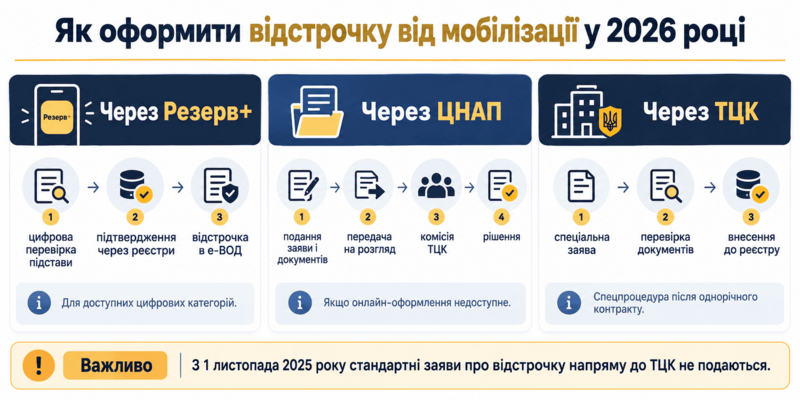
Since November 1, 2025, standard deferment applications have been submitted through Reserve+ for available digital categories or through an ASC when online processing is unavailable or supporting documents are required. The ASC accepts the documents, while the TRC and SP commission makes the decision in the relevant cases. Generally, TRCs do not accept such applications directly, although exceptions established by law exist, including the special procedure following a one-year contract.
The grounds under Article 23 should be identified, the documents listed in Annex 5 prepared, and the result verified. If an application is refused, it is important to obtain the reasons for the refusal.
Automatic Extension of Deferment
Some deferments are extended automatically when the system receives confirmation from state registers that the relevant grounds remain valid. This may apply to specified categories of persons with disabilities, students, parents of children with disabilities, and other citizens for whom the mechanism is available. However, automatic extension is not universal: incomplete or outdated information may prevent verification.
Therefore, the status in Reserve+ should be checked before the current deferment expires. If the record has not been updated, the reason must be established and the prescribed method of submitting documents used.
Changing the Grounds for Deferment
Following the amendments introduced by Resolution No. 978, a person who has a valid deferment and has acquired another lawful ground may apply through an ASC to change the grounds. The previous deferment remains valid while the application is considered. If approved, it is replaced by the new entry in the register. If refused, the previous deferment remains valid until its expiration, unless other grounds for cancellation exist.
Converting a personal deferment into employee reservation through an ASC is not provided for: these are separate legal procedures.
Reservation of Persons Liable for Military Service in 2026
Who Can Be Reserved from Mobilization?
Reservation may be available to employees of government authorities, enterprises performing mobilization tasks, critically important enterprises, and other designated employers. An enterprise's status does not automatically mean that all its employees are reserved: separate requirements and restrictions apply.
How Is Reservation Arranged?
In most applicable cases, the employer initiates the procedure through the Diia portal by submitting employee information. After the information is verified, details of the valid reservation are entered into the register and displayed in the military registration document. Employees should check the result and validity period: an employment relationship alone does not confirm that reservation has been granted.
What Changed in the Reservation Rules in 2026?
Resolution No. 692 amended the criteria established by Resolution No. 76: from September 1, 2026, the salary threshold for specified categories of employees increased from 2.5 to 3 minimum monthly wages. Exceptions apply to certain employers, including those operating in areas of hostilities. Both the enterprise's status and the employee's eligibility conditions must be checked.
Powers of the TRC and the National Police
What Is the TRC Authorized to Do?
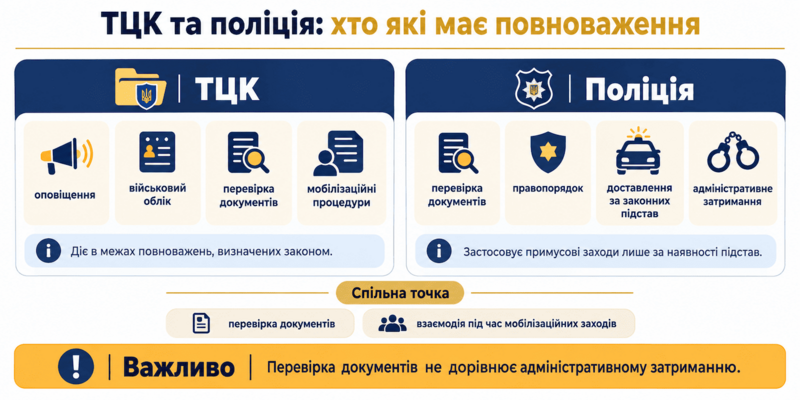
The TRC organizes notifications, updates military registration information, prepares documents concerning violations, participates in document checks through authorized representatives, ensures the operation of deferment commissions, and performs other procedures provided for by law. Each action must be carried out within the scope of its authority, with the necessary documents prepared and a verifiable legal basis.
What Is the Role of the Police?
Police officers check documents within the limits of the law, maintain public order, and may carry out administrative detention or escort individuals to the relevant authorities where legally prescribed grounds exist. Their actions are governed by the Law on the National Police and the Code of Ukraine on Administrative Offenses. The mere involvement of a police officer does not automatically make every instance of escorting a person lawful: the grounds and compliance with the procedure must be verified.
Can the TRC Detain a Person Liable for Military Service?
TRC representatives do not have a general right to independently carry out administrative detention instead of the police. Document checks, escorting a person, administrative detention, and criminal procedural measures must be distinguished. Each has its own grounds and safeguards. If a person's liberty has been restricted, it is important to establish who imposed the restriction, under which legal provision, and what procedural documents were prepared.
Liability for Violations of Mobilization Legislation
Administrative Liability
Article 210 of the Code of Ukraine on Administrative Offenses concerns violations of military registration rules, while Article 210-1 concerns violations of legislation on defense, mobilization preparation, and mobilization. During a special period, fines for citizens under the relevant provisions range from UAH 17,000 to UAH 25,500; separate penalties apply to officials. The specific article depends on the circumstances rather than the general statement that someone «violated mobilization rules».
A fine may be appealed if there is insufficient evidence of a violation or procedural irregularities occurred.
When Can Criminal Liability Arise?
Article 336 of the Criminal Code of Ukraine establishes liability for evasion of conscription during mobilization, punishable by imprisonment for three to five years. However, the statement «failed to appear twice — automatically a criminal case» is incorrect. It is necessary to establish the relevant legal obligation, conscription requirements, compliance with the procedure, and the intentional nature of the evasion.
Failure to appear to update information and evasion of conscription after completing the required procedures are different legal situations. If there is a risk of criminal proceedings, a military law attorney can examine the documents, grounds for conscription, and evidence supporting the allegations.
How Long Does Mobilization Last in Ukraine in 2026?
Presidential Decree No. 597/2026 of July 13, 2026, approved by Law No. 4929-IX, extended general mobilization for 90 days from August 2, 2026, until October 31, 2026. This was the period in force on the verification date, not a statement that mobilization would necessarily end the following day. Martial law and general mobilization are extended through separate legal decisions.
Does the End of Another 90-Day Period Automatically Terminate Mobilization?
Extending general mobilization requires a corresponding presidential decree and its approval by law. Extending martial law alone does not replace such a decision. After October 31, it is necessary to check whether a new legal act has been adopted and when it takes effect. Until then, it is incorrect to present a possible further extension as an established legal fact.
Law, Resolution, or Draft Law: How to Understand Mobilization News
| Document | Who Adopts It | What It Regulates | Is It Binding? |
|---|---|---|---|
| Law No. 3543-XII | Verkhovna Rada | Basic rights, obligations, and deferments | Yes |
| Amending law | Verkhovna Rada | Amends existing legal provisions | After entering into force |
| Resolution No. 560 | Cabinet of Ministers | Practical conscription procedures | Yes, within the limits of the law |
| Decree extending mobilization | President; approval by Parliament | Duration of mobilization | Under the established procedure |
| Draft law | Introduced to Parliament by a person or body with legislative initiative | Proposes amendments | No |
A law has greater legal force than a Cabinet of Ministers resolution. Departmental letters, consultations, and publications cannot amend the law, although they may sometimes explain how it is applied in practice.
Why Does a Registered Draft Law Not Yet Change Mobilization Rules?
Registration of a draft law concerning electronic summonses, new age requirements, or conscription priorities does not yet create obligations for citizens. A draft may be amended, rejected, or adopted in a different version. The document number and status, dates of adoption, signing, publication, and entry into force should be checked. Until the necessary procedures are completed, current legislation applies, not speculation in the news.
What Should a Person Liable for Military Service Check in 2026?
- Whether their address, contact details, and other military registration information are correct.
- Which military registration category and type are displayed in Reserve+.
- Whether their deferment or reservation is valid and whether the grounds and expiration date are recorded correctly.
- Whether their MMB decision is current if a medical examination is required in their specific circumstances.
- Whether the register contains incorrect entries and whether supporting documents are available to correct them.
- What purpose is stated in the summons received and how it was served.
- Whether legislation has changed since the publication of the material they are relying on.
If documents contradict information in the «Oberih» register, the source of the error should be identified and confirmation of its correction obtained. In a disputed situation, it is important to keep copies of applications, responses, postal documents, and official decisions rather than relying solely on verbal explanations.
FAQ: Frequently Asked Questions About Mobilization in 2026
Does Mobilization Automatically End If Martial Law Is Extended but a Mobilization Decree Has Not Yet Entered into Force?
Extending martial law does not automatically extend mobilization. A separate presidential decree approved by the Verkhovna Rada is required.
Do New Rules Apply to Summonses Issued Previously?
The legality of serving a summons is assessed according to the rules in force at the time of service. Subsequent procedures may be governed by new provisions unless otherwise specified.
What Should You Do If the Law and Reserve+ Records Contradict Each Other?
You should check the current legal provision and documents confirming your status. If Reserve+ contains an error, you must initiate a correction of the register information.
Can the TRC Impose a New Fine for a Violation Committed Earlier?
A law that increases liability does not apply retroactively. An exception applies to provisions that reduce or eliminate liability.
Which Version of Resolution No. 560 Applies to a Procedure That Began Before the Amendments?
As a general rule, the provisions in force at the time of the relevant procedural action apply. However, the transitional provisions of the amended resolution must also be considered.
Must a Person Liable for Military Service Personally Monitor Legislative Changes?
Citizens are required to comply with current legislation. Lack of knowledge of new provisions generally does not exempt a person from liability, but government authorities must also follow established procedures.
Can You Rely on Explanations from the Ministry of Defense or the TRC If They Differ from a Legal Regulation?
Yes, such explanations may be used as evidence of a government authority's position. However, they do not take precedence over laws and other binding legal regulations.
Which Has Greater Legal Force: the Mobilization Law or Cabinet of Ministers Resolution No. 560?
The law has greater legal force. If a Cabinet of Ministers resolution contradicts the law, the relevant provision or a decision made on its basis may be challenged.

Leave a request for consultation and our specialist will contact you soon!
Leave a request and our specialist will contact you soon!



Fill out the form or contact us in any way convenient for you
Choose the nearest office to you and receive consultations in a convenient format for you